

1 kreuzer – Further Austria
Add to wishlist
Austria
Context
Years: 1791–1792
Country: Austria
Issuer: Further Austria
Ruler: Leopold II
Currency:
Demonetized: Yes
Material
References
KM: #
Numista: #92822
Obverse
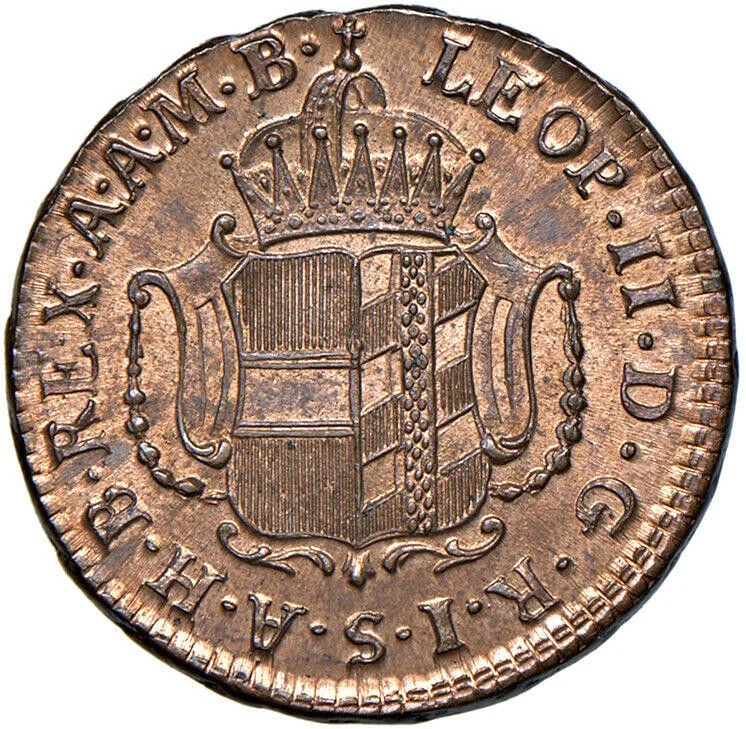
Description:
Crowned arms with the legend of Leopold II's titles.
Inscription:
LEOP·II·D·G·R·I·S·A·H·B·REX·A·A·M·B
Script: Latin
Reverse
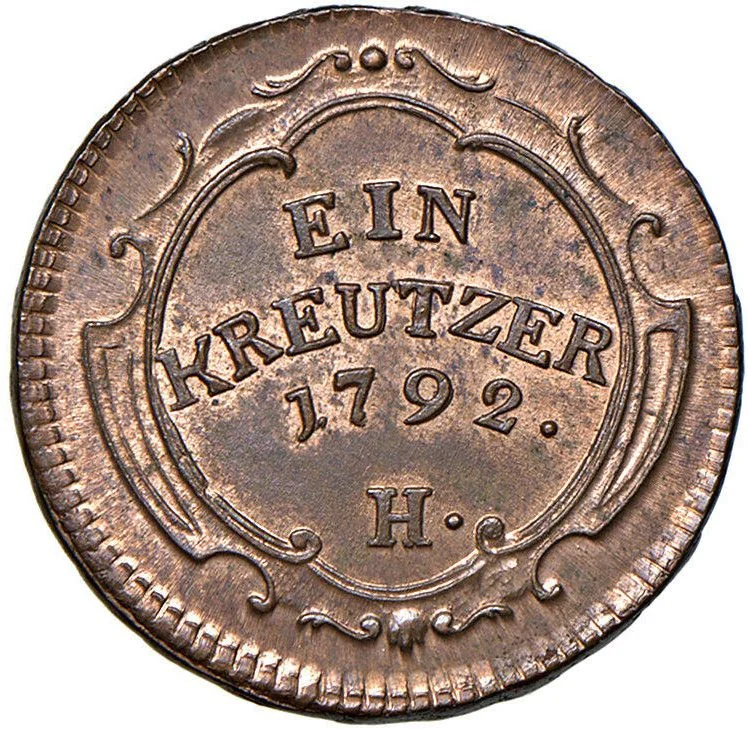
Description:
Denomination, date, and mintmark in framed inscription.
Inscription:
EIN
KREUTZER
1792.
H.
KREUTZER
1792.
H.
Script: Latin
Edge
Mints
| Name | Mark |
|---|---|
| Günzburg | H |
Historical background
In 1791, the currency situation in Further Austria (Vorderösterreich) was complex and fragmented, reflecting the territory's disparate geography and political structure. These Habsburg possessions, scattered across modern-day southwest Germany, Switzerland, and Vorarlberg, lacked a unified monetary system. While ultimately under the authority of the Vienna court, local circulation was dominated by a mixture of regional coinage from nearby German states (particularly from the Swabian and Rhenish circles), alongside older Habsburg talers and kreuzers. This created a challenging environment for trade and administration, as merchants and officials constantly dealt with fluctuating exchange rates between multiple coin types.
The primary theoretical standard was the Conventionstaler, established by the Habsburg monetary convention of 1753, which was pegged to the Cologne Mark of silver. However, in daily practice, this large silver unit was more a unit of account than common pocket money. Everyday transactions were conducted in a proliferation of smaller silver and billon coins—such as kreuzers, batzen, and hellers—many minted by local Austrian authorities in cities like Freiburg or by neighboring princes. The simultaneous circulation of these varied coins, each with its own intrinsic silver content and value, led to frequent confusion, arbitrage, and localized inflation.
This monetary disarray was symptomatic of the broader challenges facing the Habsburg monarchy on the eve of the French Revolutionary Wars. While Emperor Joseph II had recently attempted broader administrative and financial centralization, the intricate, legacy-bound currency network of Further Austria proved resistant to swift reform. The situation would soon be rendered obsolete by the impending political cataclysm; within a few years, the French Revolutionary armies would begin to occupy and redraw the map of the region, ultimately leading to the dissolution of Further Austria and the imposition of more standardized monetary systems in its wake.
The primary theoretical standard was the Conventionstaler, established by the Habsburg monetary convention of 1753, which was pegged to the Cologne Mark of silver. However, in daily practice, this large silver unit was more a unit of account than common pocket money. Everyday transactions were conducted in a proliferation of smaller silver and billon coins—such as kreuzers, batzen, and hellers—many minted by local Austrian authorities in cities like Freiburg or by neighboring princes. The simultaneous circulation of these varied coins, each with its own intrinsic silver content and value, led to frequent confusion, arbitrage, and localized inflation.
This monetary disarray was symptomatic of the broader challenges facing the Habsburg monarchy on the eve of the French Revolutionary Wars. While Emperor Joseph II had recently attempted broader administrative and financial centralization, the intricate, legacy-bound currency network of Further Austria proved resistant to swift reform. The situation would soon be rendered obsolete by the impending political cataclysm; within a few years, the French Revolutionary armies would begin to occupy and redraw the map of the region, ultimately leading to the dissolution of Further Austria and the imposition of more standardized monetary systems in its wake.
💎 Extremely Rare