

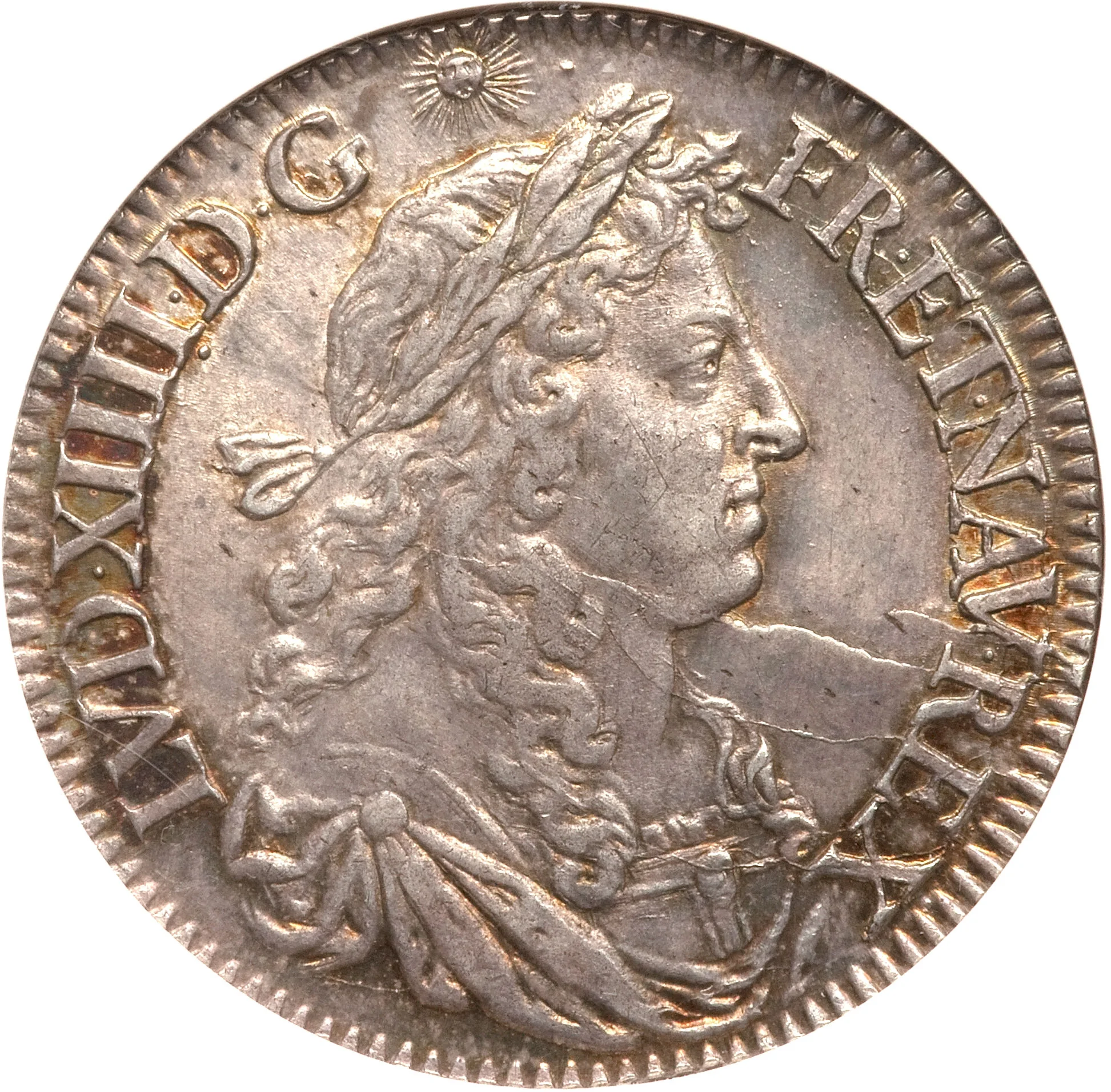
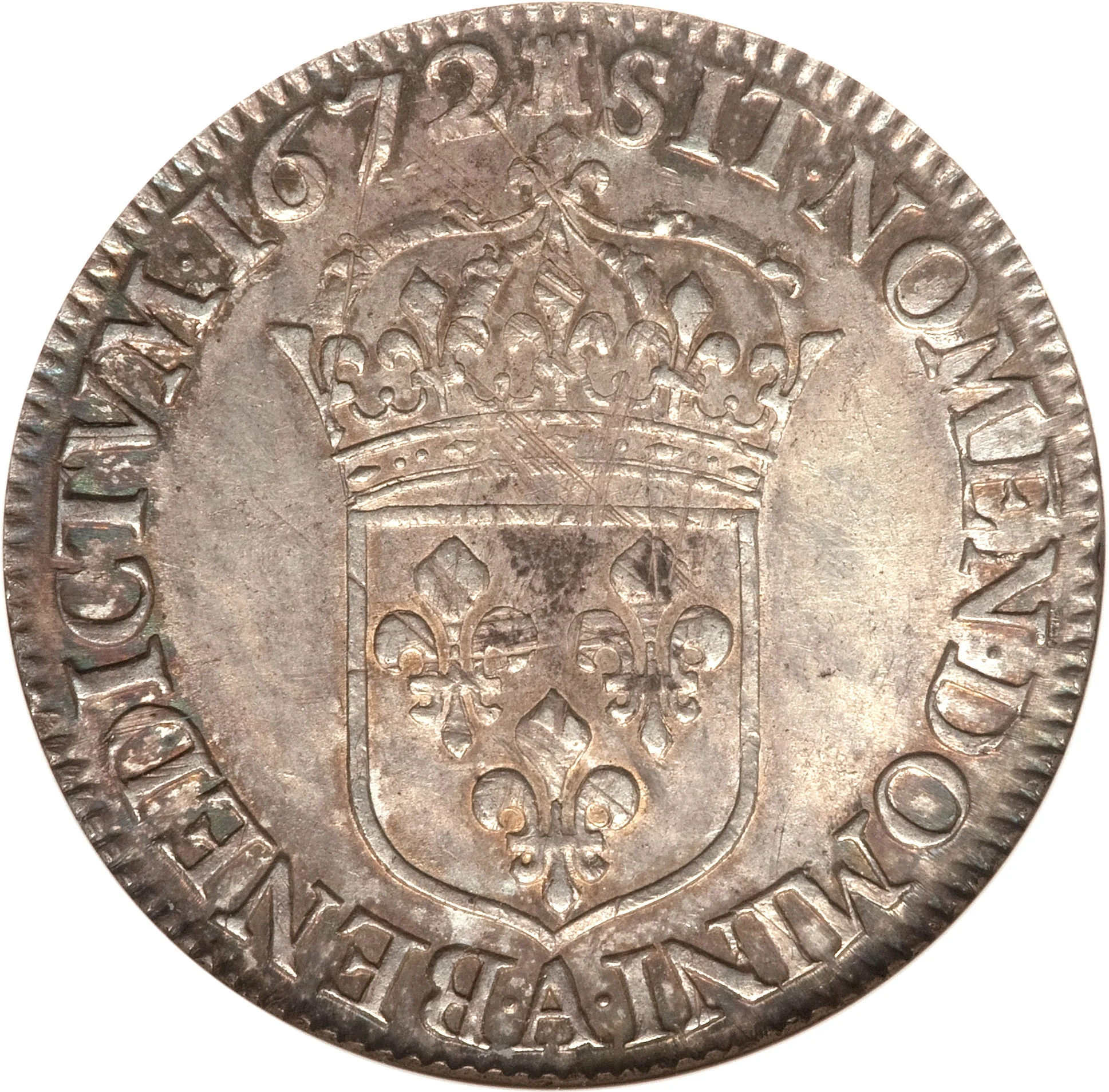
½ Silver Ecu – France
France

Obverse
Description:
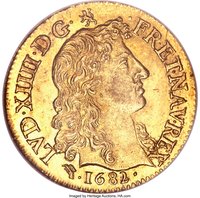
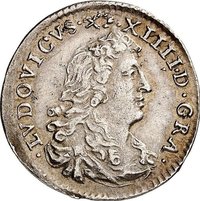
Young Louis XIV bust, laureate and armored, with long hair. Caption begins at 7 o'clock.
Inscription:
•LVD•XIIII•D•G FR•ET•NAV•REX•
Script: Latin
Reverse
Edge
Mints
| Name | Mark |
|---|---|
| Monnaie de Paris | A |
Historical background
In 1670, France operated under a complex and often chaotic monetary system, a legacy of medieval practices that posed significant challenges to the Crown's ambitions. The nation lacked a single, unified currency. Instead, a plethora of gold écus, silver livres tournois (divided into sous and deniers), and copper liards circulated alongside numerous foreign coins, particularly Spanish pieces of eight. Crucially, the value of these coins was not fixed by their metal content alone but was frequently altered by royal decree. The livre was a unit of account, not a physical coin, and its official exchange rate against actual minted coins could be changed by the king, a practice known as augmentation (devaluation) or diminution (revaluation).
This system was a direct instrument of royal power and fiscal policy. King Louis XIV and his finance minister, Jean-Baptiste Colbert, were engaged in a state-building project requiring vast revenues for war, Versailles, and a growing bureaucracy. Manipulating the currency provided a short-term solution: by ordering recoinages and altering official values, the Crown could extract seigniorage profits, effectively taxing all holders of metal currency. However, these manipulations created severe economic instability. Merchants and international bankers faced unpredictable exchange rates, hindering commerce and credit. The public grew distrustful, often hoarding older coins believed to have higher intrinsic value.
Colbert, a proponent of mercantilism, understood these disruptions were detrimental to long-term economic strength. While the frequent manipulations of the previous decades continued into the early 1670s, Colbert sought greater stability to foster trade and manufacturing. His efforts included standardizing coinage within France and attempting to fix the livre to a more stable silver standard. Nevertheless, the impending costs of the Dutch War (1672-1678) would soon force a return to aggressive monetary manipulations, highlighting the persistent tension between the Crown's immediate fiscal needs and the goal of a stable national currency.
This system was a direct instrument of royal power and fiscal policy. King Louis XIV and his finance minister, Jean-Baptiste Colbert, were engaged in a state-building project requiring vast revenues for war, Versailles, and a growing bureaucracy. Manipulating the currency provided a short-term solution: by ordering recoinages and altering official values, the Crown could extract seigniorage profits, effectively taxing all holders of metal currency. However, these manipulations created severe economic instability. Merchants and international bankers faced unpredictable exchange rates, hindering commerce and credit. The public grew distrustful, often hoarding older coins believed to have higher intrinsic value.
Colbert, a proponent of mercantilism, understood these disruptions were detrimental to long-term economic strength. While the frequent manipulations of the previous decades continued into the early 1670s, Colbert sought greater stability to foster trade and manufacturing. His efforts included standardizing coinage within France and attempting to fix the livre to a more stable silver standard. Nevertheless, the impending costs of the Dutch War (1672-1678) would soon force a return to aggressive monetary manipulations, highlighting the persistent tension between the Crown's immediate fiscal needs and the goal of a stable national currency.
✨ Legendary