

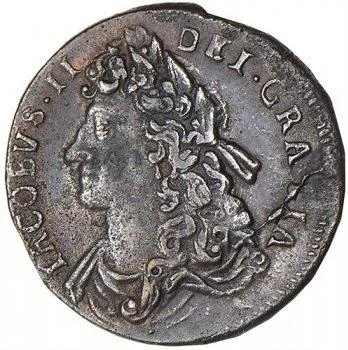
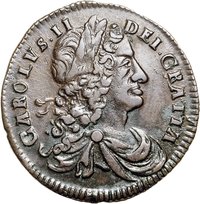
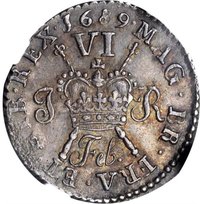
Obverse
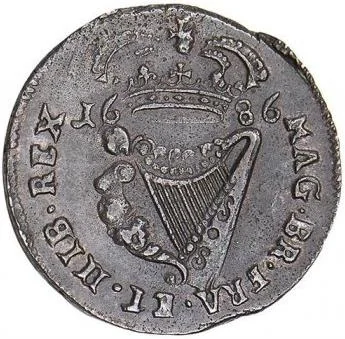
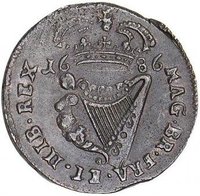
Reverse
Description:
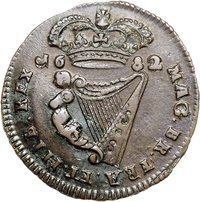
Crowned Gaelic harp dividing date, legend above.
Inscription:
16 86
MAG·BR·FRA·ET·HIB·REX
MAG·BR·FRA·ET·HIB·REX
Script: Latin
Edge
Plain
Categories
| Person> Monarch |
| Symbols> Coat of Arms |
Mintings
| Year | Mint Mark | Mintage | Quality | Collection |
|---|---|---|---|---|
| 1685 | — | — | ||
| 1686 | — | — | ||
| 1687 | — | — | ||
| 1688 | — | — |
Historical background
In 1685, Ireland’s currency was a complex and unstable system, deeply entangled with English monetary policy and the island’s own economic realities. The official currency was sterling, with pounds, shillings, and pence, but a chronic shortage of official coinage in circulation was a severe problem. This scarcity was exacerbated by the fact that good silver coinage tended to be exported to England, leaving Ireland reliant on a patchwork of underweight, worn, and foreign coins—primarily Spanish pieces of eight and French écus—which circulated at values set by proclamation. The state of the coinage reflected Ireland’s subordinate colonial status within the Stuart kingdom and hindered everyday commerce.
The monetary situation was further strained by the political and religious landscape under the Catholic King James II, who ascended the throne in February 1685. While his reign initially raised hopes among the Catholic majority for economic and political relief from the restrictive Penal Laws, it also created deep anxiety among the Protestant settler class who controlled much of the land and wealth. This tension had direct monetary consequences, as fears of political instability could trigger hoarding of good coin and capital flight to England, worsening the shortage. The economy was overwhelmingly agricultural, and the lack of a reliable medium of exchange complicated rent payments and trade.
Ultimately, the currency woes of 1685 were a prelude to far greater turmoil. Within three years, the political crisis of the Glorious Revolution would erupt, leading to the Williamite War in Ireland (1689-1691). The financial demands of this conflict would lead to a dramatic and disastrous deterioration of the currency. In 1689, King James II’s administration in Dublin would resort to issuing an emergency base metal coinage known as "gunmoney," officially mandating its acceptance but leading to rapid depreciation and economic chaos. Thus, the fragile and scarce currency of 1685 stood on the brink of a complete breakdown.
The monetary situation was further strained by the political and religious landscape under the Catholic King James II, who ascended the throne in February 1685. While his reign initially raised hopes among the Catholic majority for economic and political relief from the restrictive Penal Laws, it also created deep anxiety among the Protestant settler class who controlled much of the land and wealth. This tension had direct monetary consequences, as fears of political instability could trigger hoarding of good coin and capital flight to England, worsening the shortage. The economy was overwhelmingly agricultural, and the lack of a reliable medium of exchange complicated rent payments and trade.
Ultimately, the currency woes of 1685 were a prelude to far greater turmoil. Within three years, the political crisis of the Glorious Revolution would erupt, leading to the Williamite War in Ireland (1689-1691). The financial demands of this conflict would lead to a dramatic and disastrous deterioration of the currency. In 1689, King James II’s administration in Dublin would resort to issuing an emergency base metal coinage known as "gunmoney," officially mandating its acceptance but leading to rapid depreciation and economic chaos. Thus, the fragile and scarce currency of 1685 stood on the brink of a complete breakdown.
⭐ Rare