

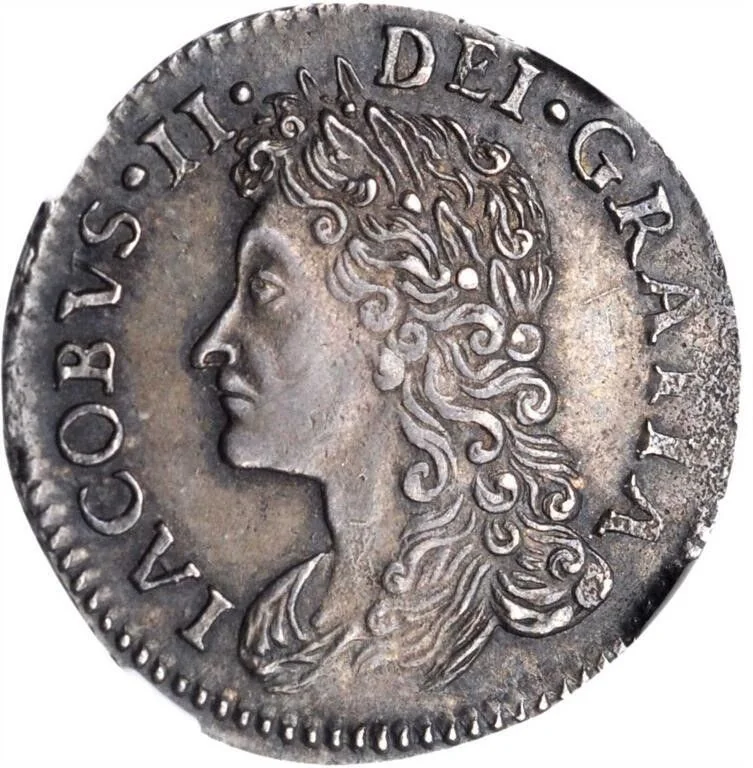
6 Pence – Ireland
Ireland
Material
Diameter: 21.5 mm
Weight: 3.9 g
Silver weight: 3.90 g
Shape: Irregular round
Composition: Silver
Magnetic: No
Alignment: Medal alignment
flip
References
KM: #Click to copy to clipboard93a
Numista: #332397
Value
Bullion value: $11.09
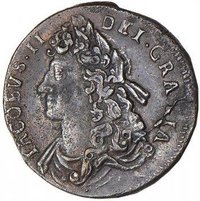
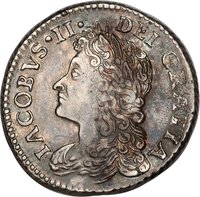
Obverse
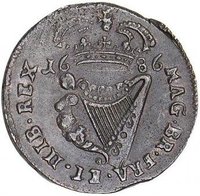
Reverse
Description:
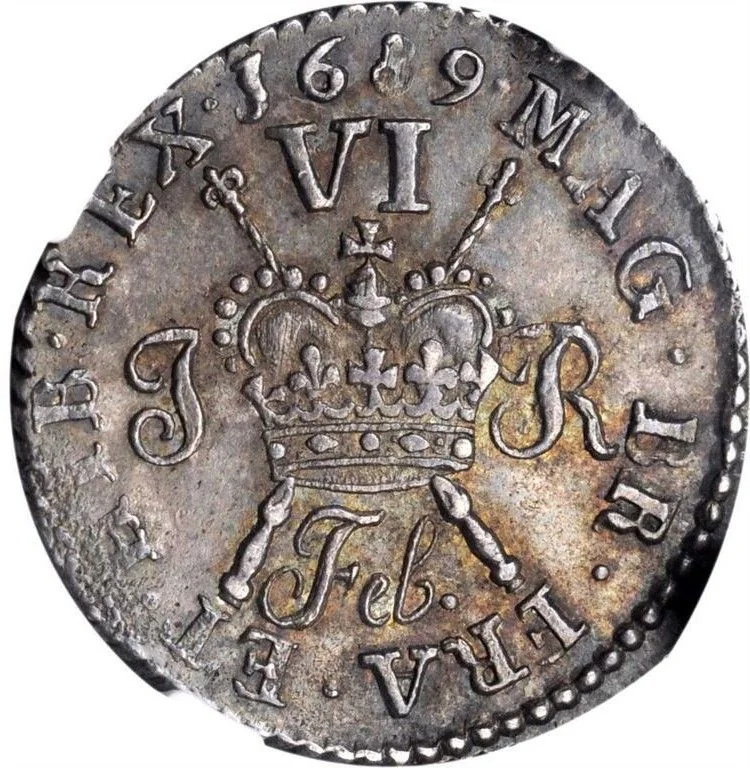
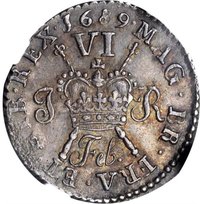
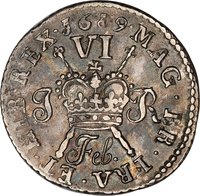
Crown over crossed scepters flanked by initials. Value (Roman) above, month (script) below.
Inscription:
MAG · BR · FRA · ET · HIB · REX · 1689 ·
VI
I R
Feb
VI
I R
Feb
Scripts: Latin, Latin (cursive)
Edge
Mintings
| Year | Mint Mark | Mintage | Quality | Collection |
|---|---|---|---|---|
| — | — | — |
Historical background
In 1689, Ireland was engulfed in the Williamite War, a pivotal conflict between the deposed Catholic King James II and the newly crowned Protestant King William III. This war, part of the wider Nine Years' War, created immediate and severe economic disruption. The normal machinery of state finance collapsed, trade was severely hampered, and the existing silver coinage in circulation—much of it old and worn—began to be hoarded, leading to a critical shortage of specie for soldiers, merchants, and the general populace.
To address this crisis, James II's Jacobite administration in Dublin took a radical step. Lacking proper bullion, they established a temporary mint in Dublin Castle in June 1689 to produce an emergency coinage. Using melted-down brass, gunmetal, and even old cannon, they struck the now-infamous "gunmoney." These coins, issued in shilling, sixpence, and later crown denominations, were promissory notes in metal form, stamped with their month and year of issue and a promise of future redemption in silver. Their value was purely fiat, backed by James's promise to pay after a victory that grew increasingly unlikely.
The situation was further complicated by the presence of Williamite forces, who also needed to pay troops and conduct commerce. They continued to use the older English and silver coinage, creating a dual-currency system divided along political and military lines. As the war turned against James, confidence in gunmoney evaporated. It suffered from rapid inflation and depreciation, becoming so worthless that by 1690 it was often accepted only by weight as crude metal, leaving the Irish economy in a state of monetary chaos until the war's conclusion and the subsequent recoinage under William III.
To address this crisis, James II's Jacobite administration in Dublin took a radical step. Lacking proper bullion, they established a temporary mint in Dublin Castle in June 1689 to produce an emergency coinage. Using melted-down brass, gunmetal, and even old cannon, they struck the now-infamous "gunmoney." These coins, issued in shilling, sixpence, and later crown denominations, were promissory notes in metal form, stamped with their month and year of issue and a promise of future redemption in silver. Their value was purely fiat, backed by James's promise to pay after a victory that grew increasingly unlikely.
The situation was further complicated by the presence of Williamite forces, who also needed to pay troops and conduct commerce. They continued to use the older English and silver coinage, creating a dual-currency system divided along political and military lines. As the war turned against James, confidence in gunmoney evaporated. It suffered from rapid inflation and depreciation, becoming so worthless that by 1690 it was often accepted only by weight as crude metal, leaving the Irish economy in a state of monetary chaos until the war's conclusion and the subsequent recoinage under William III.
✨ Legendary