

½ Daler – Sweden
Sweden
Context
References
KM: #Click to copy to clipboard140
Numista: #160322
Value
Bullion value: $36.37
Obverse
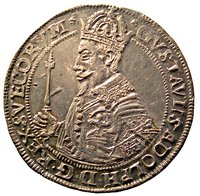
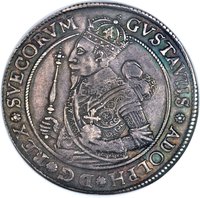
Description:
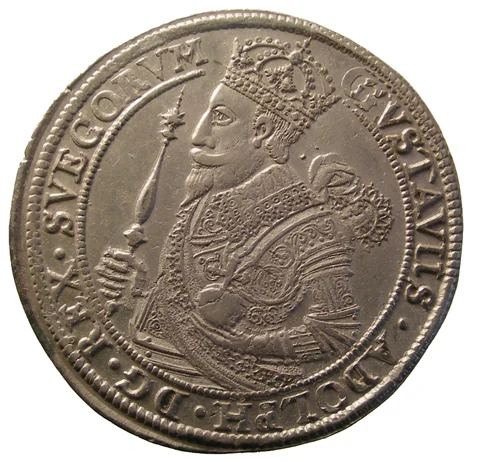
Gustav II Adolf, half-figure with mace and globe, ornamentation behind shoulder.
Script: Latin
Reverse
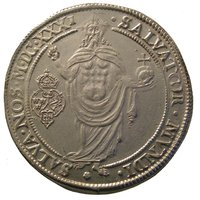
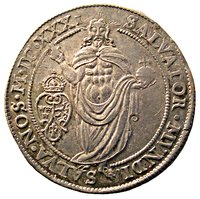
Description:
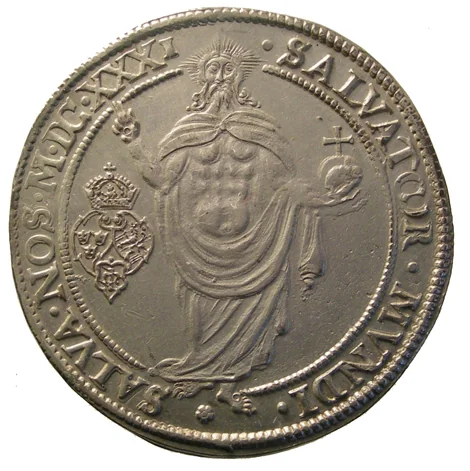
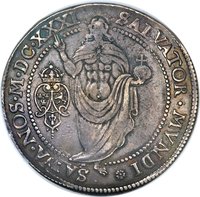
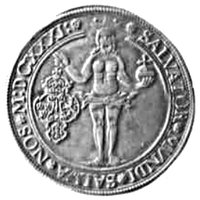
Christ blessing, holding an orb.
Script: Latin
Edge
Mints
| Name | Mark |
|---|---|
| Stockholm | — |
Mintings
| Year | Mint Mark | Mintage | Quality | Collection |
|---|---|---|---|---|
| 1631 | — | — |
Historical background
In 1631, Sweden was in the midst of the Thirty Years' War, and King Gustavus Adolphus's military campaigns on the continent were placing an immense strain on the nation's finances. The war effort demanded vast sums of money to pay for armies, supplies, and alliances, far exceeding ordinary tax revenues. To meet this crisis, the Swedish state resorted to aggressive financial measures, including the heavy exploitation of its copper resources. Sweden was Europe's leading copper producer, and this metal became the bedrock of its monetary system and war funding.
The currency situation was defined by the cumbersome kopparmynt (copper coinage). Since 1624, Sweden had operated on a bimetallic standard, but the value of silver coins was tied to a fluctuating copper standard. Large, heavy copper plates, some weighing several kilograms, were minted as official currency with a face value theoretically equal to their metal content. However, to generate immediate war funds, the government began to deliberately increase the nominal value of this copper money beyond its intrinsic worth, a practice that led to inflation. Furthermore, the state compelled towns and the nobility to accept these overvalued coins for taxes and payments, effectively forcing a form of credit from its own population.
Concurrently, vast quantities of actual Swedish copper were exported, especially through Amsterdam, to generate the foreign silver and gold needed to pay troops abroad. This created a paradoxical situation: Sweden was rich in copper but often short of the precious metals required for international warfare. The domestic economy suffered under the weight of the heavy, impractical coinage and creeping debasement, while the financial administration, led by figures like Chancellor Axel Oxenstierna, grew increasingly complex to manage the war debt. Thus, the currency of 1631 was not a tool of domestic commerce but primarily a fiscal instrument for sustaining Sweden's pivotal role in the European conflict.
The currency situation was defined by the cumbersome kopparmynt (copper coinage). Since 1624, Sweden had operated on a bimetallic standard, but the value of silver coins was tied to a fluctuating copper standard. Large, heavy copper plates, some weighing several kilograms, were minted as official currency with a face value theoretically equal to their metal content. However, to generate immediate war funds, the government began to deliberately increase the nominal value of this copper money beyond its intrinsic worth, a practice that led to inflation. Furthermore, the state compelled towns and the nobility to accept these overvalued coins for taxes and payments, effectively forcing a form of credit from its own population.
Concurrently, vast quantities of actual Swedish copper were exported, especially through Amsterdam, to generate the foreign silver and gold needed to pay troops abroad. This created a paradoxical situation: Sweden was rich in copper but often short of the precious metals required for international warfare. The domestic economy suffered under the weight of the heavy, impractical coinage and creeping debasement, while the financial administration, led by figures like Chancellor Axel Oxenstierna, grew increasingly complex to manage the war debt. Thus, the currency of 1631 was not a tool of domestic commerce but primarily a fiscal instrument for sustaining Sweden's pivotal role in the European conflict.
Series: 1631 Sweden circulation coins


✨ Legendary