

½ Ore – Sweden
Sweden
Context
References
KM: #Click to copy to clipboard127
Numista: #168862
Obverse
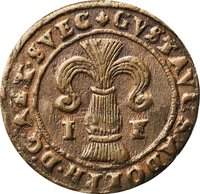
Description:
Swedish royal coat of arms on a shield, encircled partially by a ring with an outer inscription.
Inscription:
GVST:ADOLP:D:G:SVE:GOT:VA:REX.M:P:F
Reverse
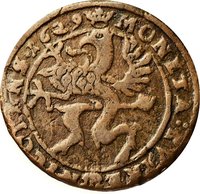
Description:
Griffin walking left inside circle, wings spread. Value on both sides. Legend outside circle ends with date in Roman numerals and small crown.
Inscription:
MONETA:CVPRE: (mm) NICOPENSIS:MDCXXIX (crown)
I/2 ÖR
I/2 ÖR
Edge
Mints
| Name | Mark |
|---|---|
| Nyköping | — |
Mintings
| Year | Mint Mark | Mintage | Quality | Collection |
|---|---|---|---|---|
| 1629 | — | — |
Historical background
In 1629, Sweden was in the midst of the Thirty Years' War, a conflict that placed immense financial strain on the state. King Gustavus Adolphus's ambitious military campaigns, particularly the intervention in the German theatre, required vast sums of money. The crown's primary method of financing this war was through heavy taxation, the seizure of church lands, and, crucially, the exploitation of Sweden's rich copper resources. The state-owned copper mines, especially the great mine at Falun, became the fiscal engine of the war effort, with copper effectively serving as a strategic monetary reserve.
This reliance on copper directly shaped the currency situation. Sweden had a unique bimetallic system, but silver was chronically scarce due to its outflow to pay for mercenaries and supplies abroad. To fill the void, Sweden became the first European nation to issue large-scale copper plate money (kopparplåtmynt). These were literally heavy, rectangular plates of copper, stamped with their face value, which could be worth up to several riksdaler. While innovative, this currency was cumbersome—a ten-daler plate in 1644 weighed over 20 kilograms—and its value was intrinsically tied to the fluctuating market price of copper, leading to instability.
Consequently, the monetary system in 1629 was under significant stress, characterized by a complex and unwieldy circulating medium. Alongside copper plates, older silver coins, lower-denomination örtug coins, and a growing amount of debased foreign coinage circulated. The government struggled to maintain confidence and a stable exchange rate between copper and silver. Thus, Sweden's currency in 1629 was essentially a war economy instrument: administratively complex, physically burdensome, and fundamentally geared toward extracting resources to sustain the kingdom's great power ambitions on the battlefields of Europe.
This reliance on copper directly shaped the currency situation. Sweden had a unique bimetallic system, but silver was chronically scarce due to its outflow to pay for mercenaries and supplies abroad. To fill the void, Sweden became the first European nation to issue large-scale copper plate money (kopparplåtmynt). These were literally heavy, rectangular plates of copper, stamped with their face value, which could be worth up to several riksdaler. While innovative, this currency was cumbersome—a ten-daler plate in 1644 weighed over 20 kilograms—and its value was intrinsically tied to the fluctuating market price of copper, leading to instability.
Consequently, the monetary system in 1629 was under significant stress, characterized by a complex and unwieldy circulating medium. Alongside copper plates, older silver coins, lower-denomination örtug coins, and a growing amount of debased foreign coinage circulated. The government struggled to maintain confidence and a stable exchange rate between copper and silver. Thus, Sweden's currency in 1629 was essentially a war economy instrument: administratively complex, physically burdensome, and fundamentally geared toward extracting resources to sustain the kingdom's great power ambitions on the battlefields of Europe.
✨ Legendary