

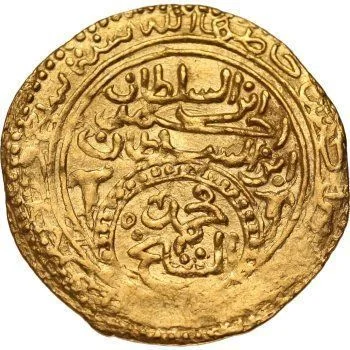
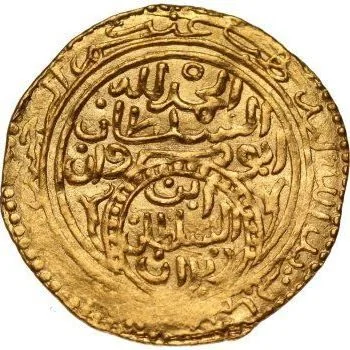
Dinar – Morocco
Morocco
Context
Years: 1628–1630
Issuer: Morocco 
Ruler: Abu Marwan ‘Abd al-Malik II
Currency:
(1549—1659)
Demonetized: Yes
Material
References
KM: #Click to copy to clipboard22
Numista: #157672
Value
Bullion value: $750.11
Mints
| Name | Mark |
|---|---|
| Marrakush | — |
Mintings
| Year | Mint Mark | Mintage | Quality | Collection |
|---|---|---|---|---|
| 1628 | — | — | ||
| 1629 | — | — | ||
| 1630 | — | — |
Historical background
In 1628, the currency situation in the Saadian Sultanate of Morocco was characterized by a complex and often unstable bimetallic system, heavily influenced by both internal pressures and international trade. The primary coins in circulation were the gold benduqi (a local dinar) and the silver dirham, but their weight, purity, and value were not consistently standardized across the realm, leading to frequent confusion and regional disparities. This period also saw a significant influx of foreign coinage, particularly Spanish reales and Ottoman gold coins, which circulated alongside local issues due to Morocco's active position in trans-Saharan trade and its often-contentious exchanges with European powers.
The monetary landscape was under severe strain from the state's financial demands. The vast expenditures of Sultan Zaydan an-Nasir’s court, coupled with the costs of maintaining military campaigns against both Ottoman-aligned forces and Portuguese strongholds on the coast, drained the treasury. This led to repeated debasements of the silver coinage, where the silver content was reduced to stretch the mint's bullion reserves. Consequently, public trust in the official currency eroded, encouraging hoarding of full-weight foreign coins and creating a disconnect between the nominal and market value of money.
Ultimately, the currency situation of 1628 reflected a kingdom caught between its imperial ambitions and economic realities. While the Saadian dynasty controlled the lucrative sugar plantations and the key trade gateway of Marrakesh, its inability to impose a uniform and trusted monetary standard weakened central fiscal authority. The reliance on foreign specie highlighted Morocco's integration into broader Mediterranean and Atlantic economies, yet the persistent debasement and instability foreshadowed the financial difficulties that would contribute to the dynasty's gradual decline in the decades to follow.
The monetary landscape was under severe strain from the state's financial demands. The vast expenditures of Sultan Zaydan an-Nasir’s court, coupled with the costs of maintaining military campaigns against both Ottoman-aligned forces and Portuguese strongholds on the coast, drained the treasury. This led to repeated debasements of the silver coinage, where the silver content was reduced to stretch the mint's bullion reserves. Consequently, public trust in the official currency eroded, encouraging hoarding of full-weight foreign coins and creating a disconnect between the nominal and market value of money.
Ultimately, the currency situation of 1628 reflected a kingdom caught between its imperial ambitions and economic realities. While the Saadian dynasty controlled the lucrative sugar plantations and the key trade gateway of Marrakesh, its inability to impose a uniform and trusted monetary standard weakened central fiscal authority. The reliance on foreign specie highlighted Morocco's integration into broader Mediterranean and Atlantic economies, yet the persistent debasement and instability foreshadowed the financial difficulties that would contribute to the dynasty's gradual decline in the decades to follow.

✨ Legendary