

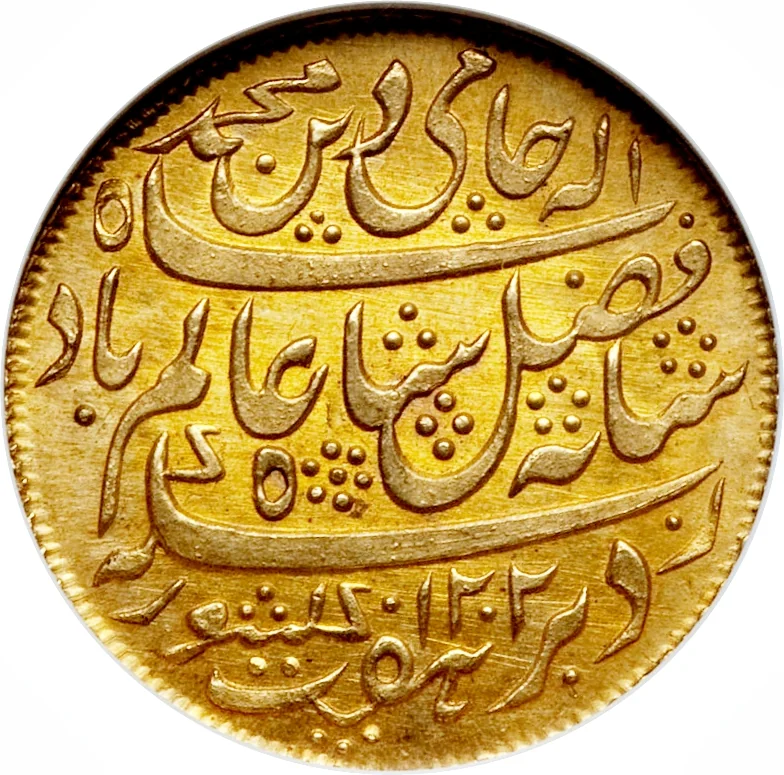
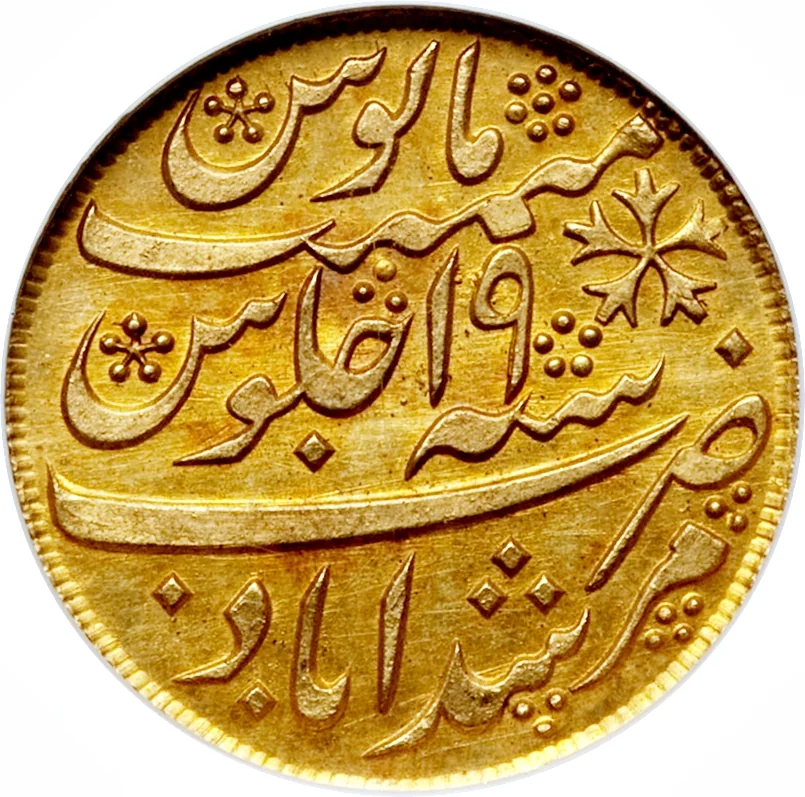
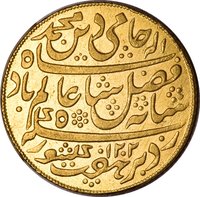
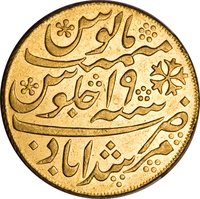
½ Mohur – Bengal Presidency
India
Context
Year: 1788
Islamic (Hijri) Year: 1202
Country: India 
Issuer: Bengal Presidency
Currency:
(1765—1835)
Demonetized: Yes
Material
References
KM: #Click to copy to clipboard101
Numista: #15714
Value
Bullion value: $1026.29
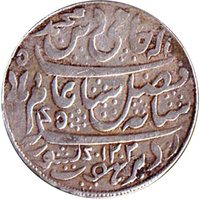
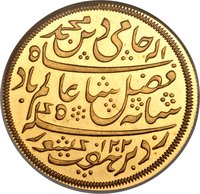
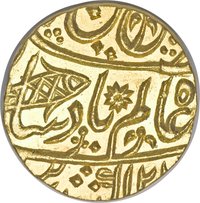
Obverse
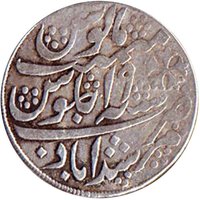
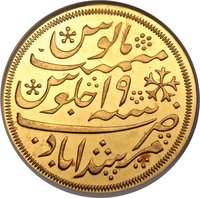
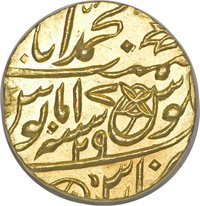
Reverse
Edge
Oblique milled
Mintings
| Year | Mint Mark | Mintage | Quality | Collection |
|---|---|---|---|---|
| 1788 | — | — |
Historical background
By 1788, the Bengal Presidency under the East India Company was grappling with a severe and complex currency crisis that threatened both commerce and administration. The core of the problem was a massive shortage of specie (coin), particularly the silver Sicca Rupee, the standard currency for revenue collection and major transactions. This scarcity was caused by several factors: the continuous export of silver to China to pay for tea and other goods, the Company's own heavy financial remittances to London, and the hoarding of coin by a nervous public amidst political uncertainty. The result was a crippling deflationary environment where the value of money was high, but its physical absence paralyzed trade and made it difficult for zamindars (landholders) to pay their land taxes in the required specie.
The Company's response, prior to 1788, had been largely ineffective and even counterproductive. They attempted to introduce a new, lighter "Faroockabad" rupee to replace the older, heavier Sicca Rupee, but without demonetizing the older coin. This created a chaotic bimetallic system where two rupees of different intrinsic values had the same face value, leading to Gresham's Law in practice: "bad" (lighter) money drove "good" (heavier) money out of circulation into hoards or melting pots. Furthermore, a proliferation of private and often debased batta (discount on currency exchange) further eroded public trust. The banking and credit system was underdeveloped, unable to compensate for the lack of physical coin, leaving the rural economy in particular in distress.
Consequently, in 1788, the Presidency stood at a financial impasse. Revenue collection was failing, the Company's own commercial operations were hampered, and the wider economy was stagnating. The situation demanded a fundamental reform, setting the stage for Governor-General Lord Cornwallis's major intervention upon his arrival. The crisis of 1788 directly precipitated the great currency reform of 1793, which would finally establish a unified, Company-controlled silver standard, demonstrating how the monetary chaos of the late 1780s forced the East India Company to transition from a predatory trader to a formal state authority responsible for its fiscal and monetary system.
The Company's response, prior to 1788, had been largely ineffective and even counterproductive. They attempted to introduce a new, lighter "Faroockabad" rupee to replace the older, heavier Sicca Rupee, but without demonetizing the older coin. This created a chaotic bimetallic system where two rupees of different intrinsic values had the same face value, leading to Gresham's Law in practice: "bad" (lighter) money drove "good" (heavier) money out of circulation into hoards or melting pots. Furthermore, a proliferation of private and often debased batta (discount on currency exchange) further eroded public trust. The banking and credit system was underdeveloped, unable to compensate for the lack of physical coin, leaving the rural economy in particular in distress.
Consequently, in 1788, the Presidency stood at a financial impasse. Revenue collection was failing, the Company's own commercial operations were hampered, and the wider economy was stagnating. The situation demanded a fundamental reform, setting the stage for Governor-General Lord Cornwallis's major intervention upon his arrival. The crisis of 1788 directly precipitated the great currency reform of 1793, which would finally establish a unified, Company-controlled silver standard, demonstrating how the monetary chaos of the late 1780s forced the East India Company to transition from a predatory trader to a formal state authority responsible for its fiscal and monetary system.
✨ Legendary