

5 marks – Sweden
Add to wishlist
Sweden
Context
Material
Weight: 1.64 g
Gold Weight:: 1.43 g
Shape: Irregular square
Composition: 87% Gold
Magnetic: No
Technique: Klippe
References
KM: #
Numista: #156923
Value
Bullion value: $221.96
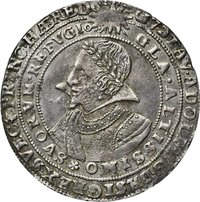
Obverse
Description:
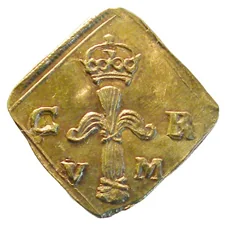
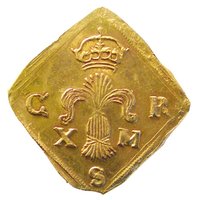
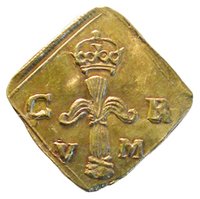
Crowned wheat sheaf between C-R and U-M.
Script: Latin
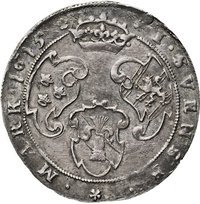
Reverse
Description:
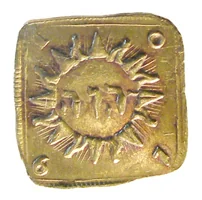
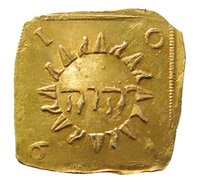
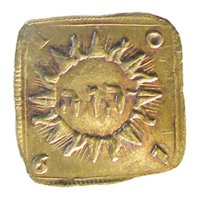
Radiant "Jehovah" with corner dates.
Script: Latin
Edge
Mints
| Name | Mark |
|---|---|
| Stockholm | — |
Mintings
| Year | Mint Mark | Mintage | Quality | Collection |
|---|---|---|---|---|
| 1610 | — | — | ||
| 1611 | — | — | ||
| 1612 | — | — |
Historical background
In 1610, Sweden was grappling with a severe and complex currency crisis, a direct consequence of the aggressive foreign policy and wars pursued by King Charles IX. To finance continuous conflicts, primarily against Poland-Lithuania and Russia, the crown repeatedly debased the coinage. This meant reducing the silver content in coins like the öre and mark while officially maintaining their face value, effectively creating more money from the same amount of precious metal to pay for soldiers and supplies. This practice, while a short-term fiscal fix, fundamentally undermined confidence in the currency and triggered rampant inflation, as the actual intrinsic value of the coins in people's pockets plummeted.
The domestic economy suffered profoundly. The proliferation of low-quality, clipped, and counterfeit coins—a chaotic mix of domestic and foreign currencies—created a climate of uncertainty and distrust in everyday transactions. Merchants and peasants alike were reluctant to accept the officially minted coins at their nominal value, knowing they contained less silver, leading to economic friction and hardship. This period is often described as the "Kipper and Wipper" era (a German term for clipping and culling coins), a wider Central European crisis of debasement that Sweden was fully entangled in by 1610.
This monetary chaos presented an immediate and critical challenge for Gustavus Adolphus upon his accession to the throne in 1611. The disastrous state of the treasury and currency was a primary threat to the kingdom's stability and his military ambitions. Consequently, a major currency reform became one of his most urgent priorities. The groundwork laid in these years would culminate in the sweeping and successful 1624 reform, which introduced a new, stable monetary system based on the silver riksdaler, finally restoring order and providing the sound financial foundation necessary for Sweden's emergence as a great power.
The domestic economy suffered profoundly. The proliferation of low-quality, clipped, and counterfeit coins—a chaotic mix of domestic and foreign currencies—created a climate of uncertainty and distrust in everyday transactions. Merchants and peasants alike were reluctant to accept the officially minted coins at their nominal value, knowing they contained less silver, leading to economic friction and hardship. This period is often described as the "Kipper and Wipper" era (a German term for clipping and culling coins), a wider Central European crisis of debasement that Sweden was fully entangled in by 1610.
This monetary chaos presented an immediate and critical challenge for Gustavus Adolphus upon his accession to the throne in 1611. The disastrous state of the treasury and currency was a primary threat to the kingdom's stability and his military ambitions. Consequently, a major currency reform became one of his most urgent priorities. The groundwork laid in these years would culminate in the sweeping and successful 1624 reform, which introduced a new, stable monetary system based on the silver riksdaler, finally restoring order and providing the sound financial foundation necessary for Sweden's emergence as a great power.
✨ Legendary