

1 patagon – Spanish Netherlands
Add to wishlist
Netherlands
Context
Years: 1686–1700
Country: Netherlands
Issuer: Spanish Netherlands
Ruler: Charles II
Currency:
(1506—1713)
Demonetized: Yes
Material
References
KM: #
Numista: #106167
Value
Bullion value: $61.47
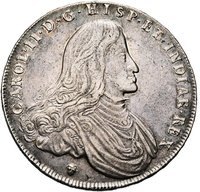
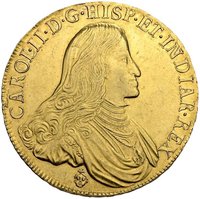
Obverse
Description:
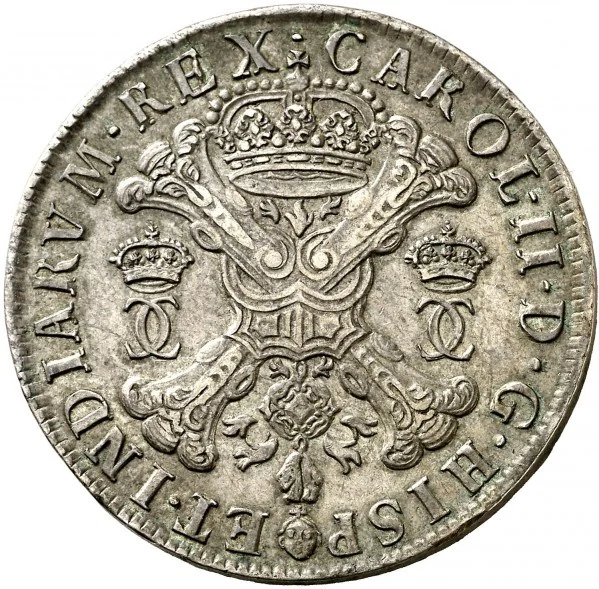
Burgundian cross with the Golden Fleece, flanked by two crowned, interlaced C monograms.
Inscription:
CAROL II • D • G • HISP ET INDIARVM REX
Script: Latin
Engraver: Philippe Roëttiers.
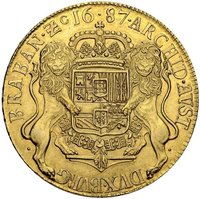
Reverse
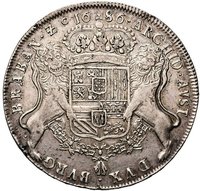
Description:
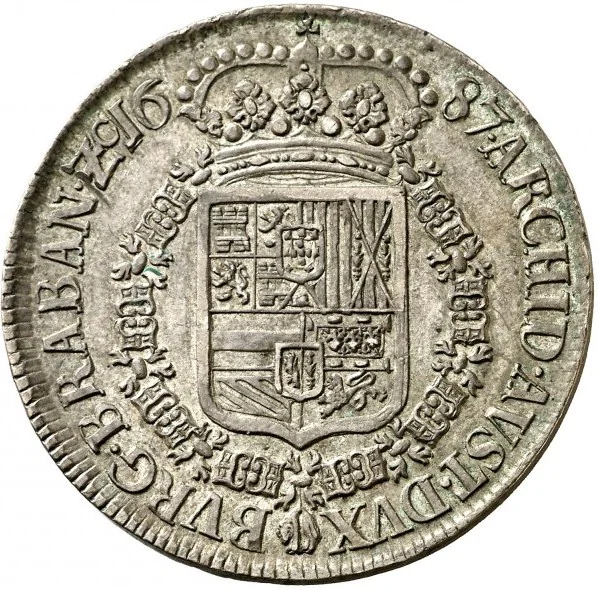
Crowned quartered arms encircled by the Golden Fleece collar. The crown divides the date above.
Inscription:
ARCHID·AVST·DVX·BVRG·BRABAN·Zc
Script: Latin
Engraver: Philippe Roëttiers.
Edge
Reeded
Mints
| Name | Mark |
|---|---|
| Antwerp | — |
| Royal Mint of Belgium | — |
Mintings
| Year | Mint Mark | Mintage | Quality | Collection |
|---|---|---|---|---|
| 1686 | — | — | ||
| 1687 | tête | — | ||
| 1688 | — | — | ||
| 1689 | — | — | ||
| 1690 | — | — | ||
| 1691 | — | — | ||
| 1692 | — | — | ||
| 1694 | — | — | ||
| 1695 | — | — | ||
| 1696 | — | — | ||
| 1697 | — | — | ||
| 1698 | — | — | ||
| 1699 | — | — | ||
| 1700 | — | — |
Historical background
In 1686, the Spanish Netherlands (approximately modern-day Belgium and Luxembourg) grappled with a severe and chronic monetary crisis, a legacy of the wider economic and political struggles of the Spanish Habsburg Empire. The region's currency system was chaotic, characterized by the simultaneous circulation of a bewildering variety of domestic and foreign coins. These included officially minted local patagons and ducatons, but also heavily debased domestic coinage and, most problematically, a flood of underweight foreign coins, particularly French Louis d'or and Dutch rijksdaalders. The intrinsic silver content of these coins often exceeded their official face value within the Spanish Netherlands, leading to their rapid export (Gresham's Law in action), which drained the land of sound money and left behind the poorest quality coins for daily commerce.
This instability was exacerbated by the Spanish Crown's own fiscal policies. Chronic deficits, often funded by manipulating the coinage, had led to repeated official devaluations and re-valuations (mutaciones), which shattered public trust. Merchants and creditors faced constant uncertainty about the real value of payments, stifling trade and investment. Furthermore, the region was still recovering from the Franco-Dutch War (1672-1678), which had ended with the Treaty of Nijmegen. While this brought a temporary peace, the Spanish Netherlands remained a contested buffer zone between the powerful French kingdom and the Dutch Republic, making long-term economic planning difficult and perpetuating the influx of competing foreign currencies.
Consequently, by 1686, authorities faced immense pressure to restore order. The solution was seen in a major monetary reform: a complete recall and recoinage to standardize the currency and re-establish its credibility. This ambitious plan, which would come to fruition with the great recoinage edict of 1687, was in its preparatory stages in 1686. The goal was to introduce new, full-weight silver coins like the patagon and ducaton at stable rates, thereby driving out foreign and debased money. Thus, 1686 represents a pivotal year of crisis and planning, immediately preceding a last-ditch, systematic attempt to impose monetary sovereignty and stability on a strategically vital but economically fractured region.
This instability was exacerbated by the Spanish Crown's own fiscal policies. Chronic deficits, often funded by manipulating the coinage, had led to repeated official devaluations and re-valuations (mutaciones), which shattered public trust. Merchants and creditors faced constant uncertainty about the real value of payments, stifling trade and investment. Furthermore, the region was still recovering from the Franco-Dutch War (1672-1678), which had ended with the Treaty of Nijmegen. While this brought a temporary peace, the Spanish Netherlands remained a contested buffer zone between the powerful French kingdom and the Dutch Republic, making long-term economic planning difficult and perpetuating the influx of competing foreign currencies.
Consequently, by 1686, authorities faced immense pressure to restore order. The solution was seen in a major monetary reform: a complete recall and recoinage to standardize the currency and re-establish its credibility. This ambitious plan, which would come to fruition with the great recoinage edict of 1687, was in its preparatory stages in 1686. The goal was to introduce new, full-weight silver coins like the patagon and ducaton at stable rates, thereby driving out foreign and debased money. Thus, 1686 represents a pivotal year of crisis and planning, immediately preceding a last-ditch, systematic attempt to impose monetary sovereignty and stability on a strategically vital but economically fractured region.
✨ Legendary