

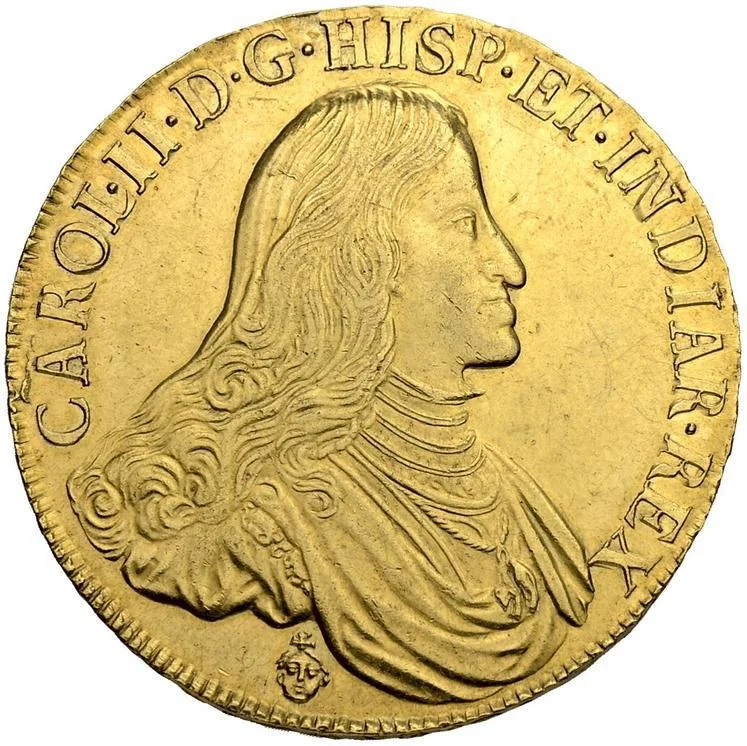
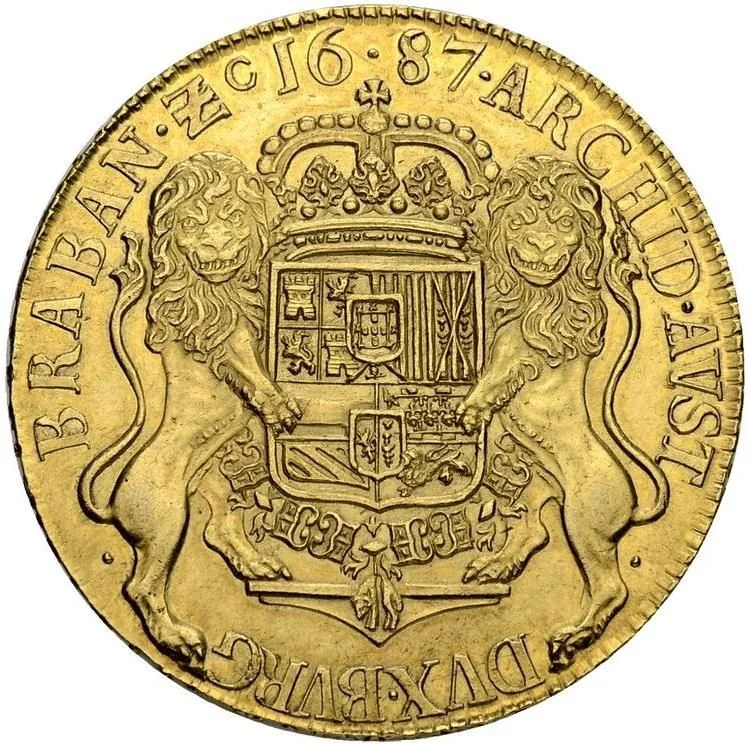
8 sovereigns – Spanish Netherlands
Add to wishlist
Netherlands
Context
Year: 1687
Country: Netherlands
Issuer: Spanish Netherlands
Ruler: Charles II
Currency:
(1506—1713)
Demonetized: Yes
Material
References
KM: #
Numista: #355917
Value
Bullion value: $6464.83
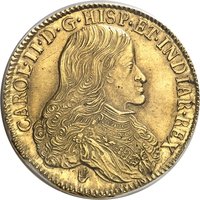
Obverse
Description:
Bareheaded bust right, mintmark beneath.
Inscription:
CAROL • II • D • G • HISP • ET • INDIAR • REX
Script: Latin
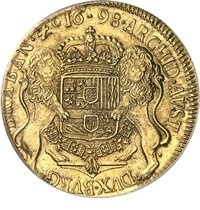
Reverse
Description:
Arms crowned and collared with the Golden Fleece, lion-flanked.
Inscription:
ARCHID • AVST • DVX • BVRG BRABAN • Zc 16 • 87
Script: Latin
Edge
Mints
| Name | Mark |
|---|---|
| Royal Mint of Belgium | Head |
Mintings
| Year | Mint Mark | Mintage | Quality | Collection |
|---|---|---|---|---|
| 1687 | — | — |
Historical background
In 1687, the Spanish Netherlands (approximately modern-day Belgium and Luxembourg) grappled with a severe and chronic monetary crisis, a legacy of decades of warfare and economic fragmentation. The circulating medium was a chaotic mix of domestic and foreign coins, including Spanish reales, Dutch daalders, German thalers, and French écus, each with fluctuating intrinsic values. This proliferation of different coins, many physically debased or clipped, created widespread confusion in trade and made the official exchange rates, set by repeated government ordinances, largely theoretical and ineffective. The situation was exacerbated by the outflow of full-weight silver to neighboring countries, leaving behind poorer quality currency—a classic example of Gresham's Law, where "bad money drives out good."
The root causes were deeply structural. The region, a battleground in the Franco-Dutch War which had only ended in 1678, faced immense fiscal pressure from Madrid to fund the Habsburg military. Furthermore, the Spanish Crown's own recurrent currency debasements, particularly of the real and the maravedí, reverberated in its northern provinces. Local authorities, like the Council of Finance in Brussels, issued periodic plakkaten (edicts) to re-tariff coins, attempting to align their legal value with their ever-changing metal content. However, these reactive measures failed to establish a stable standard, as they could not control the flood of foreign coins or prevent arbitrage by merchants and money-changers who exploited the discrepancies between regions and ordinances.
Consequently, the economy of the Spanish Netherlands in 1687 operated under a cloud of monetary uncertainty that hindered commerce and investment. Merchants faced significant risk in everyday transactions, and public trust in coinage was low. This instability stood in stark contrast to the flourishing, well-regulated financial systems of its powerful northern neighbor, the Dutch Republic, and increasingly, England. The currency chaos thus reflected the broader political and economic decline of Spanish Habsburg power, leaving the region's economy vulnerable and complicating the administration of Governor-General Francisco Antonio de Agurto, the Marquis of Gastañaga, who had to balance local economic distress with the imperial demands of a fading superpower.
The root causes were deeply structural. The region, a battleground in the Franco-Dutch War which had only ended in 1678, faced immense fiscal pressure from Madrid to fund the Habsburg military. Furthermore, the Spanish Crown's own recurrent currency debasements, particularly of the real and the maravedí, reverberated in its northern provinces. Local authorities, like the Council of Finance in Brussels, issued periodic plakkaten (edicts) to re-tariff coins, attempting to align their legal value with their ever-changing metal content. However, these reactive measures failed to establish a stable standard, as they could not control the flood of foreign coins or prevent arbitrage by merchants and money-changers who exploited the discrepancies between regions and ordinances.
Consequently, the economy of the Spanish Netherlands in 1687 operated under a cloud of monetary uncertainty that hindered commerce and investment. Merchants faced significant risk in everyday transactions, and public trust in coinage was low. This instability stood in stark contrast to the flourishing, well-regulated financial systems of its powerful northern neighbor, the Dutch Republic, and increasingly, England. The currency chaos thus reflected the broader political and economic decline of Spanish Habsburg power, leaving the region's economy vulnerable and complicating the administration of Governor-General Francisco Antonio de Agurto, the Marquis of Gastañaga, who had to balance local economic distress with the imperial demands of a fading superpower.
✨ Legendary