

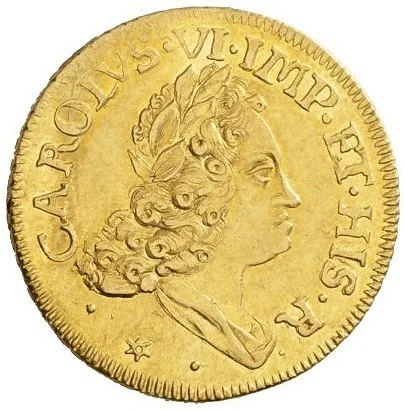
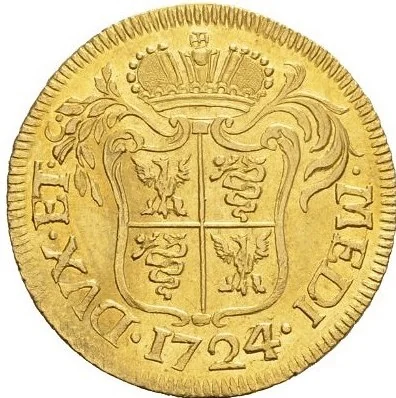
1 Doppia – Milan
Italy
Context
Years: 1720–1724
Country: Italy 
Issuer: Milan
Ruler: Charles III
Currency:
(1515—1796)
Demonetized: Yes
Material
References
KM: #Click to copy to clipboard129
Numista: #106037
Value
Bullion value: $1094.01
Obverse
Reverse
Description:
Crown over quartered shield, two branches above, date below.
Inscription:
MEDI DVX·ET·
·1724·
·1724·
Script: Latin
Edge
Categories
| Object> Armour |
| Symbols> Coat of Arms |
Mints
| Name | Mark |
|---|---|
| Milan | — |
Mintings
| Year | Mint Mark | Mintage | Quality | Collection |
|---|---|---|---|---|
| 1720 | — | — | ||
| 1724 | — | — |
Historical background
In 1720, Milan found itself at the epicentre of a severe monetary crisis, a direct consequence of the speculative frenzy known as the Mississippi Bubble that had originated in France. The Duchy of Milan, then under Austrian Habsburg rule after the War of the Spanish Succession, was deeply entangled in the financial schemes of the French Compagnie des Indes. Eager to replicate French successes, the Austrian authorities and local speculators had issued vast amounts of paper money and public debt, backed by promised future profits from colonial trade. When the bubble in Paris burst in late 1719, confidence in these paper instruments evaporated almost overnight in Milan, leading to a frantic scramble to convert paper into scarce silver and gold coin.
The immediate result was economic paralysis. As the value of paper money plummeted, prices for basic goods soared, causing widespread hardship and social unrest. Trade and credit ground to a halt, crippling merchants and the broader Lombard economy, which was one of the most advanced in Europe. The Habsburg government, under Emperor Charles VI, responded with a series of chaotic and often contradictory decrees, attempting to fix exchange rates, mandate acceptance of devalued paper, and later, to withdraw it from circulation. These measures only deepened public mistrust and failed to restore stability.
The crisis of 1720 left a profound and lasting mark on Milanese society and economic policy. It discredited speculative finance and paper money for generations, reinforcing a conservative preference for metallic coinage. Furthermore, it severely damaged the credibility of the Austrian administration, highlighting its fiscal vulnerability and contributing to longstanding local resentment towards external rule. The episode served as a harsh lesson on the dangers of financial contagion and speculative excess, shaping Milan's cautious approach to banking and currency for decades to come.
The immediate result was economic paralysis. As the value of paper money plummeted, prices for basic goods soared, causing widespread hardship and social unrest. Trade and credit ground to a halt, crippling merchants and the broader Lombard economy, which was one of the most advanced in Europe. The Habsburg government, under Emperor Charles VI, responded with a series of chaotic and often contradictory decrees, attempting to fix exchange rates, mandate acceptance of devalued paper, and later, to withdraw it from circulation. These measures only deepened public mistrust and failed to restore stability.
The crisis of 1720 left a profound and lasting mark on Milanese society and economic policy. It discredited speculative finance and paper money for generations, reinforcing a conservative preference for metallic coinage. Furthermore, it severely damaged the credibility of the Austrian administration, highlighting its fiscal vulnerability and contributing to longstanding local resentment towards external rule. The episode served as a harsh lesson on the dangers of financial contagion and speculative excess, shaping Milan's cautious approach to banking and currency for decades to come.
✨ Legendary