Logo Title
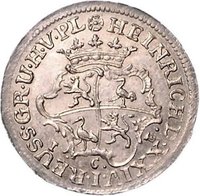
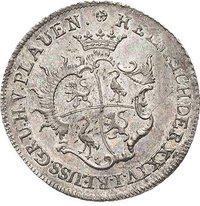
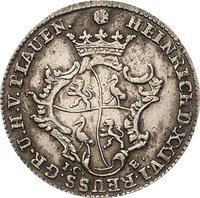
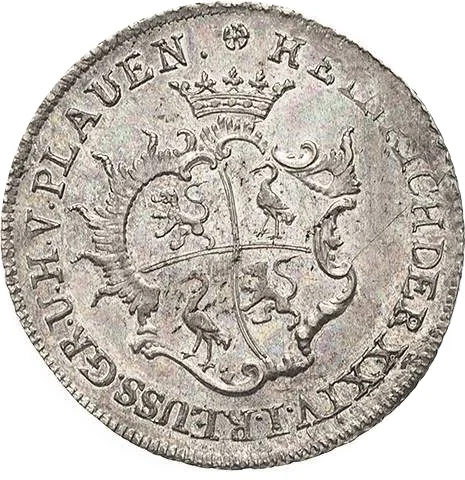
obverse
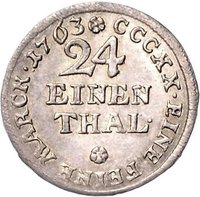
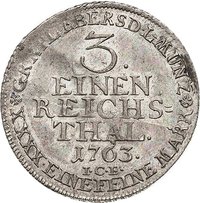
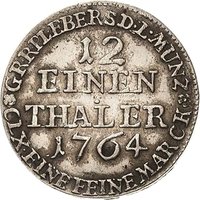
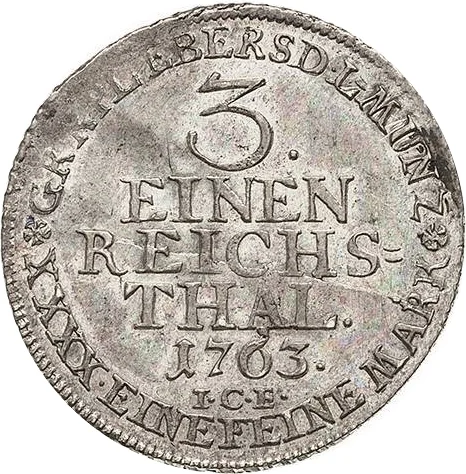
reverse
Leipziger Münzhandlung und Auktion Manfred Höhn
Context
Year: 1763
Country: Germany Country flag
Currency:
(1739—1806)
Demonetized: Yes
Total mintage: 4,540
Material
Weight: 7.01 g
Silver weight: 5.84 g
Shape: Round
Composition: 83.3% Silver
Magnetic: No
References
KM: #Click to copy to clipboard13
Numista: #147745
Value
Bullion value: $16.70

Obverse

Description:
Crowned coat of arms.
Script: Latin

Reverse

Description:
Value and date centered, I.C.E. below.
Script: Latin

Edge

Mints

NameMark
Saalfeld

Mintings

YearMint MarkMintageQualityCollection
17634,540

Historical background

In 1763, the County of Reuss-Ebersdorf, a small Thuringian state within the Holy Roman Empire, faced a complex and challenging currency situation deeply influenced by broader regional turmoil. The immediate backdrop was the conclusion of the Seven Years' War (1756-1763), which had left the German territories economically devastated. Widespread debasement of coinage by various states to fund the war had led to a severe proliferation of unstable and heterogeneous currencies circulating across the region. Like its neighbors, Reuss-Ebersdorf struggled with a chaotic monetary environment filled with coins of varying standards and dubious value, undermining local trade and economic stability.

The county's monetary system operated within the framework of the Reichsthaler, as mandated by Imperial ordinances. However, the practical authority lay with the reigning Count, Heinrich XXIV, who issued his own low-denomination Kleingeld (small change) for local use. The primary challenge was the acute shortage of high-value, "good" specie (silver coins) and the overabundance of depreciated small coins, leading to inflation and a loss of public confidence. Furthermore, Reuss-Ebersdorf was economically intertwined with neighboring Saxon and other Thuringian territories, meaning its economy was vulnerable to their respective currency manipulations and debasements.

Consequently, 1763 marked a pivotal year of attempted reform, coinciding with the Imperial Münzkonvention (monetary convention) proposed in Leipzig. While larger states like Prussia and Austria drove this effort to standardize the Reichsthaler, smaller counties like Reuss-Ebersdorf had little choice but to align with these regional agreements to restore order. The county's efforts would have focused on withdrawing debased coinage and stabilizing its minting practices in accordance with emerging conventions, a difficult but necessary process to re-establish fiscal credibility and facilitate recovery in the war's aftermath.

Series: 1763 County of Reuss-Ebersdorf circulation coins

1⁄24 Thaler obverse
1⁄24 Thaler reverse
1⁄24 Thaler
1763
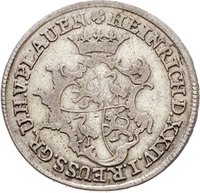
⅙ Thaler obverse
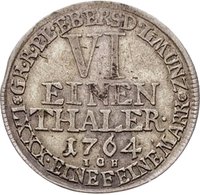
⅙ Thaler reverse
⅙ Thaler
1763-1764
⅓ Thaler obverse
⅓ Thaler reverse
⅓ Thaler
1763
Legendary