

1 Courant Ducat – Denmark
Denmark
Context
Years: 1714–1716
Issuer: Denmark 
Ruler: Frederick IV
Currency:
(1625—1813)
Subdivision: 1 Courant Ducat = 2 Riksdaler Courant
Demonetized: Yes
Material
References
KM: #Click to copy to clipboard508
Numista: #146739
Value
Bullion value: $410.79
Obverse
Description:
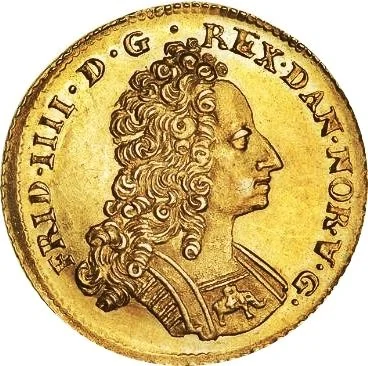
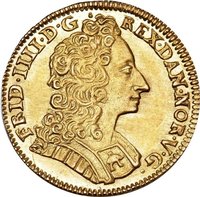
King's bust right, curly hair dividing legend.
Inscription:
FRID.IIII.D.G.REX DAN.NOR.V.G
Script: Latin
Reverse
Description:
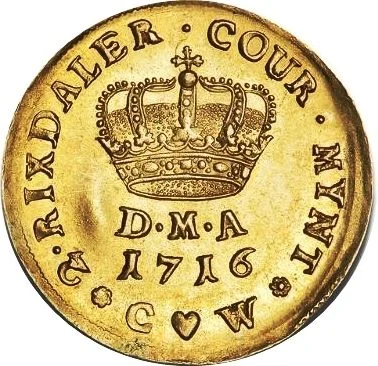
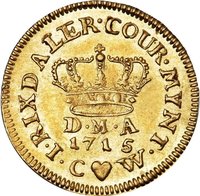
Crown above D.M.A. and date; heart divides date below. Value in legend around rim.
Inscription:
2 · RIXDALER · COUR · MVNT ·
• D • M • A •
1715
• C ♥ W •
• D • M • A •
1715
• C ♥ W •
Script: Latin
Edge
Mints
| Name | Mark |
|---|---|
| Royal Danish Mint | ♥ |
Mintings
| Year | Mint Mark | Mintage | Quality | Collection |
|---|---|---|---|---|
| 1714 | CW; | — | ||
| 1715 | CW; | — | ||
| 1716 | CW; | — |
Historical background
In 1714, Denmark was navigating a complex and challenging currency situation, largely shaped by the immense financial strain of the Great Northern War (1700-1721). The kingdom, allied with Russia against Sweden, had been fighting for over a decade. This protracted conflict demanded extraordinary state expenditure, funded primarily through heavy taxation, borrowing, and—critically—the repeated debasement of the coinage. The royal mint systematically reduced the silver content in coins while maintaining their face value, a short-term measure to generate profit for the treasury but one that eroded public trust and sparked inflation.
The domestic monetary system was consequently in a state of disorder. Older, high-quality coins were hoarded or melted down for their intrinsic metal value (Gresham's Law in action), while the newer, inferior coins flooded the market. This led to a disparity between the official exchange rates of various coins and their actual market value based on silver content, causing confusion and hindering trade. Furthermore, Denmark's economy was still heavily reliant on the rigsdaler as a unit of account, but its physical representation in circulating coins was unstable and unreliable.
Recognizing the crisis, the state had begun to implement reforms. The most significant was the introduction of a new currency system by royal decree in 1713, which took effect in the following years. This reform aimed to stabilize the situation by defining a new rigsdaler specie tied to a specific silver content and establishing a fixed relationship between it and the lower-denomination mark coins. While 1714 fell within this transitional period, with the old debased coins still circulating, the year was part of a crucial shift from wartime fiscal expediency toward the restoration of a standardized and trustworthy monetary system, a process essential for Denmark's post-war economic recovery.
The domestic monetary system was consequently in a state of disorder. Older, high-quality coins were hoarded or melted down for their intrinsic metal value (Gresham's Law in action), while the newer, inferior coins flooded the market. This led to a disparity between the official exchange rates of various coins and their actual market value based on silver content, causing confusion and hindering trade. Furthermore, Denmark's economy was still heavily reliant on the rigsdaler as a unit of account, but its physical representation in circulating coins was unstable and unreliable.
Recognizing the crisis, the state had begun to implement reforms. The most significant was the introduction of a new currency system by royal decree in 1713, which took effect in the following years. This reform aimed to stabilize the situation by defining a new rigsdaler specie tied to a specific silver content and establishing a fixed relationship between it and the lower-denomination mark coins. While 1714 fell within this transitional period, with the old debased coins still circulating, the year was part of a crucial shift from wartime fiscal expediency toward the restoration of a standardized and trustworthy monetary system, a process essential for Denmark's post-war economic recovery.
✨ Legendary