

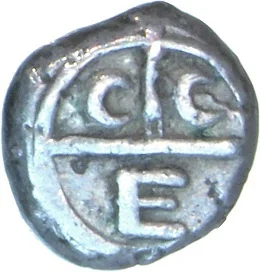

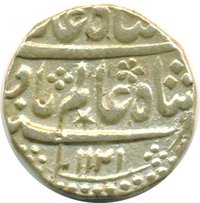
Obverse
Description:
Bale mark: CC/E in a plain circle.
Inscription:
CC
E
E
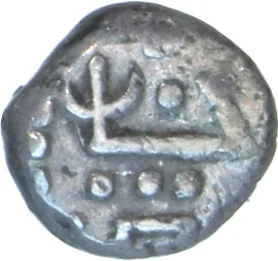
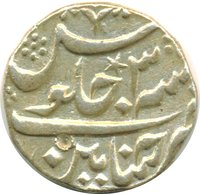
Reverse
Description:
Persian.
Edge
Plain
Mintings
| Year | Mint Mark | Mintage | Quality | Collection |
|---|---|---|---|---|
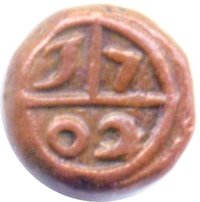
| 1704 | — | — |
Historical background
In 1704, the currency situation within the Madras Presidency was a complex and often chaotic tapestry, reflecting its position as a key node of the English East India Company (EIC) on the Coromandel Coast. The monetary system was not unified but operated through a dynamic and sometimes unstable interaction of multiple currencies. The most prominent were the silver pagoda (a gold coin) and the fanam (a small gold fraction), which served as the traditional units of account for larger commercial and revenue transactions. Alongside these, a plethora of silver rupees of varying weights and purities—from Mughal, Arcot, and other regional mints—circulated widely, their values constantly fluctuating against each other and against the gold-based units.
This multi-currency environment created significant challenges for the EIC’s trade and administration. Merchants and Company accountants had to navigate intricate exchange rates and contend with the problem of "cowrie shells" and copper "cash" coins, which formed the essential small change for the daily transactions of the local population. The lack of a standardized, high-value silver coin minted by the Company itself was a particular vulnerability, forcing reliance on imported Spanish American silver or Mughal rupees, which were subject to supply disruptions and arbitrage by rival European companies and Indian money-changers (shroffs).
Consequently, the period was one of monetary experimentation and frustration for the Company’s Madras Council. Efforts to assert control included regulating the rates of popular coins like the "Larín" or issuing proclamations to fix the value of the silver rupee against the gold pagoda. However, these attempts were often undermined by market forces and the sheer volume of disparate coins in circulation. Thus, in 1704, the Presidency was still decades away from the more stable currency reforms that would come later in the century, operating instead within a fluid and commercially demanding bazaar economy where the shroff’s assay scales held as much authority as any official proclamation.
This multi-currency environment created significant challenges for the EIC’s trade and administration. Merchants and Company accountants had to navigate intricate exchange rates and contend with the problem of "cowrie shells" and copper "cash" coins, which formed the essential small change for the daily transactions of the local population. The lack of a standardized, high-value silver coin minted by the Company itself was a particular vulnerability, forcing reliance on imported Spanish American silver or Mughal rupees, which were subject to supply disruptions and arbitrage by rival European companies and Indian money-changers (shroffs).
Consequently, the period was one of monetary experimentation and frustration for the Company’s Madras Council. Efforts to assert control included regulating the rates of popular coins like the "Larín" or issuing proclamations to fix the value of the silver rupee against the gold pagoda. However, these attempts were often undermined by market forces and the sheer volume of disparate coins in circulation. Thus, in 1704, the Presidency was still decades away from the more stable currency reforms that would come later in the century, operating instead within a fluid and commercially demanding bazaar economy where the shroff’s assay scales held as much authority as any official proclamation.
✨ Legendary