

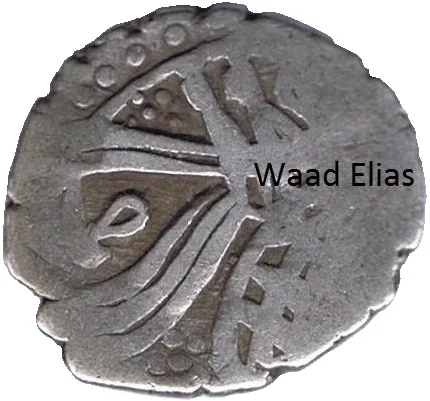
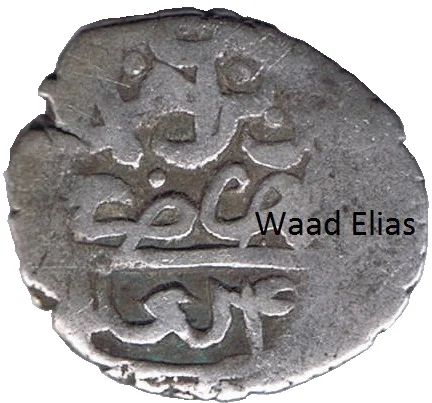
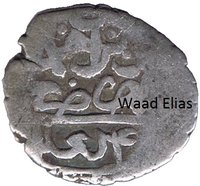
Dirhem – Baghdad Eyalet
Iraq
Context
Year: 1640
Islamic (Hijri) Year: 1049
Country: Iraq 
Issuer: Baghdad Eyalet
Ruler: Ibrahim I
Currency:
(1535—1688)
Demonetized: Yes
Material
Diameter: 18.2 mm
Weight: 3 g
Silver weight: 3.00 g
Shape: Irregular round
Composition: Silver
Magnetic: No
References
KM: #Click to copy to clipboard23
Numista: #142472
Value
Bullion value: $8.58
Mintings
| Year | Mint Mark | Mintage | Quality | Collection |
|---|---|---|---|---|
| 1640 | — | — | ||
| 1640 | — | — |
Historical background
In 1640, the currency situation in Baghdad Eyalet, a strategically vital province of the Ottoman Empire, was characterized by instability and complexity, largely stemming from its position on the frontier with the Safavid Empire. The primary circulating currency was the Ottoman akçe, a small silver coin, but its value and purity were frequently undermined by debasement. The central Ottoman government, often in need of revenue for military campaigns, would reduce the silver content of newly minted coins, leading to inflation and a loss of public confidence. This was particularly disruptive in a commercial hub like Baghdad, which relied on trustworthy currency for both local trade and long-distance caravan commerce.
Compounding this instability was the persistent inflow of foreign and irregular coins. Spanish silver reales (pieces of eight) from global trade networks, Safavid abbasi coins from neighboring Persia, and a variety of older Ottoman and even regional Arab issues all circulated simultaneously. This created a chaotic monetary environment where exchange rates fluctuated based on the perceived metal content and origin of each coin, requiring money changers (sarrafs) to play a critical and powerful role in daily economic life. Their expertise was essential for assessing, weighing, and exchanging this heterogeneous mix of currency.
Furthermore, Baghdad's frequent status as a contested war zone, having been recaptured by the Ottomans from the Safavids only in 1638, meant that the provincial administration often operated with significant autonomy. Local governors and military commanders, facing the immediate costs of garrisoning the city and securing the frontier, sometimes resorted to issuing their own temporary coinage or manipulating the currency to meet payrolls, adding another layer of local monetary disturbance. Thus, in 1640, a merchant in Baghdad's bazaars navigated a fragile system built on a debased official coinage, a jumble of foreign currencies, and the ad-hoc financial measures of a frontier garrison state.
Compounding this instability was the persistent inflow of foreign and irregular coins. Spanish silver reales (pieces of eight) from global trade networks, Safavid abbasi coins from neighboring Persia, and a variety of older Ottoman and even regional Arab issues all circulated simultaneously. This created a chaotic monetary environment where exchange rates fluctuated based on the perceived metal content and origin of each coin, requiring money changers (sarrafs) to play a critical and powerful role in daily economic life. Their expertise was essential for assessing, weighing, and exchanging this heterogeneous mix of currency.
Furthermore, Baghdad's frequent status as a contested war zone, having been recaptured by the Ottomans from the Safavids only in 1638, meant that the provincial administration often operated with significant autonomy. Local governors and military commanders, facing the immediate costs of garrisoning the city and securing the frontier, sometimes resorted to issuing their own temporary coinage or manipulating the currency to meet payrolls, adding another layer of local monetary disturbance. Thus, in 1640, a merchant in Baghdad's bazaars navigated a fragile system built on a debased official coinage, a jumble of foreign currencies, and the ad-hoc financial measures of a frontier garrison state.

✨ Legendary