

⅒ Thaler – Austrian Empire
Austria

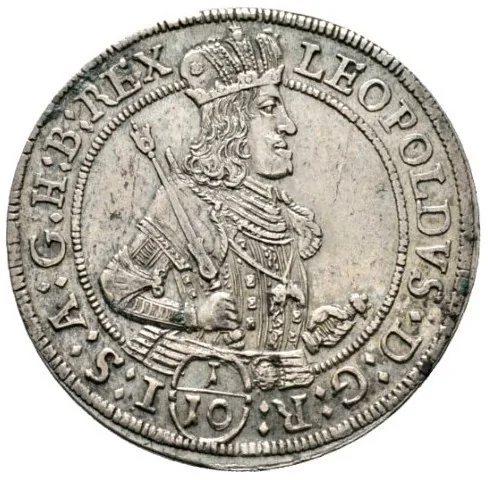
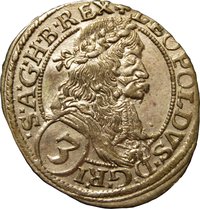
Obverse
Description:
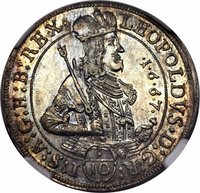
Half-portrait of Leopold I, crowned and armored, holding a sceptre and sword. Fractional value in circle below legend.
Inscription:
LEOPOLDVS D G R (1/10) I S A G H B REX
Script: Latin
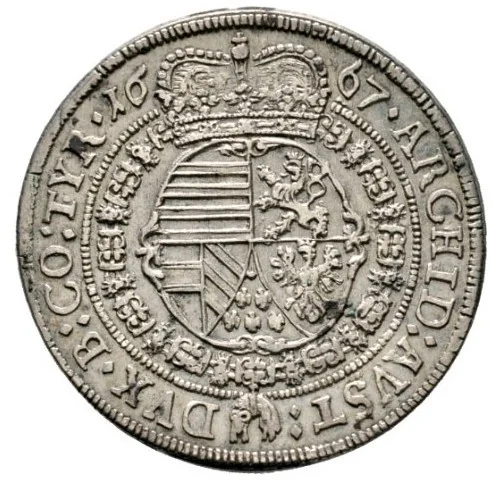
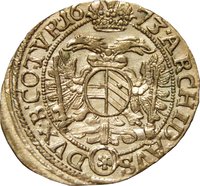
Reverse
Description:
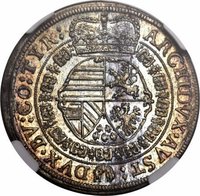
Four-fold arms with the Golden Fleece cord: 1) Ancient Hungary, 2) Bohemia, 3) Austria and Ancient Burgundy, 4) Tyrol. Low Austria's arms below, between the lower shields. Divided date above.
Inscription:
ARCHID AVST // DVX B CO TYR
Script: Latin
Edge
Mints
| Name | Mark |
|---|---|
| Hall | — |
Mintings
| Year | Mint Mark | Mintage | Quality | Collection |
|---|---|---|---|---|
| 1667 | — | — |
Historical background
In 1667, the Austrian Habsburg monarchy operated under a complex and fragmented monetary system, a direct reflection of its politically decentralized structure. The Empire was not a unified economic zone; instead, several distinct Kreise (circles), such as Austria, Bohemia, and Tyrol, minted their own coins according to regional agreements and privileges. The most important silver coin was the Reichsthaler, a theoretical standard, but in daily circulation, people used a plethora of smaller regional coins like Kreuzers, Groschen, and Guldens. This proliferation of currencies of varying silver content created chronic confusion and hindered trade across the realms.
The period was marked by significant monetary instability and "coinage debasement." To finance continuous warfare, especially against the Ottoman Empire in the east, the Habsburg state and its affiliated estates often resorted to reducing the precious metal content in newly minted coins while assigning them the same face value. This practice, essentially a form of inflation, led to a loss of public trust, drove older, purer coins out of circulation (Gresham's Law), and caused price fluctuations. The Vienna Münzstätte (mint) was a central player in this, frequently altering coinage standards to meet fiscal demands.
Efforts at reform were piecemeal and largely regional. Emperor Leopold I's government faced immense challenges in imposing a uniform monetary policy, as the powerful estates and mining towns (like those in Tyrol controlling silver) fiercely guarded their minting rights. Consequently, while the need for a stable, universal currency was widely recognized to facilitate commerce and state finance, the political will and central authority to achieve it were lacking. The monetary landscape of 1667 was thus one of entrenched complexity, fiscal expediency, and ongoing struggle between centralizing impulses and local autonomy.
The period was marked by significant monetary instability and "coinage debasement." To finance continuous warfare, especially against the Ottoman Empire in the east, the Habsburg state and its affiliated estates often resorted to reducing the precious metal content in newly minted coins while assigning them the same face value. This practice, essentially a form of inflation, led to a loss of public trust, drove older, purer coins out of circulation (Gresham's Law), and caused price fluctuations. The Vienna Münzstätte (mint) was a central player in this, frequently altering coinage standards to meet fiscal demands.
Efforts at reform were piecemeal and largely regional. Emperor Leopold I's government faced immense challenges in imposing a uniform monetary policy, as the powerful estates and mining towns (like those in Tyrol controlling silver) fiercely guarded their minting rights. Consequently, while the need for a stable, universal currency was widely recognized to facilitate commerce and state finance, the political will and central authority to achieve it were lacking. The monetary landscape of 1667 was thus one of entrenched complexity, fiscal expediency, and ongoing struggle between centralizing impulses and local autonomy.
✨ Legendary