

1 rupee – Awadh
Add to wishlist
India
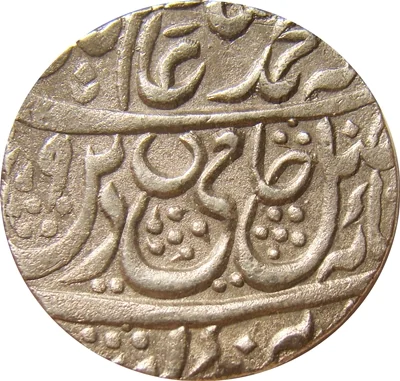
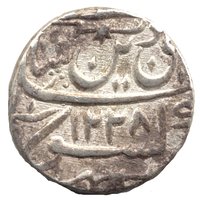
Obverse
Description:
Shah Alam II, dated by year.
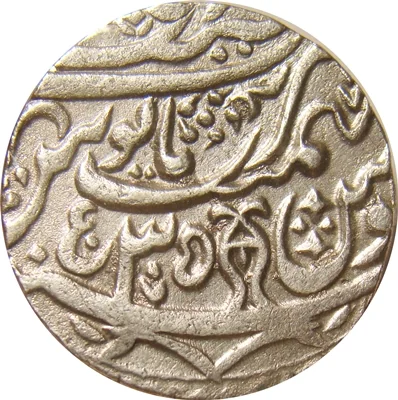
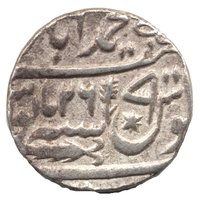
Reverse
Description:
"Mim" and "Ain" fish mint, regnal year.
Edge
Mints
| Name | Mark |
|---|---|
| Najibabad | — |
Mintings
| Year | Mint Mark | Mintage | Quality | Collection |
|---|---|---|---|---|
| 1782 | — | — | ||
| 1790 | — | — | ||
| 1791 | — | — | ||
| 1794 | — | — | ||
| 1795 | — | — |
Historical background
In 1782, the currency situation in Awadh was characterised by significant instability and complexity, reflecting the broader political and economic pressures of the era. The Nawab of Awadh, Asaf-ud-Daula, ruled a state that was nominally autonomous but practically a subsidiary ally of the British East India Company following the Treaty of Faizabad (1775). This political subordination drained the treasury through massive annual subsidies to the Company, creating a chronic fiscal deficit that directly impacted the monetary system. The state's revenue was insufficient, leading to debasement of coinage and erratic minting practices to meet obligations.
The monetary landscape was a fragmented mosaic of various circulating coins. The official rupee of the Awadh state minted in Lucknow and other mints competed with older Mughal rupees, rupees from neighbouring regional powers like the Marathas and the Rohillas, and the increasingly influential silver rupees of the British East India Company from Bengal. Furthermore, the French sicca rupee also had some circulation. This proliferation of coins of varying weight, purity, and value, known as sikka (current) and sanat (old), created a chaotic environment for trade. Money changers (sarrafs) held considerable power, as their expertise was essential to navigate the discounts and premia applied to different coins, a system ripe for corruption and arbitrage.
This currency confusion severely hampered the Awadh economy, discouraging large-scale commerce and efficient revenue collection. The Nawab's administration, financially strained and administratively weak, lacked the centralised authority to impose a uniform monetary standard. Consequently, by 1782, the currency situation was not merely an economic issue but a symptom of Awadh's eroding sovereignty. It underscored a transition from a robust, independent Mughal successor state to a financially crippled entity whose economic policies were increasingly reactive to the demands of the British East India Company and the need to sustain a lavish court amidst growing internal debt.
The monetary landscape was a fragmented mosaic of various circulating coins. The official rupee of the Awadh state minted in Lucknow and other mints competed with older Mughal rupees, rupees from neighbouring regional powers like the Marathas and the Rohillas, and the increasingly influential silver rupees of the British East India Company from Bengal. Furthermore, the French sicca rupee also had some circulation. This proliferation of coins of varying weight, purity, and value, known as sikka (current) and sanat (old), created a chaotic environment for trade. Money changers (sarrafs) held considerable power, as their expertise was essential to navigate the discounts and premia applied to different coins, a system ripe for corruption and arbitrage.
This currency confusion severely hampered the Awadh economy, discouraging large-scale commerce and efficient revenue collection. The Nawab's administration, financially strained and administratively weak, lacked the centralised authority to impose a uniform monetary standard. Consequently, by 1782, the currency situation was not merely an economic issue but a symptom of Awadh's eroding sovereignty. It underscored a transition from a robust, independent Mughal successor state to a financially crippled entity whose economic policies were increasingly reactive to the demands of the British East India Company and the need to sustain a lavish court amidst growing internal debt.
✨ Legendary