

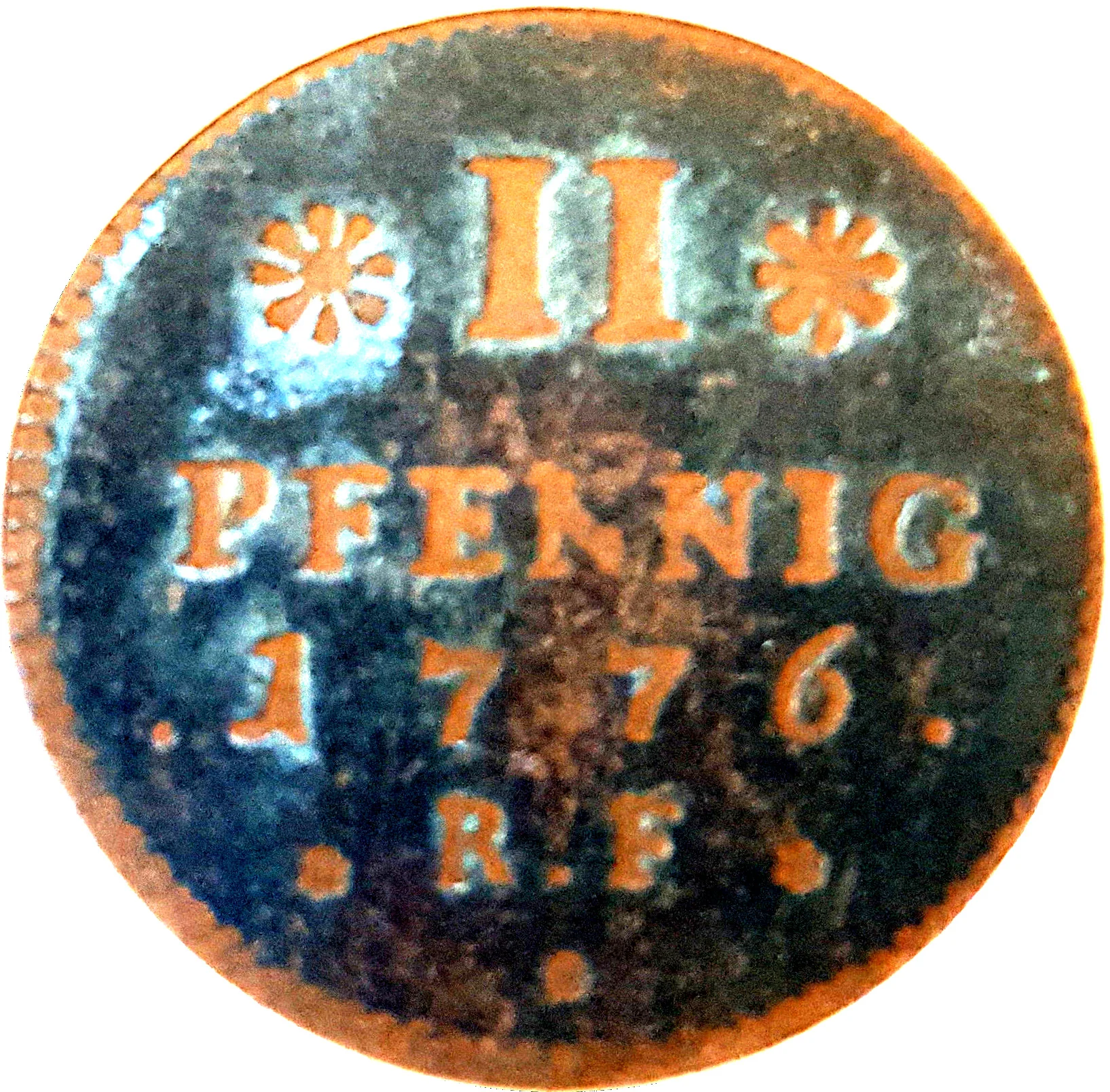
2 Pfennigs – Landgraviate of Hesse-Darmstadt
Context
Year: 1776
Issuer: Landgraviate of Hesse-Darmstadt
Ruler: Louis IX
Currency:
(1568—1805)
Demonetized: Yes
Material
References
KM: #Click to copy to clipboard233
Numista: #139221
Obverse
Description:
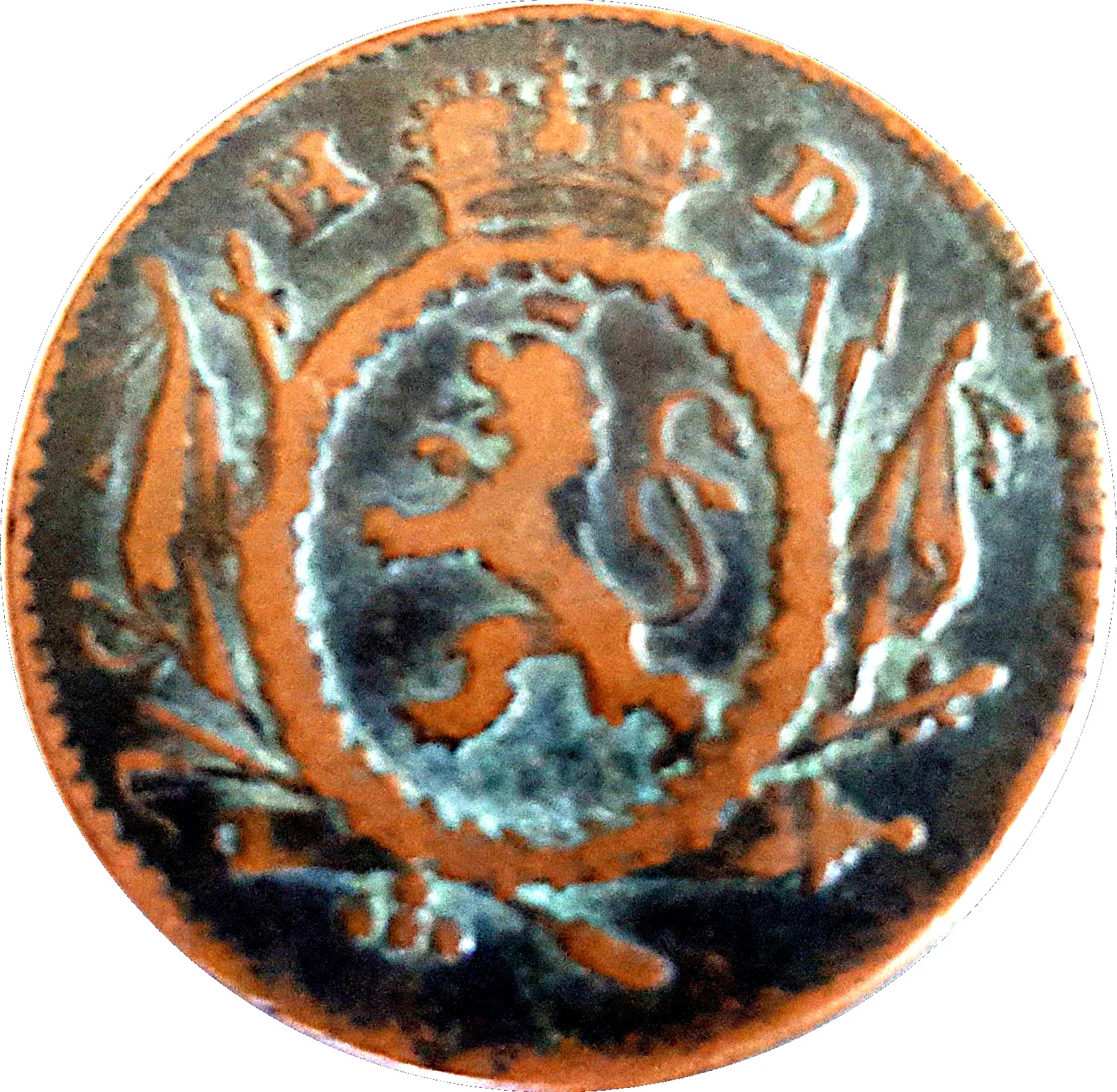
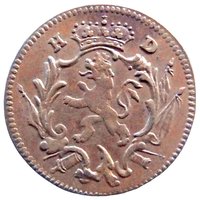
Crowned arms with "H.D." above, flanked by flags and cannons.
Inscription:
Inscription : H D
Script: Latin
Reverse
Edge
Mints
| Name | Mark |
|---|---|
| Darmstadt | — |
Mintings
| Year | Mint Mark | Mintage | Quality | Collection |
|---|---|---|---|---|
| 1776 | — | — |
Historical background
In 1776, the currency situation in the Landgraviate of Hesse-Darmstadt was complex and fragmented, typical of the Holy Roman Empire's decentralized political structure. The landgraviate did not have a single, unified currency but operated within a multi-layered monetary system. Officially, it used the South German Gulden (florin) as its accounting unit, subdivided into 60 Kreuzer. However, the actual coins in circulation were a diverse mix, including those minted by Hesse-Darmstadt itself, coins from neighboring German states (like Electoral Mainz and the Palatinate), and even older, debased coins from previous centuries. This created a chronic problem of uncertainty in everyday transactions.
The root of this complexity lay in the landgraviate's limited sovereign minting rights and its economic position. While the ruling Landgrave Ludwig IX maintained a mint in Darmstadt, its output was often insufficient to meet economic needs, leading to reliance on foreign coinage. More critically, the value of these various coins was not based on their face value but on their intrinsic precious metal content (silver), which was frequently manipulated. Neighboring states often debased their coinage to gain seigniorage profit, and these "bad" coins would flood into Hesse-Darmstadt, driving "good" full-weight coins out of circulation—a phenomenon described by Gresham's Law.
Consequently, by 1776, merchants and officials in Hesse-Darmstadt faced constant challenges in trade and taxation, requiring detailed Wechselkurse (exchange rate tables) to navigate the values of dozens of different coins. The system was inefficient and prone to exploitation, hindering economic development. This monetary disarray reflected the broader weaknesses of the Empire and would persist until the Napoleonic era's reforms forced greater standardization, highlighting a pre-modern economy in need of consolidation.
The root of this complexity lay in the landgraviate's limited sovereign minting rights and its economic position. While the ruling Landgrave Ludwig IX maintained a mint in Darmstadt, its output was often insufficient to meet economic needs, leading to reliance on foreign coinage. More critically, the value of these various coins was not based on their face value but on their intrinsic precious metal content (silver), which was frequently manipulated. Neighboring states often debased their coinage to gain seigniorage profit, and these "bad" coins would flood into Hesse-Darmstadt, driving "good" full-weight coins out of circulation—a phenomenon described by Gresham's Law.
Consequently, by 1776, merchants and officials in Hesse-Darmstadt faced constant challenges in trade and taxation, requiring detailed Wechselkurse (exchange rate tables) to navigate the values of dozens of different coins. The system was inefficient and prone to exploitation, hindering economic development. This monetary disarray reflected the broader weaknesses of the Empire and would persist until the Napoleonic era's reforms forced greater standardization, highlighting a pre-modern economy in need of consolidation.
💎 Extremely Rare