

1 Thaler – Teutonic Order
Germany
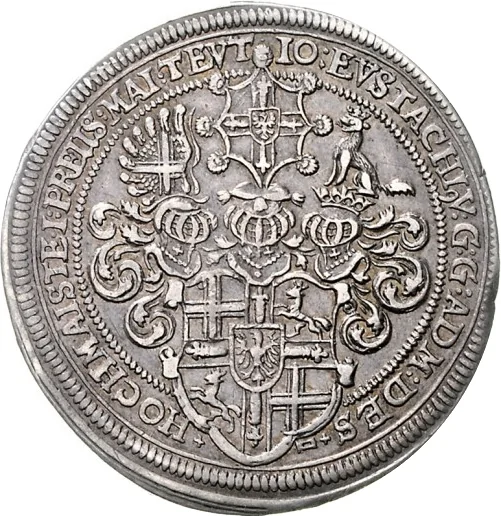
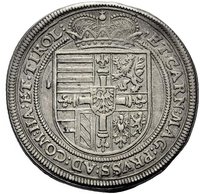
Obverse
Description:
Armed and helmeted.
Script: Latin
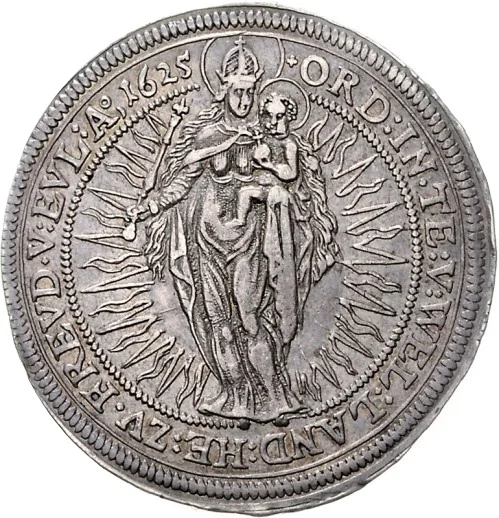
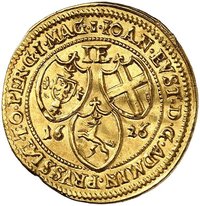
Reverse
Description:
Madonna and child in glowing oval.
Script: Latin
Edge
Mintings
| Year | Mint Mark | Mintage | Quality | Collection |
|---|---|---|---|---|
| 1625 | — | — |
Historical background
In 1625, the Teutonic Order's currency situation was defined by its dual role as both a monastic state and a vassal of the Polish-Lithuanian Commonwealth. The Order's territory, centered on the Duchy of Prussia (a Polish fief since 1525), operated within the complex monetary landscape of the Polish-Lithantian Commonwealth, which was itself a mosaic of circulating foreign and domestic coins. While the Order minted its own low-denomination copper and silver coins (such as schillings and groschen) at its mints in Königsberg and elsewhere, these were primarily for local and regional trade. The authority to issue high-value silver talers, however, required explicit permission from the Polish king, a clear sign of its limited monetary sovereignty.
Economically, the period was one of significant strain due to the Thirty Years' War (1618-1648). While the conflict raged primarily to the west, its economic shockwaves disrupted Baltic trade routes and caused widespread currency debasement across the region. The Teutonic Order, reliant on the export of agricultural goods from its Prussian estates, faced inflationary pressures as the value of its coinage fluctuated against the myriad of foreign currencies in circulation, including Polish złoty, Swedish riksdalers, Dutch rijksdaalders, and various German thalers. This period saw a "Kipper und Wipper" crisis in neighboring states, where small coins were heavily debased, a temptation the Order's mint masters had to navigate carefully.
Consequently, the monetary policy of Grand Master Johann Eustach von Westernach was largely reactive, focused on maintaining the stability and acceptability of the Order's coinage in a turbulent era. The primary challenge was ensuring that its issued coins retained sufficient precious metal content to be trusted in commerce, both locally and in the wider Baltic trade, while simultaneously generating necessary seigniorage revenue for the state treasury. The currency situation, therefore, reflected the Order's broader political reality: a semi-autonomous entity trying to manage its economic stability while embedded within the larger and often unstable financial systems of the Commonwealth and war-torn Europe.
Economically, the period was one of significant strain due to the Thirty Years' War (1618-1648). While the conflict raged primarily to the west, its economic shockwaves disrupted Baltic trade routes and caused widespread currency debasement across the region. The Teutonic Order, reliant on the export of agricultural goods from its Prussian estates, faced inflationary pressures as the value of its coinage fluctuated against the myriad of foreign currencies in circulation, including Polish złoty, Swedish riksdalers, Dutch rijksdaalders, and various German thalers. This period saw a "Kipper und Wipper" crisis in neighboring states, where small coins were heavily debased, a temptation the Order's mint masters had to navigate carefully.
Consequently, the monetary policy of Grand Master Johann Eustach von Westernach was largely reactive, focused on maintaining the stability and acceptability of the Order's coinage in a turbulent era. The primary challenge was ensuring that its issued coins retained sufficient precious metal content to be trusted in commerce, both locally and in the wider Baltic trade, while simultaneously generating necessary seigniorage revenue for the state treasury. The currency situation, therefore, reflected the Order's broader political reality: a semi-autonomous entity trying to manage its economic stability while embedded within the larger and often unstable financial systems of the Commonwealth and war-torn Europe.
✨ Legendary