

1 Thaler – Teutonic Order
Germany

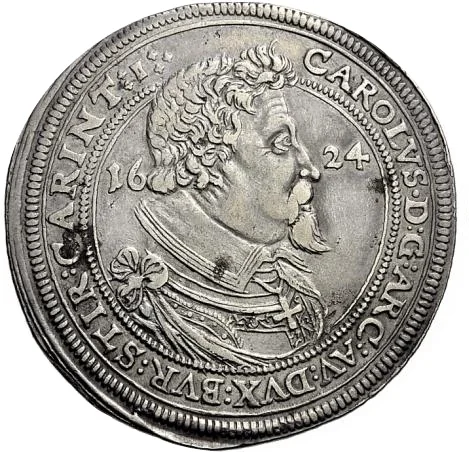
Obverse
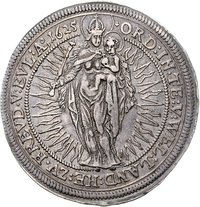
Description:
Bust dividing date in inner circle.
Script: Latin
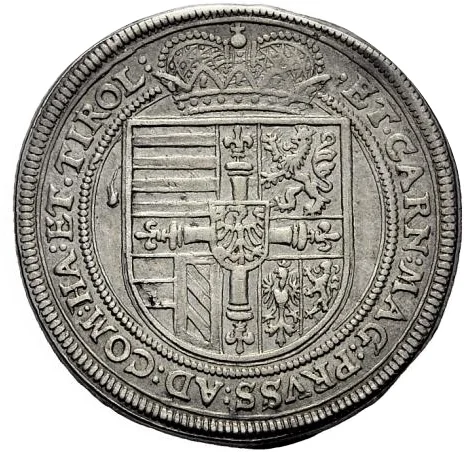
Reverse
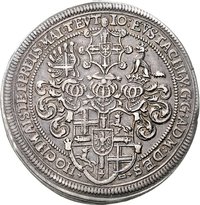
Description:
Crowned coat of arms.
Script: Latin
Edge
Mintings
| Year | Mint Mark | Mintage | Quality | Collection |
|---|---|---|---|---|
| 1624 | — | — |
Historical background
In 1624, the Teutonic Order State, a monastic territory centred in Bad Mergentheim after its secularisation in Prussia (1525), operated within the complex monetary landscape of the Holy Roman Empire. The Order itself did not possess Münzrecht (the right of coinage) as a sovereign minting authority. Instead, its economy relied on a circulation of diverse currencies. The most significant of these was the Reichsthaler, a large silver coin standardised by Imperial ordinances, alongside a plethora of regional coins from neighbouring states like the Archbishopric of Mainz and the Duchy of Württemberg, and countless smaller Kippermünzen (debased coins) from minor lordships.
This period, part of the early Kipper- und Wipperzeit (c. 1618-1623), was marked by severe currency debasement and inflation triggered by the financial demands of the Thirty Years' War. While the peak crisis had slightly abated by 1624, the monetary system remained fragile and chaotic. The Teutonic Order's administration, therefore, had to constantly manage accounting in stable Rechnungsgulden (accounting florins) while handling physical coins of fluctuating silver content, leading to frequent re-issuances of currency exchange rate tables (Münztafeln) for its officials and subjects.
Consequently, the economic background for the Teutonic Order in 1624 was one of cautious stabilisation amidst enduring instability. Its financial operations focused on managing rents from its scattered Kommenden (monastic estates) and ensuring the value of its reserves, all while navigating an Empire-wide monetary system that was only beginning to recover from a period of severe distortion. The Order’s monetary situation was thus not one of sovereign policy, but of pragmatic adaptation to the turbulent coinage currents of the German war economy.
This period, part of the early Kipper- und Wipperzeit (c. 1618-1623), was marked by severe currency debasement and inflation triggered by the financial demands of the Thirty Years' War. While the peak crisis had slightly abated by 1624, the monetary system remained fragile and chaotic. The Teutonic Order's administration, therefore, had to constantly manage accounting in stable Rechnungsgulden (accounting florins) while handling physical coins of fluctuating silver content, leading to frequent re-issuances of currency exchange rate tables (Münztafeln) for its officials and subjects.
Consequently, the economic background for the Teutonic Order in 1624 was one of cautious stabilisation amidst enduring instability. Its financial operations focused on managing rents from its scattered Kommenden (monastic estates) and ensuring the value of its reserves, all while navigating an Empire-wide monetary system that was only beginning to recover from a period of severe distortion. The Order’s monetary situation was thus not one of sovereign policy, but of pragmatic adaptation to the turbulent coinage currents of the German war economy.
✨ Legendary