

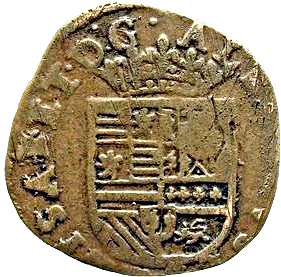
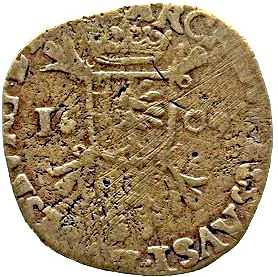
1 Liard – Spanish Netherlands
Netherlands
Context
Years: 1607–1609
Country: Netherlands 
Issuer: Spanish Netherlands
Currency:
(1506—1713)
Demonetized: Yes
Material
Diameter: 26 mm
Weight: 3.82 g
Shape: Irregular round
Composition: Copper
Magnetic: No
Technique: Hammered
Alignment: Coin alignment
flip
References
KM: #Click to copy to clipboard30
Numista: #104905
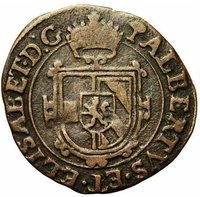
Obverse
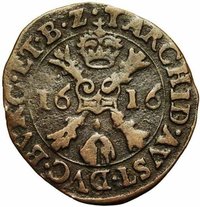
Reverse
Description:
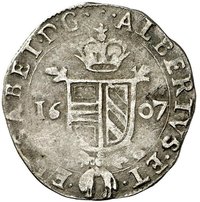
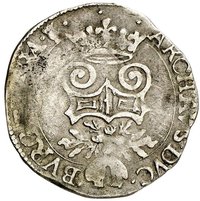
Burgundian cross with s'Hertogenbosch arms at center, flanking date.
Inscription:
ARCHIDVCES AVST DV[CE] BV[RG] ET B
16 09
16 09
Script: Latin
Edge
Categories
| Symbols> Coat of Arms |
Mints
| Name | Mark |
|---|---|
| 's-Hertogenbosch | — |
Mintings
| Year | Mint Mark | Mintage | Quality | Collection |
|---|---|---|---|---|
| 1607 | — | — | ||
| 1608 | — | — | ||
| 1609 | — | — |
Historical background
In 1607, the Spanish Netherlands found itself in a profound monetary crisis, a direct consequence of the ongoing Eighty Years' War (1568–1648). The protracted conflict had drained the royal treasury, leading the Spanish Crown to repeatedly debase the coinage, particularly the heavily used real and patagon. This practice of reducing the precious metal content while maintaining face value created a chaotic "bad money drives out good" scenario, where older, full-weight coins were hoarded or exported, leaving a circulation of unreliable and depreciated currency. This eroded public trust, disrupted commerce, and created price instability, as merchants struggled to ascertain the true value of constantly changing coins.
The situation was exacerbated by the region's economic centrality and the presence of competing currencies. As a major commercial hub, the Spanish Netherlands saw widespread use of foreign coins, such as the Dutch rijksdaalder and German thaler, which often held their value better than the official Spanish issues. This further complicated transactions and highlighted the weakness of the Habsburg monetary authority. Local authorities and the States General of the provinces attempted to respond by issuing ordinances that set official exchange rates (tariffs) for the myriad of coins in circulation, but these measures were largely reactive and failed to address the root cause: the Crown's fiscal desperation.
By 1607, the need for a comprehensive reform was urgent. The Twelve Years' Truce, which began that year, provided a crucial respite from open warfare, creating a political window to address the monetary chaos. This set the stage for the ambitious and sweeping currency reforms that would be enacted the following year, in 1608, under the direction of Archdukes Albert and Isabella. Their plan aimed to recall and remint all debased coinage, introduce new, stable silver denominations like the patagon and half-patagon, and restore confidence in the monetary system—a critical foundation for the region's economic recovery during the truce.
The situation was exacerbated by the region's economic centrality and the presence of competing currencies. As a major commercial hub, the Spanish Netherlands saw widespread use of foreign coins, such as the Dutch rijksdaalder and German thaler, which often held their value better than the official Spanish issues. This further complicated transactions and highlighted the weakness of the Habsburg monetary authority. Local authorities and the States General of the provinces attempted to respond by issuing ordinances that set official exchange rates (tariffs) for the myriad of coins in circulation, but these measures were largely reactive and failed to address the root cause: the Crown's fiscal desperation.
By 1607, the need for a comprehensive reform was urgent. The Twelve Years' Truce, which began that year, provided a crucial respite from open warfare, creating a political window to address the monetary chaos. This set the stage for the ambitious and sweeping currency reforms that would be enacted the following year, in 1608, under the direction of Archdukes Albert and Isabella. Their plan aimed to recall and remint all debased coinage, introduce new, stable silver denominations like the patagon and half-patagon, and restore confidence in the monetary system—a critical foundation for the region's economic recovery during the truce.
💎 Extremely Rare