

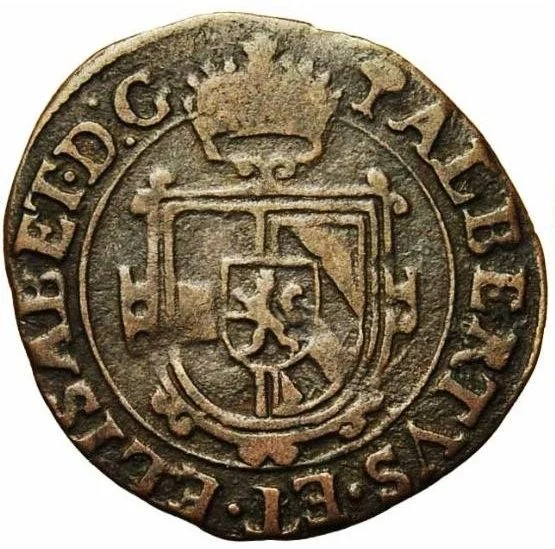
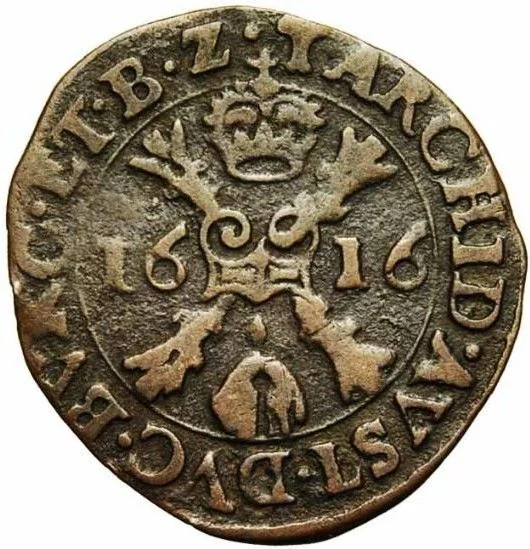
Gigot – Spanish Netherlands
Netherlands
Context
Years: 1608–1619
Country: Netherlands 
Issuer: Spanish Netherlands
Currency:
(1506—1713)
Subdivision: Gigot = ½ Liard
Demonetized: Yes
Material
Diameter: 21 mm
Weight: 1.92 g
Thickness: 0.8 mm
Shape: Irregular round
Composition: Copper
Magnetic: No
Technique: Hammered
Alignment: Coin alignment
flip
References
KM: #Click to copy to clipboard32
Numista: #31704
Obverse
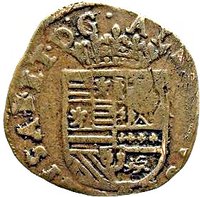
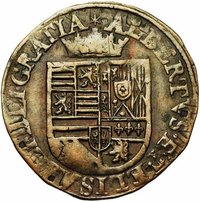
Description:
Austria-Burgundy arms, mintmark (tree) precedes legend.
Inscription:
ALBERTVS · ET · ELISABET · D : G ·
Script: Latin
Reverse
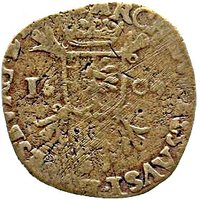
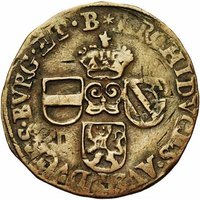
Description:
Burgundian cross with central firesteel divides date. Crown above, Toison d'Or jewels below. Mintmark may lead legend.
Inscription:
ARCHID · AVST · DVC · BVRG · ET · B · Z
Script: Latin
Edge
Mints
| Name | Mark |
|---|---|
| 's-Hertogenbosch | — |
| Antwerp | — |
| Maastricht | — |
| Royal Mint of Belgium | — |
Mintings
| Year | Mint Mark | Mintage | Quality | Collection |
|---|---|---|---|---|
| 1608 | — | — | ||
| 1609 | — | — | ||
| 1615 | — | — | ||
| 1616 | — | — | ||
| 1617 | — | — | ||
| 1618 | — | — | ||
| 1619 | — | — |
Historical background
In 1608, the Spanish Netherlands found itself in a state of acute monetary crisis, a direct consequence of the ongoing Eighty Years' War. The region, a vital but beleaguered part of the Habsburg Empire, was a battleground both militarily and economically. To finance the colossal cost of the conflict, authorities had repeatedly debased the coinage, notably the patagon and the ducatón, by reducing their silver content. This practice, combined with the widespread circulation of worn, clipped, and counterfeit coins, led to a severe loss of public confidence. Gresham's Law operated in full force, as "good" full-weight coins were hoarded or exported, leaving a chaotic mix of "bad" money in daily use, disrupting trade and creating price instability.
The situation was exacerbated by the 1607 Twelve Years' Truce negotiations with the Dutch Republic. While offering a respite from fighting, the truce created economic uncertainty, particularly regarding the future legal valuation of the myriad coins in circulation. Different provinces and cities within the Spanish Netherlands often set their own exchange rates, leading to a fragmented and inefficient monetary landscape. Furthermore, the prosperous Dutch Republic to the north had a strong, stable currency (the guilder), which attracted specie away from the southern provinces, deepening the liquidity crisis and hindering economic recovery during what was meant to be a period of peace.
Consequently, the central authorities in Brussels recognized that monetary reform was imperative for economic survival. This culminated in the landmark decree of October 1608, issued by the Archdukes Albert and Isabella. This ordinance aimed to standardize and stabilize the currency by fixing the value of all circulating coins in terms of a new accounting standard, the florin. It mandated the withdrawal and recoinage of debased pieces, establishing a uniform system across the provinces. Thus, 1608 stands as a pivotal year, marking the painful nadir of the currency chaos and the first concerted, if challenging, step toward imposing much-needed monetary order.
The situation was exacerbated by the 1607 Twelve Years' Truce negotiations with the Dutch Republic. While offering a respite from fighting, the truce created economic uncertainty, particularly regarding the future legal valuation of the myriad coins in circulation. Different provinces and cities within the Spanish Netherlands often set their own exchange rates, leading to a fragmented and inefficient monetary landscape. Furthermore, the prosperous Dutch Republic to the north had a strong, stable currency (the guilder), which attracted specie away from the southern provinces, deepening the liquidity crisis and hindering economic recovery during what was meant to be a period of peace.
Consequently, the central authorities in Brussels recognized that monetary reform was imperative for economic survival. This culminated in the landmark decree of October 1608, issued by the Archdukes Albert and Isabella. This ordinance aimed to standardize and stabilize the currency by fixing the value of all circulating coins in terms of a new accounting standard, the florin. It mandated the withdrawal and recoinage of debased pieces, establishing a uniform system across the provinces. Thus, 1608 stands as a pivotal year, marking the painful nadir of the currency chaos and the first concerted, if challenging, step toward imposing much-needed monetary order.
⭐ Somewhat Rare