

1 Falus – City of Qandahar
Afghanistan
Context
Year: 1776
Islamic (Hijri) Year: 1190
Country: Afghanistan 
Issuer: City of Qandahar
Currency:
(1747—1891)
Demonetization: 1922
Material
Diameter: 23 mm
Weight: 11.6 g
Thickness: 2 mm
Shape: Irregular round
Composition: Copper
Magnetic: No
Technique: Hammered
Alignment: Coin alignment
flip
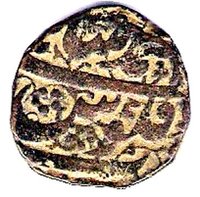
References
KM: #Click to copy to clipboard4
Numista: #10442
Obverse
Description:
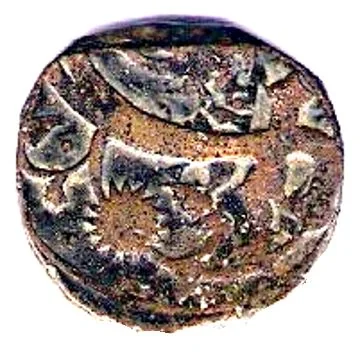
Bird, sword, star.
Reverse
Description:
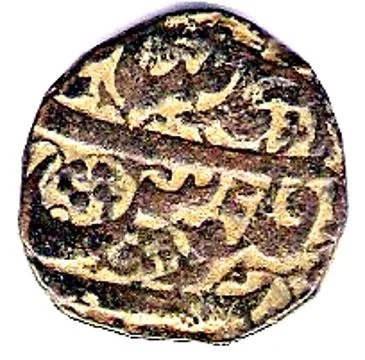
Carved words.
Edge
Mints
| Name | Mark |
|---|---|
| Ahmadshahi | — |
Mintings
| Year | Mint Mark | Mintage | Quality | Collection |
|---|---|---|---|---|
| 1776 | — | — |
Historical background
In 1776, the city of Qandahar was a strategic and economic hub caught between three competing empires: the Durrani Empire of Afghanistan, the Zand dynasty of Persia, and the rising Sikh Confederacy in the Punjab. As such, its currency situation was complex and fragmented, reflecting its contested political landscape. The primary circulating currency was the Durrani rupee, minted in silver under the authority of the Afghan ruler, Timur Shah Durrani, who had moved the empire's capital to Kabul in 1772. These coins, often bearing Timur Shah's name and mint marks from cities like Kabul and Lahore, were the standard for larger trade and state revenue.
However, the monetary environment was far from uniform. Older Persian gold mohurs and silver rupees from the Safavid and Afsharid eras still circulated from earlier periods of Persian dominance, alongside a steady influx of contemporary Zand coins from Shiraz. Furthermore, trade caravans passing through the city brought Indian rupees from Mughal and emerging regional mints, as well as Bukharan tenga from Central Asia. This resulted in a bazaar where merchants and money-changers (sarraf) were essential, constantly assessing the weight, purity, and exchange rates of a bewildering variety of coins.
This monetary pluralism was both a symptom and a cause of Qandahar's precarious autonomy. While the city nominally paid tribute to the Durrani throne, local khans and tribal leaders often exercised direct control, sometimes even striking their own crude local coinage or counterstamping existing coins to validate them for local use. The lack of a single, authoritative currency created opportunities for arbitrage but also instability, as the value of money could shift with the political winds, military campaigns, and the arrival of trade caravans, making Qandahar's economy vibrant yet inherently volatile in the late 18th century.
However, the monetary environment was far from uniform. Older Persian gold mohurs and silver rupees from the Safavid and Afsharid eras still circulated from earlier periods of Persian dominance, alongside a steady influx of contemporary Zand coins from Shiraz. Furthermore, trade caravans passing through the city brought Indian rupees from Mughal and emerging regional mints, as well as Bukharan tenga from Central Asia. This resulted in a bazaar where merchants and money-changers (sarraf) were essential, constantly assessing the weight, purity, and exchange rates of a bewildering variety of coins.
This monetary pluralism was both a symptom and a cause of Qandahar's precarious autonomy. While the city nominally paid tribute to the Durrani throne, local khans and tribal leaders often exercised direct control, sometimes even striking their own crude local coinage or counterstamping existing coins to validate them for local use. The lack of a single, authoritative currency created opportunities for arbitrage but also instability, as the value of money could shift with the political winds, military campaigns, and the arrival of trade caravans, making Qandahar's economy vibrant yet inherently volatile in the late 18th century.

💎 Extremely Rare