

1 Falus – City of Qandahar
Afghanistan
Context
Year: 1790
Islamic (Hijri) Year: 1205
Country: Afghanistan 
Issuer: City of Qandahar
Currency:
(1747—1891)
Demonetized: Yes
References
KM: #Click to copy to clipboard8
Numista: #154150
Obverse
Description:
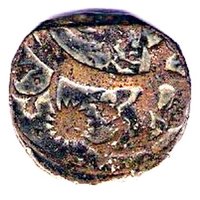
Sword surrounded by dots.
Reverse
Description:
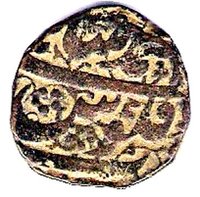
Arabic inscription.
Edge
Mintings
| Year | Mint Mark | Mintage | Quality | Collection |
|---|---|---|---|---|
| 1790 | — | — |
Historical background
In 1790, Qandahar was a contested and strategically vital city, caught between the declining Durrani Empire and rising regional powers. Following the death of Ahmad Shah Durrani in 1772, the empire fragmented, and Qandahar became a prize fought over by his descendants, particularly Timur Shah in Kabul and his rebellious brothers. This political instability directly undermined the unified monetary system that had once facilitated trade across the empire. The authority to mint coins, a key symbol of sovereignty, was disputed, leading to irregular and inconsistent currency production in the city's mint.
The primary circulating currency was the Durrani silver rupee and its fractional coins, but their purity and weight could vary depending on who controlled the city at any given moment. Older, trusted coins from the height of Ahmad Shah's reign remained in circulation alongside newer, potentially debased issues. Furthermore, the city's role as a major node on the trade routes between India, Persia, and Central Asia meant that a multitude of foreign currencies also circulated. Persian tomans, Bukharan tillas, and Indian rupees of various origins were all used in commerce, requiring money-changers (sarrafs) to constantly assess the metallic content and legitimacy of each coin.
This complex monetary environment created a climate of uncertainty for merchants and residents alike. Trust in the face value of any given coin was low, and transactions often required careful negotiation and weighing. The lack of a stable, authoritative currency reflected the broader political chaos, hindering long-distance trade and local economic stability. Ultimately, the currency situation in 1790 Qandahar was a microcosm of the city's plight: a once-great commercial hub struggling to maintain order amid the fracturing of the empire that had given it coherence.
The primary circulating currency was the Durrani silver rupee and its fractional coins, but their purity and weight could vary depending on who controlled the city at any given moment. Older, trusted coins from the height of Ahmad Shah's reign remained in circulation alongside newer, potentially debased issues. Furthermore, the city's role as a major node on the trade routes between India, Persia, and Central Asia meant that a multitude of foreign currencies also circulated. Persian tomans, Bukharan tillas, and Indian rupees of various origins were all used in commerce, requiring money-changers (sarrafs) to constantly assess the metallic content and legitimacy of each coin.
This complex monetary environment created a climate of uncertainty for merchants and residents alike. Trust in the face value of any given coin was low, and transactions often required careful negotiation and weighing. The lack of a stable, authoritative currency reflected the broader political chaos, hindering long-distance trade and local economic stability. Ultimately, the currency situation in 1790 Qandahar was a microcosm of the city's plight: a once-great commercial hub struggling to maintain order amid the fracturing of the empire that had given it coherence.

✨ Legendary