

1⁄12 Thaler – Swedish dominion of Pomerania
Sweden
Context
Years: 1693–1697
Country: Sweden 
Issuer: Swedish dominion of Pomerania
Ruler: Charles XI
Currency:
(1630—1815)
Demonetized: Yes
References
KM: #Click to copy to clipboard343
Numista: #136756
Obverse
Description:
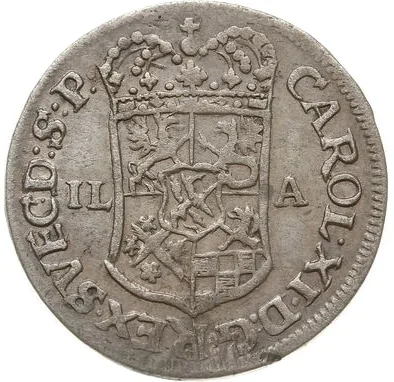
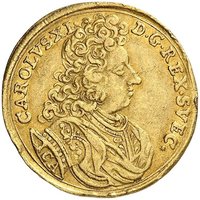
Shield with crown divides initials.
Inscription:
CAROL . XI . D. G. REX . SVECD S. P.
ILA
ILA
Script: Latin
Reverse
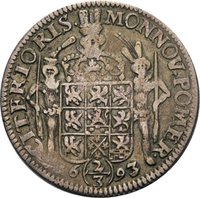
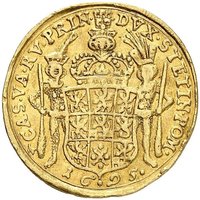
Description:
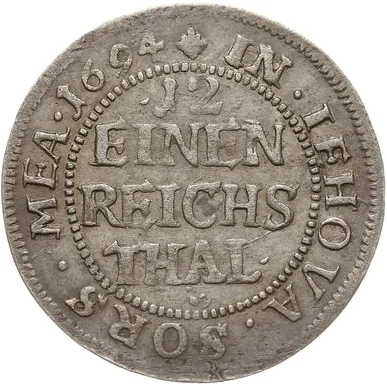
Central inscription in four lines, surrounded by legend ending with date.
Inscription:
IN IEHOVA SOERS MEA 1694
12
EINEN
REICHS
THAL
12
EINEN
REICHS
THAL
Script: Latin
Edge
Mintings
| Year | Mint Mark | Mintage | Quality | Collection |
|---|---|---|---|---|
| 1693 | ILA | — | ||
| 1694 | ILA | — | ||
| 1695 | ICA | — | ||
| 1695 | ILA | — | ||
| 1696 | ICA | — | ||
| 1697 | ICA | — |
Historical background
In 1693, the currency situation in Swedish Pomerania was complex and strained, reflecting both local economic pressures and the broader monetary policies of the Swedish Empire. The province, a remnant of Sweden's gains in the Thirty Years' War, operated within a diverse currency landscape where multiple coinage systems overlapped. Officially, the Swedish monetary system based on silver dalers and öre was in force, but in practice, the region's deep economic ties to the German hinterland meant that various German Reichsthalers, guilders, and a plethora of smaller local coins circulated widely, leading to constant exchange difficulties and confusion.
The primary challenge was severe coinage debasement and inflation. To finance its ongoing involvement in the Great Northern War (1700-1721), Sweden had already begun to reduce the silver content in its coinage, a policy that extended to its Pomeranian territories. This resulted in an influx of inferior Swedish copper and billon coins, while full-value silver coins were hoarded or exported. Consequently, prices rose sharply, and public trust in the currency eroded. The local estates frequently petitioned the Swedish governor in Stralsund, complaining about the economic hardship caused by the "bad money" and the scarcity of sound coin for everyday trade.
Ultimately, the monetary chaos of 1693 was a symptom of Swedish Pomerania's precarious position: it was a Swedish dominion integrated into the German economic sphere, subjected to the imperial fiscal demands of a warring Swedish state. While authorities attempted to regulate exchange rates and curb the influx of foreign coins, their efforts were largely ineffective against market forces. The situation would not stabilize until after the war, underscoring how the province's currency was a focal point of tension between local stability and the imperial ambitions of its Swedish rulers.
The primary challenge was severe coinage debasement and inflation. To finance its ongoing involvement in the Great Northern War (1700-1721), Sweden had already begun to reduce the silver content in its coinage, a policy that extended to its Pomeranian territories. This resulted in an influx of inferior Swedish copper and billon coins, while full-value silver coins were hoarded or exported. Consequently, prices rose sharply, and public trust in the currency eroded. The local estates frequently petitioned the Swedish governor in Stralsund, complaining about the economic hardship caused by the "bad money" and the scarcity of sound coin for everyday trade.
Ultimately, the monetary chaos of 1693 was a symptom of Swedish Pomerania's precarious position: it was a Swedish dominion integrated into the German economic sphere, subjected to the imperial fiscal demands of a warring Swedish state. While authorities attempted to regulate exchange rates and curb the influx of foreign coins, their efforts were largely ineffective against market forces. The situation would not stabilize until after the war, underscoring how the province's currency was a focal point of tension between local stability and the imperial ambitions of its Swedish rulers.
✨ Legendary