

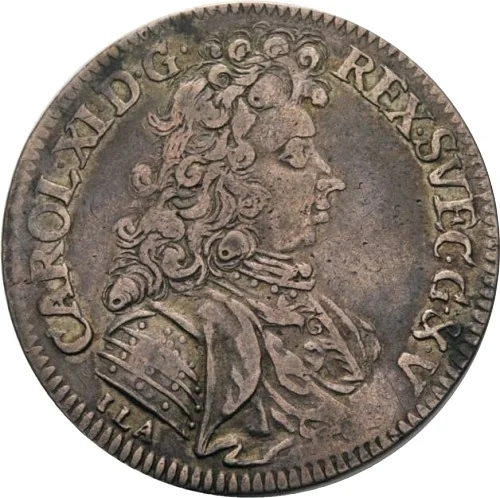
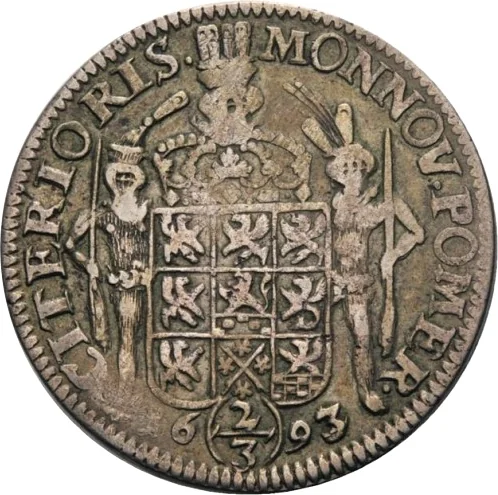
⅔ Thaler – Swedish dominion of Pomerania
Sweden
Context
Years: 1692–1697
Country: Sweden 
Issuer: Swedish dominion of Pomerania
Ruler: Charles XI
Currency:
(1630—1815)
Demonetized: Yes
References
KM: #Click to copy to clipboard341
Numista: #136755
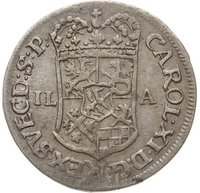
Obverse
Description:
Right-facing bust.
Script: Latin
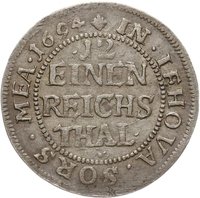
Reverse
Description:
Arms with crowned helm and flanking supporters.
Script: Latin
Edge
Mintings
| Year | Mint Mark | Mintage | Quality | Collection |
|---|---|---|---|---|
| 1692 | ILA | — | ||
| 1693 | ILA | — | ||
| 1694 | ILA | — | ||
| 1695 | ICA | — | ||
| 1695 | ILA | — | ||
| 1696 | ICA | — | ||
| 1697 | ICA | — |
Historical background
In 1692, the currency situation in Swedish Pomerania was complex and strained, reflecting the broader economic challenges of maintaining a distant dominion. The territory operated within a fragmented monetary system, where multiple coinages circulated simultaneously. Alongside official Swedish riksdalers and öre, a plethora of German Reichsthalers, local Pomeranian shillings (Schillinge), and even Polish and Dutch coins were used in daily trade. This created constant difficulties in exchange rates and valuation, hampering commerce and state revenue collection.
The root of this instability lay in Sweden's persistent efforts to align the province's finances with the Swedish monetary standard, a policy often at odds with local tradition and the region's economic ties to the German hinterland. Debasement of coinage was a recurring issue, as both the Swedish crown and local authorities sometimes reduced silver content to generate short-term funds, especially to cover the costs of garrisoning the strategically vital port of Stralsund. This eroded public trust and provoked price inflation, burdening the local population.
Ultimately, the monetary chaos of 1692 was symptomatic of Swedish Pomerania's precarious position—a Swedish outpost economically integrated into the Holy Roman Empire. While Stockholm sought control and fiscal extraction, the practical needs of the local economy required flexibility. This tension would remain unresolved, with repeated but ineffective ordinances attempting to fix exchange rates, leaving merchants and officials to navigate a confusing and unstable monetary landscape throughout the period.
The root of this instability lay in Sweden's persistent efforts to align the province's finances with the Swedish monetary standard, a policy often at odds with local tradition and the region's economic ties to the German hinterland. Debasement of coinage was a recurring issue, as both the Swedish crown and local authorities sometimes reduced silver content to generate short-term funds, especially to cover the costs of garrisoning the strategically vital port of Stralsund. This eroded public trust and provoked price inflation, burdening the local population.
Ultimately, the monetary chaos of 1692 was symptomatic of Swedish Pomerania's precarious position—a Swedish outpost economically integrated into the Holy Roman Empire. While Stockholm sought control and fiscal extraction, the practical needs of the local economy required flexibility. This tension would remain unresolved, with repeated but ineffective ordinances attempting to fix exchange rates, leaving merchants and officials to navigate a confusing and unstable monetary landscape throughout the period.
✨ Legendary