

1 Ducat – Swedish dominion of Pomerania
Sweden
Context
Years: 1691–1694
Country: Sweden 
Issuer: Swedish dominion of Pomerania
Ruler: Charles XI
Currency:
(1630—1815)
Demonetized: Yes
References
KM: #Click to copy to clipboard340.1
Numista: #420112
Value
Bullion value: $575.40
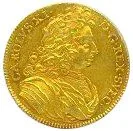
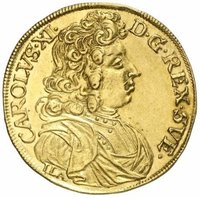
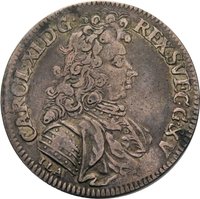
Obverse
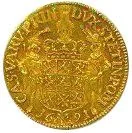
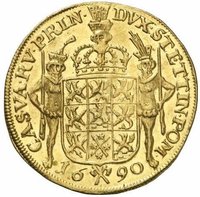
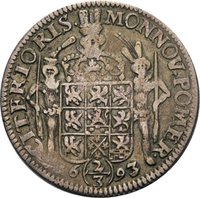
Reverse
Description:
Crowned arms supported.
Inscription:
DVX STETIN POM CAS VA RV PRIN
16 91
ILA
16 91
ILA
Script: Latin
Edge
Mints
| Name | Mark |
|---|---|
| Szczecin | — |
Mintings
| Year | Mint Mark | Mintage | Quality | Collection |
|---|---|---|---|---|
| 1691 | — | — | ||
| 1693 | — | — | ||
| 1694 | — | — |
Historical background
In 1691, the currency situation in Swedish Pomerania was complex and strained, reflecting the broader economic challenges of maintaining a distant dominion. The territory operated within a multi-currency system, where the official Swedish monetary units—like the silver riksdaler—coexisted with a plethora of circulating regional and foreign coins. These included Lübeck marks, local pfennigs, and various German thaler issues, leading to chronic confusion and frequent disputes over exchange rates and intrinsic metal values. This fragmentation hindered trade and state revenue collection, as the Swedish administration struggled to impose its monetary authority.
The primary pressure stemmed from Sweden's relentless need to finance its military commitments in the ongoing Nine Years' War (1688-1697). Stockholm routinely extracted resources from Pomerania, often demanding payments in specie, which drained the duchy of sound coinage. This, combined with the common practice of debasement (reducing the precious metal content in coins), led to inflationary tendencies and a loss of public trust in the currency. The local economy suffered as good coins were hoarded or exported, leaving inferior money in daily circulation.
Consequently, the Swedish authorities in Stettin were perennially engaged in damage control, issuing ordinances to regulate exchange rates and combat counterfeit coins. However, these measures were largely reactive and ineffective on a fundamental level. The currency chaos of 1691 thus epitomized the wider struggle of Swedish imperial control: a lucrative province was being economically exhausted to serve distant crown interests, undermining its own stability and creating a persistent tension between local economic needs and the fiscal demands of a wartime empire.
The primary pressure stemmed from Sweden's relentless need to finance its military commitments in the ongoing Nine Years' War (1688-1697). Stockholm routinely extracted resources from Pomerania, often demanding payments in specie, which drained the duchy of sound coinage. This, combined with the common practice of debasement (reducing the precious metal content in coins), led to inflationary tendencies and a loss of public trust in the currency. The local economy suffered as good coins were hoarded or exported, leaving inferior money in daily circulation.
Consequently, the Swedish authorities in Stettin were perennially engaged in damage control, issuing ordinances to regulate exchange rates and combat counterfeit coins. However, these measures were largely reactive and ineffective on a fundamental level. The currency chaos of 1691 thus epitomized the wider struggle of Swedish imperial control: a lucrative province was being economically exhausted to serve distant crown interests, undermining its own stability and creating a persistent tension between local economic needs and the fiscal demands of a wartime empire.
✨ Legendary