

2 ducats – Swedish dominion of Pomerania
Add to wishlist
Sweden
Context
Year: 1658
Country: Sweden
Issuer: Swedish dominion of Pomerania
Ruler: Charles X Gustav
Currency:
(1630—1815)
Demonetized: Yes
References
KM: #
Numista: #136448
Value
Bullion value: $1046.40
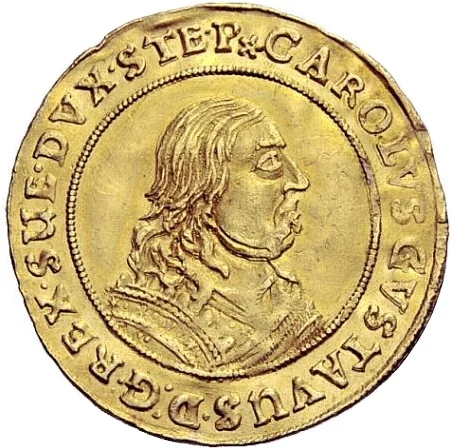
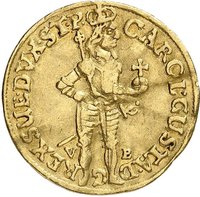
Obverse
Description:
Right-facing bust.
Inscription:
* CAROLVS GVSTAVUS • D : G • REX • SUE • DVX • STE • P.
Script: Latin
Engraver: Ulrich Butkau
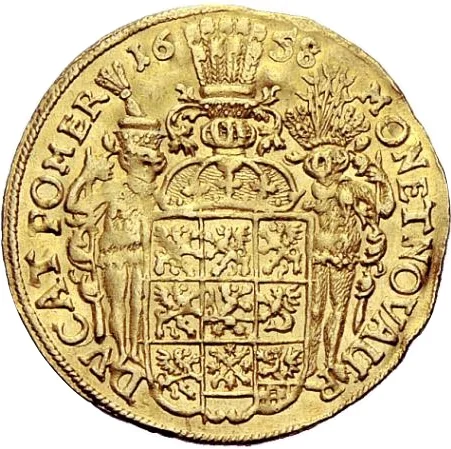
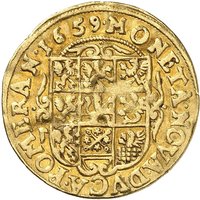
Reverse
Description:
Crowned helm with two helmeted supporters.
Inscription:
MONET NOV AU - R - DVCAT POMER - 16 - 58.
Script: Latin
Engraver: Ulrich Butkau
Edge
Mints
| Name | Mark |
|---|---|
| Szczecin | — |
Mintings
| Year | Mint Mark | Mintage | Quality | Collection |
|---|---|---|---|---|
| 1658 | — | — |
Historical background
During the Swedish dominion of Pomerania in 1658, the currency situation was chaotic and inflationary, a direct consequence of the broader financial and military pressures of the Second Northern War (1655-1660). Sweden, as a warring great power, was extracting maximum resources from its occupied territories. In Pomerania, this meant not only heavy war contributions and requisitions but also the deliberate issuance of vast quantities of debased coinage. The Swedish authorities, particularly under the governance of Charles X Gustav, systematically reduced the silver content in coins minted in Pomeranian mints like Stralsund to generate seigniorage profit, flooding the local economy with "light" or "bad" money.
This deliberate debasement created a classic situation of Gresham's Law, where "bad money drives out good." The new, inferior Swedish-Pomeranian schillings and drachms circulated widely, while older, full-value coins were hoarded or melted down. The resulting inflation severely disrupted local trade and markets, as merchants faced uncertainty about the real value of the currency. The problem was compounded by the simultaneous circulation of various other coins, including Swedish riksdalers, local German issues, and coins from neighbouring states, creating a complex and untrustworthy monetary environment for the Pomeranian population.
Ultimately, the currency policy in 1658 was not designed for the economic health of Pomerania but was a fiscal instrument of Swedish wartime strategy. The revenue from coinage debasement helped fund the ongoing campaigns against Poland and Denmark. This exploitation left the Pomeranian economy in a distressed state, burdened by both the physical devastation of war and a destabilized monetary system, a clear reflection of the territory's role as a financial resource for Swedish imperial ambitions rather than an integrated province.
This deliberate debasement created a classic situation of Gresham's Law, where "bad money drives out good." The new, inferior Swedish-Pomeranian schillings and drachms circulated widely, while older, full-value coins were hoarded or melted down. The resulting inflation severely disrupted local trade and markets, as merchants faced uncertainty about the real value of the currency. The problem was compounded by the simultaneous circulation of various other coins, including Swedish riksdalers, local German issues, and coins from neighbouring states, creating a complex and untrustworthy monetary environment for the Pomeranian population.
Ultimately, the currency policy in 1658 was not designed for the economic health of Pomerania but was a fiscal instrument of Swedish wartime strategy. The revenue from coinage debasement helped fund the ongoing campaigns against Poland and Denmark. This exploitation left the Pomeranian economy in a distressed state, burdened by both the physical devastation of war and a destabilized monetary system, a clear reflection of the territory's role as a financial resource for Swedish imperial ambitions rather than an integrated province.
✨ Legendary