

1 Ducat – Swedish dominion of Pomerania
Sweden
Context
Years: 1646–1654
Country: Sweden 
Issuer: Swedish dominion of Pomerania
Ruler: Christina
Currency:
(1630—1815)
Demonetized: Yes
References
KM: #Click to copy to clipboard199.2
Numista: #136446
Value
Bullion value: $568.81
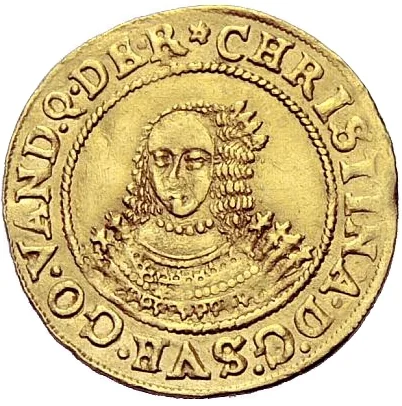
Obverse
Description:
Left-facing bust.
Inscription:
CHRISTINA. D. G. SVE. CO. VAND. Q. DE. R.
Script: Latin
Engraver: Ulrich Butkau
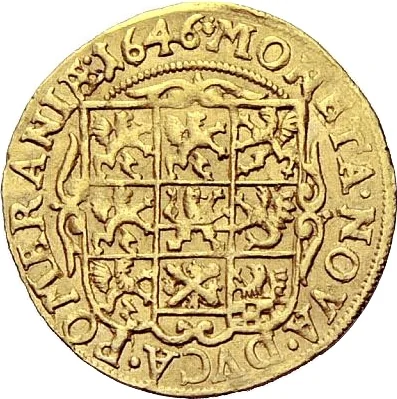
Reverse
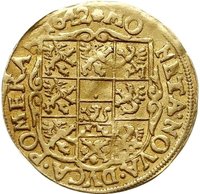
Description:
Expansive manifold arms.
Inscription:
MONETA. NOVA. DVCA. POMERANIAE. 1646
Script: Latin
Engraver: Ulrich Butkau
Edge
Mints
| Name | Mark |
|---|---|
| Szczecin | — |
Mintings
| Year | Mint Mark | Mintage | Quality | Collection |
|---|---|---|---|---|
| 1646 | — | — | ||
| 1653 | — | — | ||
| 1654 | — | — |
Historical background
In 1646, the Swedish dominion of Pomerania was caught in the complex and debilitating monetary aftermath of the Thirty Years' War. The region had been a major battleground for decades, leading to severe economic dislocation, population decline, and a fractured currency system. The official currency was the Reichsthaler, part of the Holy Roman Empire's monetary framework, but the reality in circulation was a chaotic mix of debased local coinages, low-quality Kipper und Wipper period coins from earlier in the war, and various foreign currencies brought by occupying armies. This proliferation of coins of varying intrinsic value crippled trade and created widespread uncertainty.
Swedish administration, formalized with the acquisition of Western Pomerania in the 1648 Peace of Westphalia but already being established in 1646, faced the urgent task of imposing monetary order. The primary goal was to assert control over minting rights (Münzregal) and standardize the currency to facilitate tax collection and stabilize the local economy, which was vital for supplying the Swedish war effort. However, this was a gradual process, and in 1646 the situation remained transitional, with Swedish authorities likely attempting to curb the worst abuses of debasement while their own monetary policies were still being formulated.
Consequently, the currency situation was characterized by a tense duality: the theoretical authority of the Reichsthaler system versus the practical circulation of heterogeneous and often suspect coinage. The Swedish crown sought to replace this chaos with a reliable, centrally administered currency, but the immediate reality for Pomeranians in 1646 was one of instability, where the value of money was uncertain and economic recovery was hampered by the very medium of exchange.
Swedish administration, formalized with the acquisition of Western Pomerania in the 1648 Peace of Westphalia but already being established in 1646, faced the urgent task of imposing monetary order. The primary goal was to assert control over minting rights (Münzregal) and standardize the currency to facilitate tax collection and stabilize the local economy, which was vital for supplying the Swedish war effort. However, this was a gradual process, and in 1646 the situation remained transitional, with Swedish authorities likely attempting to curb the worst abuses of debasement while their own monetary policies were still being formulated.
Consequently, the currency situation was characterized by a tense duality: the theoretical authority of the Reichsthaler system versus the practical circulation of heterogeneous and often suspect coinage. The Swedish crown sought to replace this chaos with a reliable, centrally administered currency, but the immediate reality for Pomeranians in 1646 was one of instability, where the value of money was uncertain and economic recovery was hampered by the very medium of exchange.
✨ Legendary