

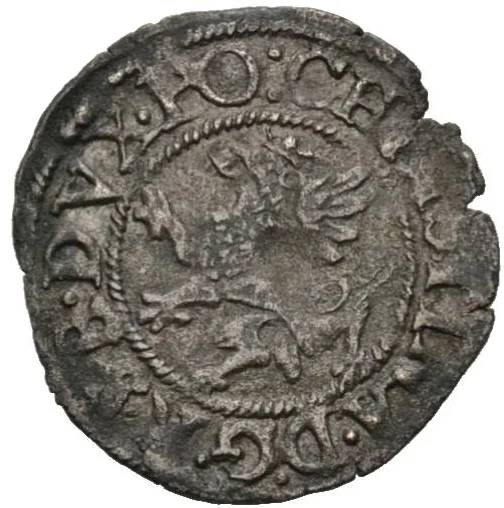
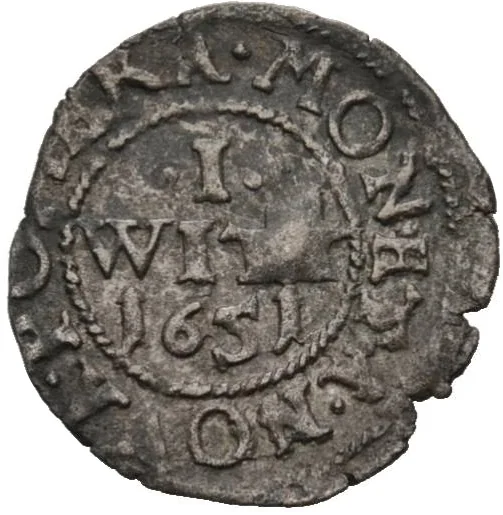
1 Witten – Swedish dominion of Pomerania
Sweden
Context
Years: 1650–1654
Country: Sweden 
Issuer: Swedish dominion of Pomerania
Ruler: Christina
Currency:
(1630—1815)
Demonetized: Yes
References
KM: #Click to copy to clipboard207
Numista: #136455
Value
Bullion value: $1.54
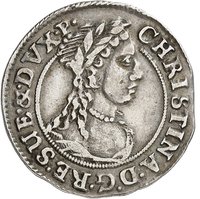
Obverse
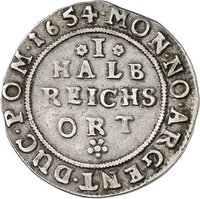
Reverse
Edge
Mintings
| Year | Mint Mark | Mintage | Quality | Collection |
|---|---|---|---|---|
| 1650 | — | — | ||
| 1651 | — | — | ||
| 1654 | — | — |
Historical background
During the mid-17th century, the Swedish dominion of Pomerania found itself in a complex and challenging monetary situation, deeply influenced by the aftermath of the Thirty Years' War. Sweden, having acquired Western Pomerania (Vorpommern) in the 1648 Peace of Westphalia, inherited a territory with a severely debased and chaotic currency system. The long war had flooded the region with a multitude of low-quality coins from various German states, while the local minting authority, the Pomeranian Kreisstände, struggled to maintain standards. This resulted in a chronic shortage of reliable, high-value specie for state and trade purposes, coexisting with an abundance of depreciated small change that crippled everyday commerce.
Swedish authorities attempted to impose order by introducing the Swedish monetary system, promoting the use of Swedish riksdaler and öre alongside the existing local currencies. However, this created a bimetallic system fraught with difficulties. Official exchange rates between Swedish coins, local Pomeranian coins, and the ubiquitous Reichsthaler were frequently set by decree but failed to reflect market realities, leading to widespread confusion, arbitrage, and Gresham's Law in action ("bad money drives out good"). The Swedish crown also sought to control and profit from the minting rights, but their efforts were often undermined by the continued circulation of debased coins from neighboring states and the logistical challenges of integrating a new monetary regime.
Consequently, the currency situation in 1650 was one of fragmented instability, acting as a significant brake on economic recovery. Trade, both within the dominion and with Sweden proper, was hampered by exchange uncertainties and a lack of trusted currency. This monetary disarray reflected the broader administrative challenges Sweden faced in governing its German possessions, caught between imposing central control and accommodating local estates and economic traditions. The situation would persist for decades, requiring repeated but only partially successful monetary ordinances from Stockholm.
Swedish authorities attempted to impose order by introducing the Swedish monetary system, promoting the use of Swedish riksdaler and öre alongside the existing local currencies. However, this created a bimetallic system fraught with difficulties. Official exchange rates between Swedish coins, local Pomeranian coins, and the ubiquitous Reichsthaler were frequently set by decree but failed to reflect market realities, leading to widespread confusion, arbitrage, and Gresham's Law in action ("bad money drives out good"). The Swedish crown also sought to control and profit from the minting rights, but their efforts were often undermined by the continued circulation of debased coins from neighboring states and the logistical challenges of integrating a new monetary regime.
Consequently, the currency situation in 1650 was one of fragmented instability, acting as a significant brake on economic recovery. Trade, both within the dominion and with Sweden proper, was hampered by exchange uncertainties and a lack of trusted currency. This monetary disarray reflected the broader administrative challenges Sweden faced in governing its German possessions, caught between imposing central control and accommodating local estates and economic traditions. The situation would persist for decades, requiring repeated but only partially successful monetary ordinances from Stockholm.
✨ Legendary