

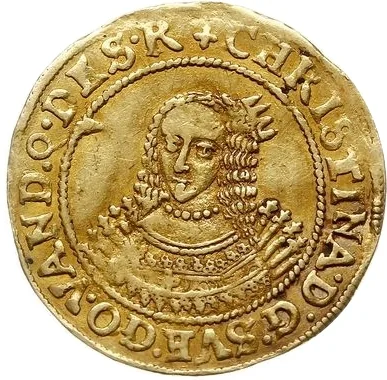
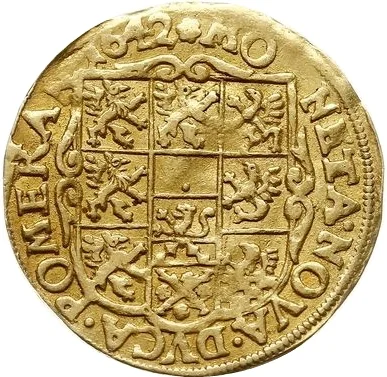
1 Ducat – Swedish dominion of Pomerania
Sweden
Context
Years: 1642–1653
Country: Sweden 
Issuer: Swedish dominion of Pomerania
Ruler: Christina
Currency:
(1630—1815)
Demonetized: Yes
References
KM: #Click to copy to clipboard199.1
Numista: #136445
Value
Bullion value: $566.48
Obverse
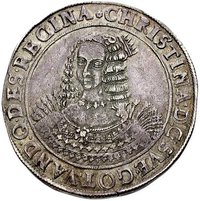
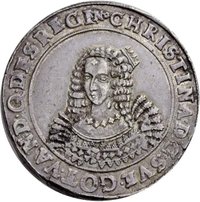
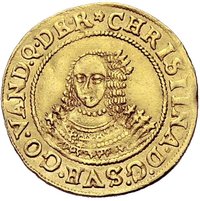
Description:
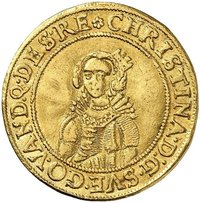
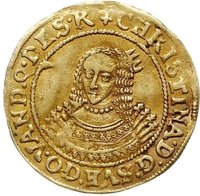
Left-facing bust.
Script: Latin
Reverse
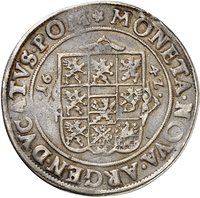
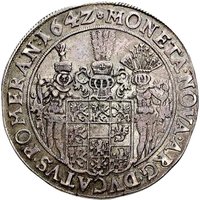
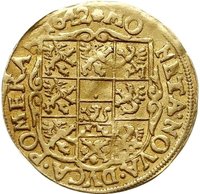
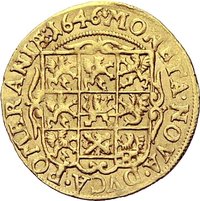
Description:
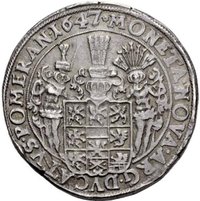
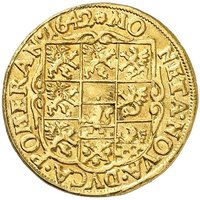
Expansive manifold arms.
Script: Latin
Edge
Mints
| Name | Mark |
|---|---|
| Szczecin | — |
Mintings
| Year | Mint Mark | Mintage | Quality | Collection |
|---|---|---|---|---|
| 1642 | — | — | ||
| 1653 | — | — |
Historical background
In 1642, the currency situation in Swedish Pomerania was complex and strained, a direct consequence of its position within the Thirty Years' War. The territory, under Swedish control since the 1630s, was not only a battlefield but also a critical financial base for the Swedish war effort. To fund its massive military expenditures, Sweden heavily exploited its German holdings, leading to severe currency manipulation. The Swedish government frequently decreed reductions in the nominal value of the circulating coins (Kipper- und Wipperzeit policies), while also demanding taxes and contributions be paid in higher-quality specie. This created a multi-tiered system where the intrinsic value of coins diverged sharply from their forced legal tender value, causing economic confusion and hardship for the local population.
The monetary landscape was a chaotic mix of various coins. Alongside Swedish issues, there circulated Imperial talers, local Pomeranian coins, and a plethora of debased currency from neighbouring German states affected by the war. The Swedish authorities, particularly under Governor-General Johan Banér, struggled to impose order but were often compelled to prioritize military financing over monetary stability. Debasement and frequent re-coinage were common tools to extract seigniorage revenue, effectively taxing the populace through inflation. This practice eroded trust in the currency, encouraging hoarding of good coins and further destabilizing everyday commerce.
Ultimately, the currency crisis of 1642 was a microcosm of wartime economics. The primary function of money in Swedish Pomerania had shifted from facilitating trade to funding an army, leading to inflationary pressures and a fragmented monetary system. While attempts were made to regulate exchange rates and curb the worst abuses, true stability would remain elusive until the conclusion of the wider conflict, leaving the local economy to function amidst a climate of financial uncertainty and depreciation.
The monetary landscape was a chaotic mix of various coins. Alongside Swedish issues, there circulated Imperial talers, local Pomeranian coins, and a plethora of debased currency from neighbouring German states affected by the war. The Swedish authorities, particularly under Governor-General Johan Banér, struggled to impose order but were often compelled to prioritize military financing over monetary stability. Debasement and frequent re-coinage were common tools to extract seigniorage revenue, effectively taxing the populace through inflation. This practice eroded trust in the currency, encouraging hoarding of good coins and further destabilizing everyday commerce.
Ultimately, the currency crisis of 1642 was a microcosm of wartime economics. The primary function of money in Swedish Pomerania had shifted from facilitating trade to funding an army, leading to inflationary pressures and a fragmented monetary system. While attempts were made to regulate exchange rates and curb the worst abuses, true stability would remain elusive until the conclusion of the wider conflict, leaving the local economy to function amidst a climate of financial uncertainty and depreciation.
✨ Legendary