

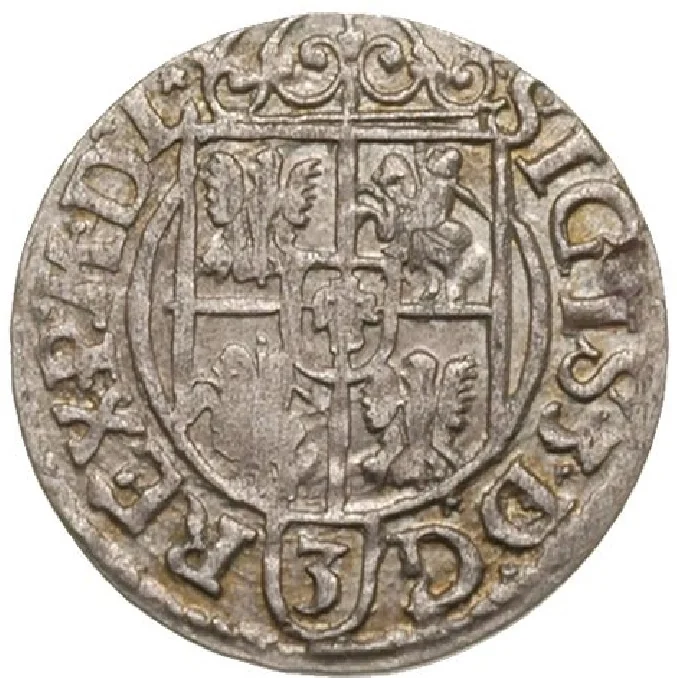
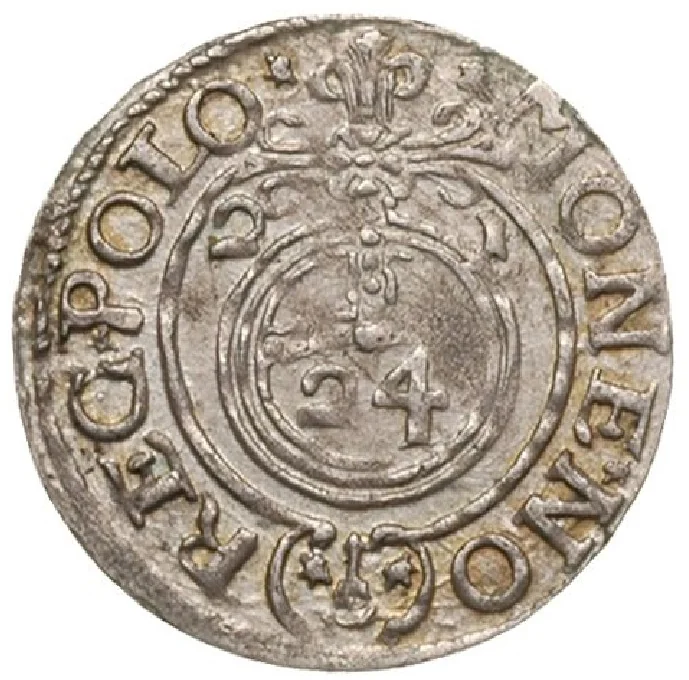
1½ Groschen – Polish–Lithuanian Commonwealth
Poland
Context
Year: 1621
Country: Poland 
Issuer: Polish–Lithuanian Commonwealth
Ruler: Sigismund III Vasa
Currency:
(1573—1795)
Demonetized: Yes
Material
References
KM: #Click to copy to clipboard41
Numista: #136364
Value
Bullion value: $1.78
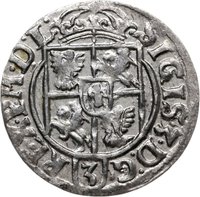
Obverse
Inscription:
SIGIS 3 D G (3) REX P M D L
Script: Latin
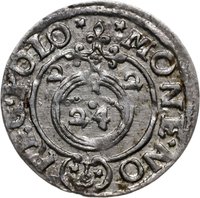
Reverse
Inscription:
MONE NO (*↑*) REG POLO
Script: Latin
Edge
Plain
Mints
| Name | Mark |
|---|---|
| Bydgoszcz | — |
Mintings
| Year | Mint Mark | Mintage | Quality | Collection |
|---|---|---|---|---|
| 1621 | — | — |
Historical background
By 1621, the currency system of the Polish–Lithuanian Commonwealth was in a state of severe crisis, primarily driven by the deliberate debasement of coinage. The monarchy, perpetually short of funds for its ambitious military campaigns and political patronage, had resorted to reducing the silver content in coins minted in the crown mints. This practice, while providing immediate revenue, flooded the economy with inferior currency, leading to rampant inflation and a classic manifestation of Gresham's Law, where "bad money drives out good." High-quality foreign coins, like the thaler, were hoarded or used for foreign trade, while the debased domestic grosz and szeląg circulated at artificially maintained face values, eroding public trust.
The situation was exacerbated by the immense costs of simultaneous warfare. The year 1621 itself saw the Commonwealth engaged in a desperate and costly defense against the Ottoman Empire at the Battle of Khotyn, which required extraordinary taxation and further monetary manipulation to finance. This fiscal pressure came on the heels of prolonged conflicts with Sweden and Russia. The Sejm (parliament), dominated by the nobility who resisted land tax increases, often acquiesced to the crown's debasement schemes as a preferable alternative to deeper reforms, thereby institutionalizing the monetary disorder.
Consequently, the economy suffered from price instability, difficulties in long-term contracting, and a distortion of trade. The value of money effectively became separated from its intrinsic metal worth, creating a complex and unreliable system of exchange. This monetary chaos contributed to broader economic stagnation in the following decades, weakening the Commonwealth's fiscal foundations at a time when its powerful neighbors were centralizing authority and strengthening their state treasuries, highlighting a critical structural flaw in the noble-dominated republic.
The situation was exacerbated by the immense costs of simultaneous warfare. The year 1621 itself saw the Commonwealth engaged in a desperate and costly defense against the Ottoman Empire at the Battle of Khotyn, which required extraordinary taxation and further monetary manipulation to finance. This fiscal pressure came on the heels of prolonged conflicts with Sweden and Russia. The Sejm (parliament), dominated by the nobility who resisted land tax increases, often acquiesced to the crown's debasement schemes as a preferable alternative to deeper reforms, thereby institutionalizing the monetary disorder.
Consequently, the economy suffered from price instability, difficulties in long-term contracting, and a distortion of trade. The value of money effectively became separated from its intrinsic metal worth, creating a complex and unreliable system of exchange. This monetary chaos contributed to broader economic stagnation in the following decades, weakening the Commonwealth's fiscal foundations at a time when its powerful neighbors were centralizing authority and strengthening their state treasuries, highlighting a critical structural flaw in the noble-dominated republic.
🌟 Uncommon