

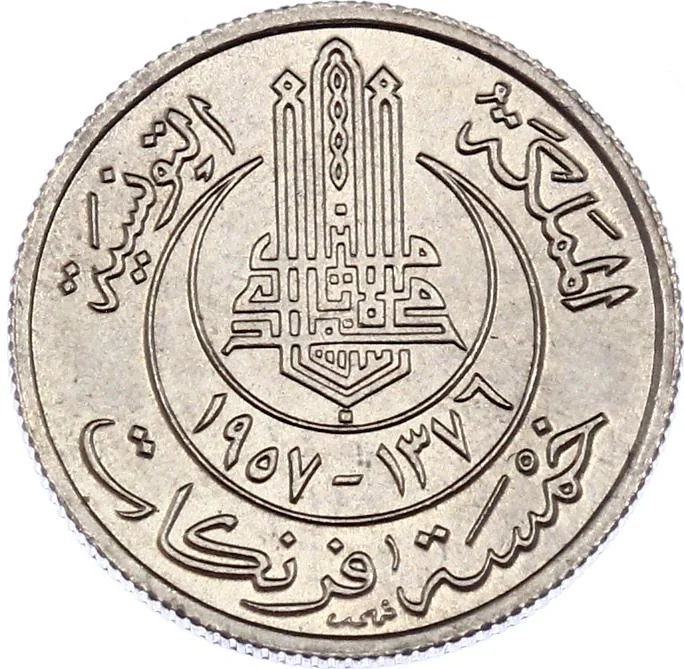
Obverse
Description:
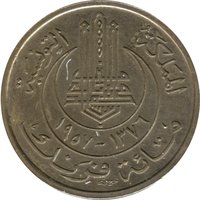
Arabic script encircles the central tughra with words of value and dates.
Inscription:
المملكة التونسية
١٣٧٦-١٩٥٧
خمسة فرنكات
١٣٧٦-١٩٥٧
خمسة فرنكات
Translation:
The Tunisian Kingdom
1376-1957
Five Francs
1376-1957
Five Francs
Script: Arabic
Language: Arabic
Engraver: Lucien Georges Bazor
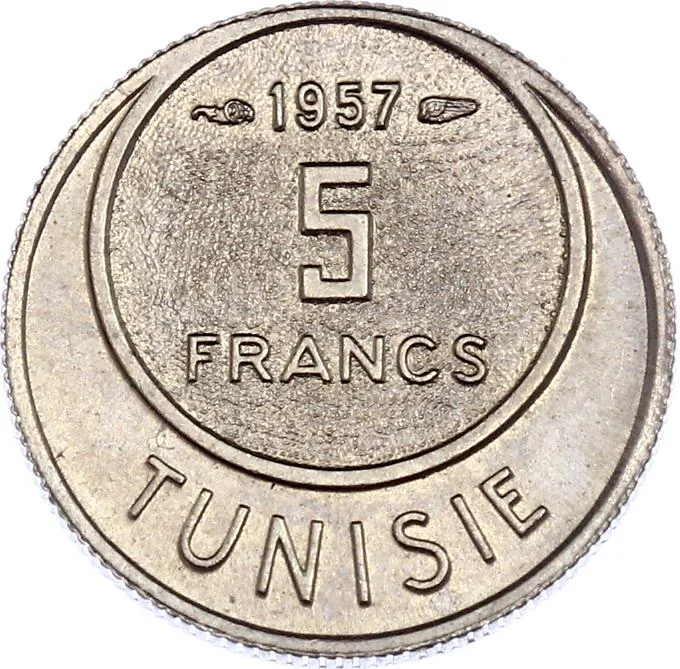
Reverse
Description:
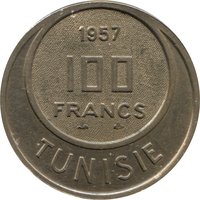
Date grégorienne, valeur et nom du pays en français.
Inscription:
1957
5
FRANCS
TUNISIE
5
FRANCS
TUNISIE
Translation:
1957
5
FRANCS
TUNISIA
5
FRANCS
TUNISIA
Script: Latin
Engraver: Lucien Georges Bazor
Edge
Reeded
Mints
| Name | Mark |
|---|---|
| Monnaie de Paris | — |
Mintings
| Year | Mint Mark | Mintage | Quality | Collection |
|---|---|---|---|---|
| 1954 | — | 18,000,000 | ||
| 1957 | — | 4,000,000 |
Historical background
In 1954, Tunisia's currency situation was intrinsically tied to its political status as a French protectorate, established in 1881. The monetary system was dominated by the Tunisian franc, which was pegged at par with the French franc and formed part of the Franc Zone (Zone Franc). This arrangement meant that Tunisia's currency issuance, managed by a public institution called the Caisse de Réservation, was fully backed by French franc reserves, effectively ceding monetary sovereignty to France. The primary function of this system was to facilitate colonial trade and financial integration, ensuring that Tunisia's economy served as a complement to the French metropolitan economy.
Economically, this fixed and guaranteed parity provided a degree of stability for commercial exchanges with France, which accounted for the vast majority of Tunisia's foreign trade. However, it also meant that Tunisia had no independent monetary policy to address its specific economic needs, such as financing development or managing local inflation. The currency circulation reflected the colonial structure: alongside the Tunisian franc, French franc notes and coins circulated freely, and major financial institutions were French-owned. This system reinforced economic dependency, as Tunisia's currency reserves were held in Paris and its money supply was dictated by the balance of payments with France.
Politically, the currency regime was a point of contention amidst the growing nationalist movement, which was actively fighting for independence. The Neo-Destour Party, led by Habib Bourguiba, viewed economic autonomy, including control over a national currency, as a fundamental pillar of sovereignty. While the major push for a central bank and a distinct currency would come after independence in 1956, the monetary landscape of 1954 was a clear symbol of colonial control. Thus, the currency situation was not merely a financial matter but a key element in the broader political struggle, setting the stage for the creation of the Central Bank of Tunisia and the Tunisian dinar in 1958.
Economically, this fixed and guaranteed parity provided a degree of stability for commercial exchanges with France, which accounted for the vast majority of Tunisia's foreign trade. However, it also meant that Tunisia had no independent monetary policy to address its specific economic needs, such as financing development or managing local inflation. The currency circulation reflected the colonial structure: alongside the Tunisian franc, French franc notes and coins circulated freely, and major financial institutions were French-owned. This system reinforced economic dependency, as Tunisia's currency reserves were held in Paris and its money supply was dictated by the balance of payments with France.
Politically, the currency regime was a point of contention amidst the growing nationalist movement, which was actively fighting for independence. The Neo-Destour Party, led by Habib Bourguiba, viewed economic autonomy, including control over a national currency, as a fundamental pillar of sovereignty. While the major push for a central bank and a distinct currency would come after independence in 1956, the monetary landscape of 1954 was a clear symbol of colonial control. Thus, the currency situation was not merely a financial matter but a key element in the broader political struggle, setting the stage for the creation of the Central Bank of Tunisia and the Tunisian dinar in 1958.
🌱 Very Common