

1 speciedaler – Denmark
Add to wishlist
Denmark
Context
Material
References
KM: #
Numista: #131340
Value
Bullion value: $63.41
Obverse
Description:
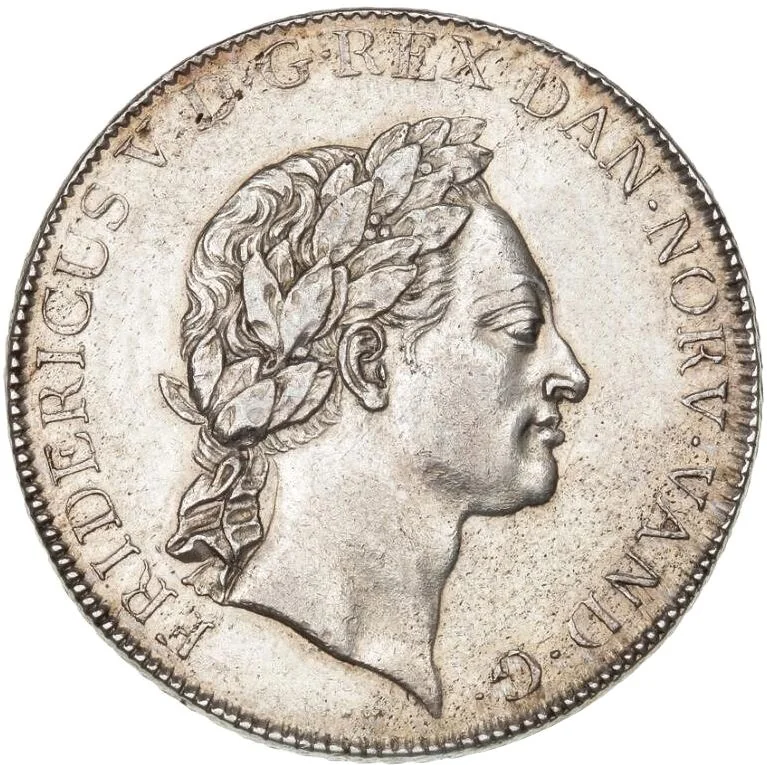
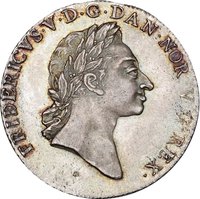
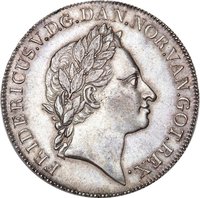
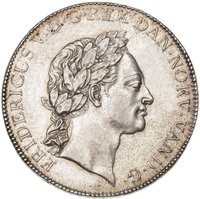
Laureate bust of Frederik V facing right. Legend encircling. Engraver's initials below truncation.
Inscription:
FRIDERICUS V D • G • REX DAN • NORV • VAND • G •
I.H.W.
I.H.W.
Script: Latin
Engraver: Johan Henrik Wolff
Reverse
Description:
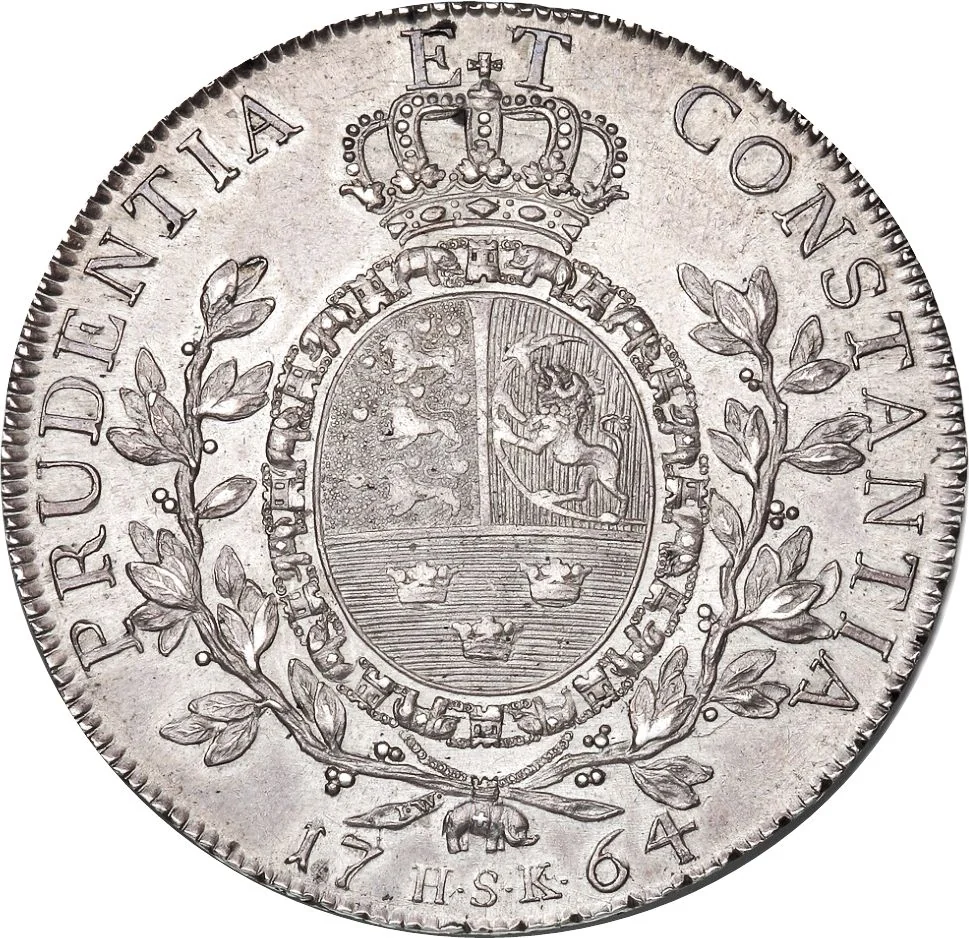
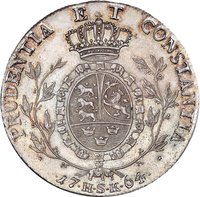
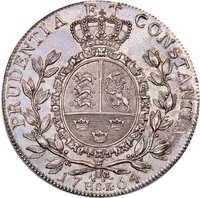
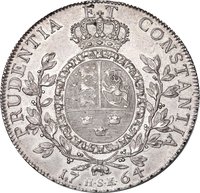
Oval shield with the arms of Denmark, Norway, and Sweden, crowned and encircled by the Order of the Elephant necklace, set between crossed laurel sprigs. The date and mint master's initials are below, the King's motto is around the rim, and the engraver's initials are on the cut branch to the left.
Inscription:
PRUDENTIA ET COSTANTIA
IW
· 17 H.S.K. 64 ·
IW
· 17 H.S.K. 64 ·
Script: Latin
Engraver: Johan Henrik Wolff
Edge
Categories
| Symbols> Coat of Arms |
Mints
| Name | Mark |
|---|---|
| Royal Danish Mint | HSK |
Historical background
In 1764, Denmark operated under a silver standard, with the rigsdaler specie as the primary unit of account, but the monetary system was complex and strained. The state treasury, deeply indebted from costly wars and a lavish court, had long resorted to debasing the currency by reducing the silver content in coins to generate short-term revenue. This practice, alongside the circulation of overvalued foreign coins and various credit notes, created a system with multiple parallel forms of money of uncertain and fluctuating value, undermining both public trust and efficient commerce.
The situation was actively managed by the government of Johann Hartvig Ernst Bernstorff, with King Christian VII as a largely figurehead monarch. A significant reform had been enacted just two years prior, in 1762, which aimed to stabilize the currency by introducing a new kurant rigsdaler in banknotes, theoretically backed by silver but in practice a fiat currency. By 1764, the success of this measure was still precarious; the new banknotes circulated alongside older debased coins, and maintaining their value required strict fiscal discipline, which was a continuous challenge for the state.
Consequently, the currency situation in 1764 was one of fragile and managed transition. The government was attempting to move away from a history of debasement towards a more stable, paper-based system, but confidence was not yet fully restored. The economy remained vulnerable to speculation and inflationary pressures, a reality that demanded careful state intervention to prevent the new system from collapsing, setting the stage for further monetary adjustments in the following decades.
The situation was actively managed by the government of Johann Hartvig Ernst Bernstorff, with King Christian VII as a largely figurehead monarch. A significant reform had been enacted just two years prior, in 1762, which aimed to stabilize the currency by introducing a new kurant rigsdaler in banknotes, theoretically backed by silver but in practice a fiat currency. By 1764, the success of this measure was still precarious; the new banknotes circulated alongside older debased coins, and maintaining their value required strict fiscal discipline, which was a continuous challenge for the state.
Consequently, the currency situation in 1764 was one of fragile and managed transition. The government was attempting to move away from a history of debasement towards a more stable, paper-based system, but confidence was not yet fully restored. The economy remained vulnerable to speculation and inflationary pressures, a reality that demanded careful state intervention to prevent the new system from collapsing, setting the stage for further monetary adjustments in the following decades.
Series: 1764 Denmark circulation coins
✨ Legendary