

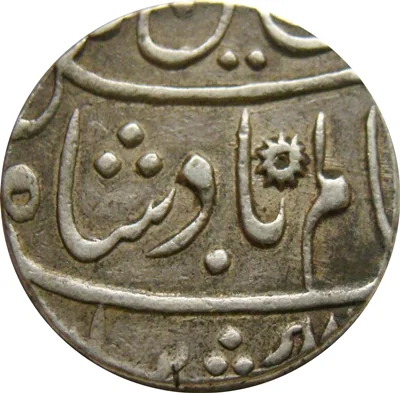
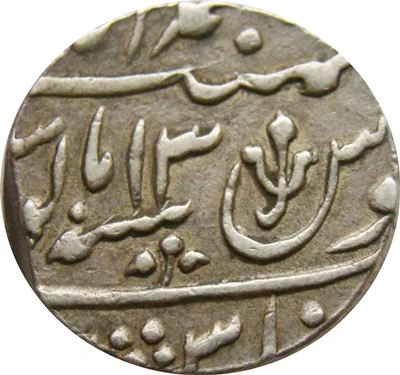
1 rupee – Awadh
Add to wishlist
India
Context
Year: 1773
Islamic (Hijri) Year:: 1186
Country: India
Issuer: Awadh
Ruler: Shah Alam II
Currency:
(1605—1857)
Demonetized: Yes
Material
References
KM: #
Numista: #129810
Value
Bullion value: $27.34
Obverse
Description:
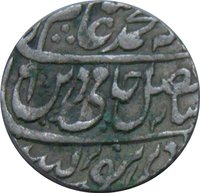
Shah Alam II star inscription.
Reverse
Description:
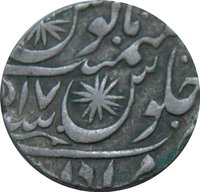
Mint, year, trident.
Edge
Mints
| Name | Mark |
|---|---|
| Varanasi | — |
Mintings
| Year | Mint Mark | Mintage | Quality | Collection |
|---|---|---|---|---|
| 1773 | — | — |
Historical background
In 1773, the currency situation in Awadh was a complex tapestry reflecting its political subordination to the British East India Company and its own internal economic strains. Following the Treaty of Allahabad in 1765, the Nawab of Awadh, Shuja-ud-Daula, was burdened with a massive war indemnity and an annual subsidy to the Company. To meet these relentless demands, the Awadh treasury was systematically drained, leading to repeated currency debasement. The Nawab's mints reduced the silver content in the local rupee (often called the "Lucknow rupee") to increase coin output, causing its value to fluctuate and depreciate against the more stable Company rupee.
This monetary instability created a dual-circuit economy. The British East India Company, collecting its tribute and conducting its trade, insisted on transactions in their own heavier, standard rupees. This created a persistent drain of full-weight silver from the region, exacerbating the shortage of quality specie. Within Awadh's internal markets, the debased local currency continued to circulate, but its declining value fueled inflation, eroded public trust, and placed a hidden tax on the peasantry and artisans who were paid in the weaker coin.
Thus, the currency crisis of 1773 was not merely a financial issue but a direct symptom of Awadh's compromised sovereignty. The Nawab’s fiscal policy was overwhelmingly dictated by the need to satisfy colonial extraction, leading to inflationary coinage that undermined the local economy. This precarious system foreshadowed greater financial and political collapse, as the scramble for revenue would eventually lead to the complete annexation of Awadh by the Company in 1856.
This monetary instability created a dual-circuit economy. The British East India Company, collecting its tribute and conducting its trade, insisted on transactions in their own heavier, standard rupees. This created a persistent drain of full-weight silver from the region, exacerbating the shortage of quality specie. Within Awadh's internal markets, the debased local currency continued to circulate, but its declining value fueled inflation, eroded public trust, and placed a hidden tax on the peasantry and artisans who were paid in the weaker coin.
Thus, the currency crisis of 1773 was not merely a financial issue but a direct symptom of Awadh's compromised sovereignty. The Nawab’s fiscal policy was overwhelmingly dictated by the need to satisfy colonial extraction, leading to inflationary coinage that undermined the local economy. This precarious system foreshadowed greater financial and political collapse, as the scramble for revenue would eventually lead to the complete annexation of Awadh by the Company in 1856.
✨ Legendary