

1 rupee – Awadh
Add to wishlist
India
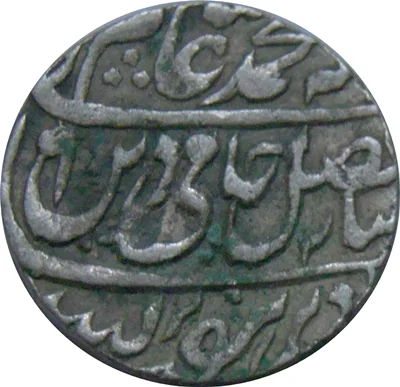
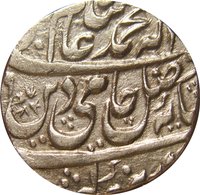
Obverse
Description:
Shah Alam II, dated by Hijri year.
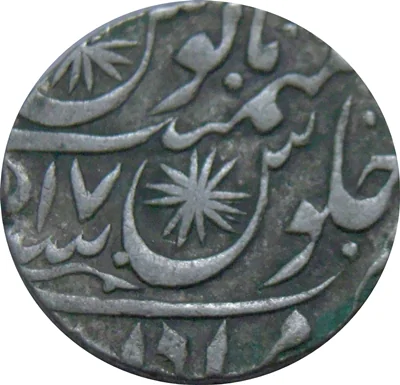
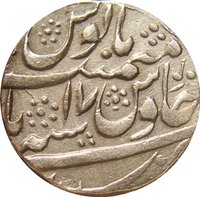
Reverse
Description:
Star Mint, regnal year
Edge
Mintings
| Year | Mint Mark | Mintage | Quality | Collection |
|---|---|---|---|---|
| 1775 | — | — | ||
| 1776 | — | — | ||
| 1777 | — | — |
Historical background
In 1775, the currency situation in Awadh was complex and transitional, reflecting its political subordination to the British East India Company following the Treaty of Allahabad (1765). While the Nawab, Shuja-ud-Daula, retained formal sovereignty, the Company's control over the rich revenues of neighboring Bengal and its increasing political interference had begun to distort Awadh's economic autonomy. The region operated on a bimetallic system, primarily using silver rupees and copper dams, but the circulation was a heterogeneous mix of Mughal, regional, and foreign coins. The dominant silver rupee was the "Sicca" rupee, minted in Bengal under Company oversight, whose influx tied Awadh's monetary stability to Calcutta's policies.
This period saw significant currency manipulation and arbitrage, known as "shroffing," which became a major point of contention. British East India Company officials and private traders, exploiting exchange rate differences, would bring heavily alloyed or debased rupees from Bengal and northern India into Awadh to be melted and reminted into purer Awadhi rupees at the local mints (sikkas) in Lucknow and Faizabad. This practice drained the treasury of Nawab Asaf-ud-Daula (who succeeded in 1775) of seigniorage revenue (minting taxes) and degraded the overall currency pool. The Nawab's administration struggled to assert control over minting standards and prevent the inflow of inferior coinage, leading to periodic monetary confusion and loss of public trust.
Consequently, the currency situation was a microcosm of Awadh's eroding sovereignty. The Nawab's court attempted reforms, including issuing distinct local rupees, but these were undermined by the economic pressure and political demands of the Company, which required large subsidy payments. The chaotic monetary environment hampered trade and agriculture, contributing to the province's gradual financial decline. Thus, by 1775, Awadh's currency was not merely an economic issue but a key battleground in the larger struggle between a weakening princely state and the expanding commercial-military power of the East India Company.
This period saw significant currency manipulation and arbitrage, known as "shroffing," which became a major point of contention. British East India Company officials and private traders, exploiting exchange rate differences, would bring heavily alloyed or debased rupees from Bengal and northern India into Awadh to be melted and reminted into purer Awadhi rupees at the local mints (sikkas) in Lucknow and Faizabad. This practice drained the treasury of Nawab Asaf-ud-Daula (who succeeded in 1775) of seigniorage revenue (minting taxes) and degraded the overall currency pool. The Nawab's administration struggled to assert control over minting standards and prevent the inflow of inferior coinage, leading to periodic monetary confusion and loss of public trust.
Consequently, the currency situation was a microcosm of Awadh's eroding sovereignty. The Nawab's court attempted reforms, including issuing distinct local rupees, but these were undermined by the economic pressure and political demands of the Company, which required large subsidy payments. The chaotic monetary environment hampered trade and agriculture, contributing to the province's gradual financial decline. Thus, by 1775, Awadh's currency was not merely an economic issue but a key battleground in the larger struggle between a weakening princely state and the expanding commercial-military power of the East India Company.
✨ Legendary