

1 Zecchino – Malta
Malta
Context
Material
References
KM: #Click to copy to clipboard133
Numista: #129568
Value
Bullion value: $573.61
Obverse
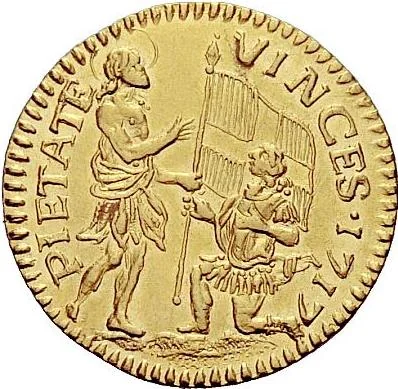
Description:
St. John presents the Order flag to the kneeling Grand Master.
Inscription:
PIETATE VINCES·1717
Script: Latin
Reverse
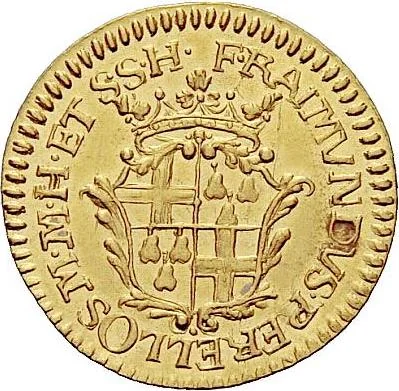
Description:
Crowned baroque shield amid sprays.
Inscription:
F·RAIMVNDVSPERELLOS M·M·H·ET S·S·H·
Script: Latin
Edge
Mintings
| Year | Mint Mark | Mintage | Quality | Collection |
|---|---|---|---|---|
| 1705 | — | — | ||
| 1717 | — | — |
Historical background
In 1705, Malta's currency situation was a complex tapestry reflecting its dual role as a strategic fortress of the Knights of Saint John and a vibrant Mediterranean trading hub. The official currency was the Maltese scudo, divided into 12 tari, each of 20 grani. However, the actual money in circulation was a chaotic mix of foreign coins, primarily Spanish pieces of eight and their fractional coins (reales), alongside Venetian sequins, French écus, and various Italian currencies. This proliferation of foreign specie was driven by the Knights' international revenues, the island's busy port, and the constant need to finance military and naval operations against the Ottoman corsairs.
The Knights' government faced significant challenges in managing this system. The fluctuating silver content and value of the many foreign coins, particularly the widely used Spanish pieces of eight, led to frequent official proclamations re-tariffing their legal value in scudi, tari, and grani. This was an attempt to stabilize exchange rates and prevent the export of full-weight silver coins, which were often melted down or traded away, leaving only worn or debased coins in local circulation—a classic example of Gresham's Law in action. Consequently, everyday transactions were often cumbersome, requiring careful assessment of each coin's origin, wear, and official decree value.
Despite the chaos, the system functioned due to Malta's commercial vitality. The Knights minted their own limited copper grani and silver tari to facilitate small change, but these were insufficient. The real engine was the mercantile community, including money-changers (banchi) who were essential for converting the myriad currencies. Ultimately, the currency situation of 1705 was one of de facto bimetallism governed by proclamation, a pragmatic but unstable solution that would persist until the Knights introduced more standardized Maltese coinage in later decades, aiming to assert greater monetary sovereignty over their island fortress.
The Knights' government faced significant challenges in managing this system. The fluctuating silver content and value of the many foreign coins, particularly the widely used Spanish pieces of eight, led to frequent official proclamations re-tariffing their legal value in scudi, tari, and grani. This was an attempt to stabilize exchange rates and prevent the export of full-weight silver coins, which were often melted down or traded away, leaving only worn or debased coins in local circulation—a classic example of Gresham's Law in action. Consequently, everyday transactions were often cumbersome, requiring careful assessment of each coin's origin, wear, and official decree value.
Despite the chaos, the system functioned due to Malta's commercial vitality. The Knights minted their own limited copper grani and silver tari to facilitate small change, but these were insufficient. The real engine was the mercantile community, including money-changers (banchi) who were essential for converting the myriad currencies. Ultimately, the currency situation of 1705 was one of de facto bimetallism governed by proclamation, a pragmatic but unstable solution that would persist until the Knights introduced more standardized Maltese coinage in later decades, aiming to assert greater monetary sovereignty over their island fortress.
✨ Legendary