

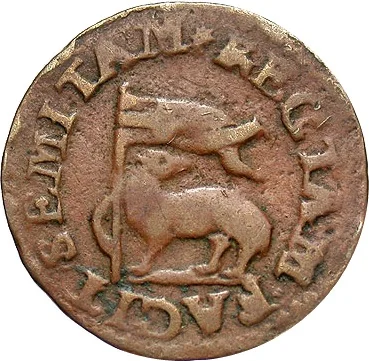
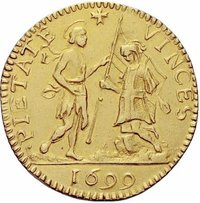
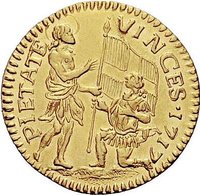
Obverse
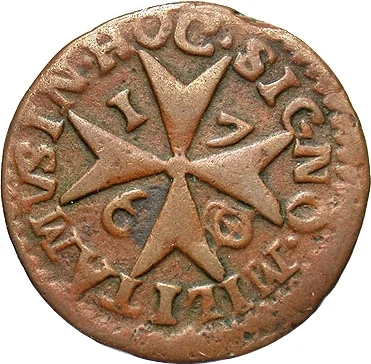
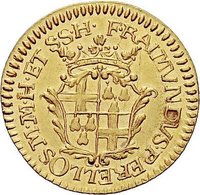
Reverse
Edge
Mintings
| Year | Mint Mark | Mintage | Quality | Collection |
|---|---|---|---|---|
| 1703 | — | — | ||
| 1704 | — | — | ||
| 1706 | — | — | ||
| 1707 | — | — | ||
| 1709 | — | — | ||
| 1715 | — | — | ||
| 1717 | — | — | ||
| 1718 | — | — | ||
| 1720 | — | — |
Historical background
In 1703, Malta’s currency situation was complex and fragmented, reflecting its strategic position and the political powers influencing the island. As a key stronghold of the Knights Hospitaller (Order of St. John), Malta was nominally under the sovereignty of the Order, but it operated within the broader economic sphere of the Mediterranean. The circulating coinage was a chaotic mix, primarily consisting of Spanish pieces of eight (reales), Sicilian and Neapolitan coins, French écus, and Turkish sequins. This proliferation of foreign currencies, each with fluctuating values, made everyday commerce difficult and prone to dispute.
The Knights themselves attempted to impose order by minting their own coins, such as the scudo, tari, and grani, at the Order’s mint in Valletta. However, these local issues were insufficient in volume and often undervalued compared to foreign specie, leading to them being hoarded or exported. Consequently, the promised official exchange rates published by the Order’s Università (municipal government) frequently diverged from market reality. This created a dual system where accounting was done in the official monetary units, but physical transactions relied on a volatile assortment of worn and clipped foreign coins.
Ultimately, the monetary disorder of 1703 was a persistent administrative headache for the Knights, undermining efficient tax collection and trade. It highlighted the tension between Malta’s international role as a cosmopolitan port and the local government’s struggle to assert economic sovereignty. This situation would persist with only partial remedies until more comprehensive reforms were undertaken later in the 18th century.
The Knights themselves attempted to impose order by minting their own coins, such as the scudo, tari, and grani, at the Order’s mint in Valletta. However, these local issues were insufficient in volume and often undervalued compared to foreign specie, leading to them being hoarded or exported. Consequently, the promised official exchange rates published by the Order’s Università (municipal government) frequently diverged from market reality. This created a dual system where accounting was done in the official monetary units, but physical transactions relied on a volatile assortment of worn and clipped foreign coins.
Ultimately, the monetary disorder of 1703 was a persistent administrative headache for the Knights, undermining efficient tax collection and trade. It highlighted the tension between Malta’s international role as a cosmopolitan port and the local government’s struggle to assert economic sovereignty. This situation would persist with only partial remedies until more comprehensive reforms were undertaken later in the 18th century.
💎 Extremely Rare