

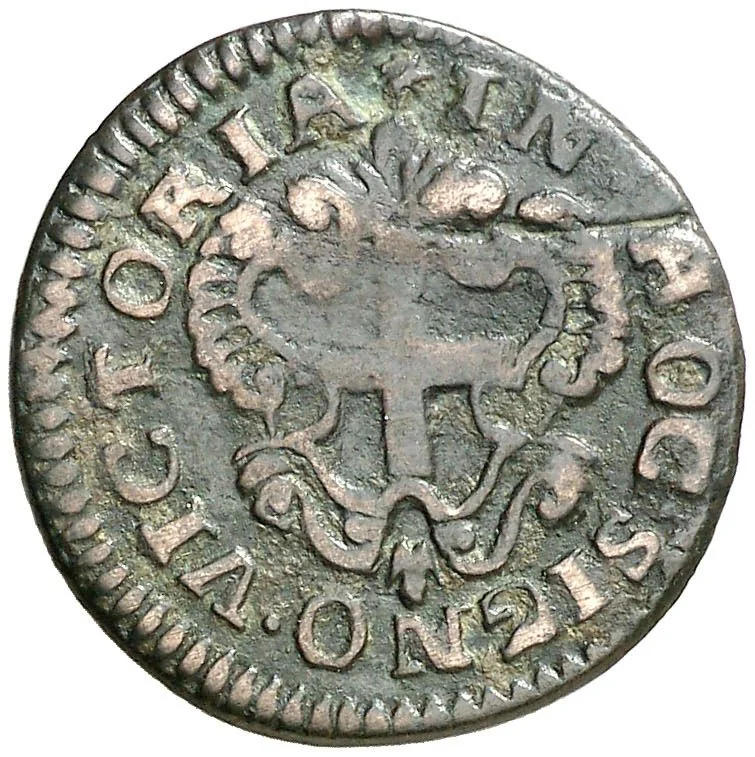
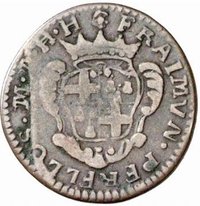
Obverse
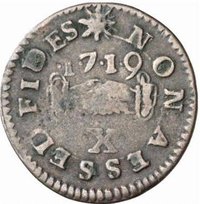
Reverse
Description:
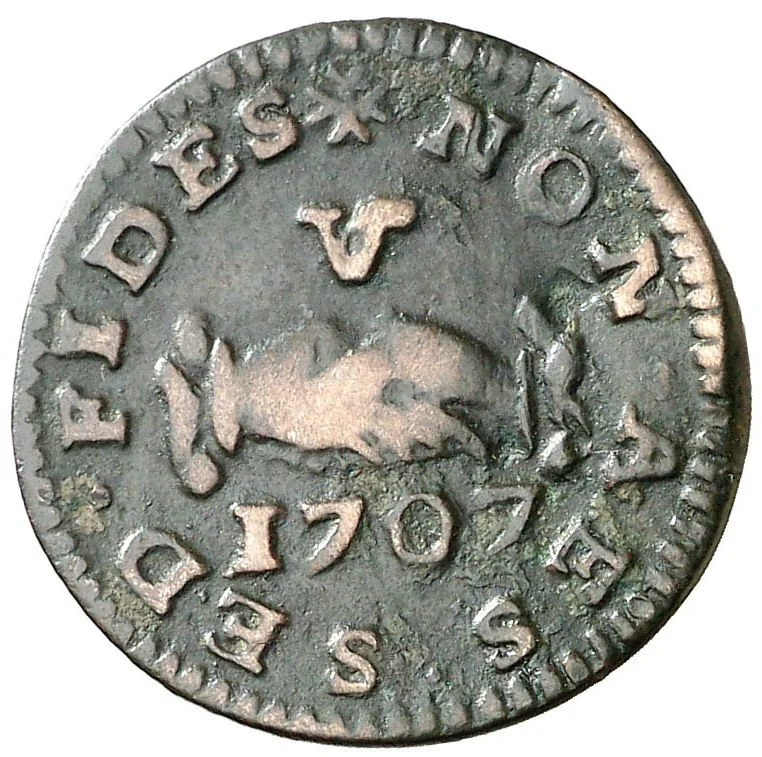
Clasped hands, date below, value above.
Inscription:
NON AES SED FIDES
V
1707
V
1707
Script: Latin
Edge
Mintings
| Year | Mint Mark | Mintage | Quality | Collection |
|---|---|---|---|---|
| 1707 | — | — |
Historical background
In 1707, Malta's currency situation was complex and reflected its unique political position as a vassal state of the Kingdom of Sicily under the Knights Hospitaller (Order of St. John). The islands did not mint their own official coinage. Instead, the circulating medium was a chaotic mix of foreign silver and gold coins, primarily Spanish pieces of eight (reales) and their fractional parts, alongside Sicilian, Neapolitan, French, and Turkish coins brought by trade and corsairing. The Order attempted to regulate this by periodically issuing bandi (edicts) that fixed the exchange rates of these myriad coins in terms of the local accounting unit, the scudo.
The foundational unit was the Maltese scudo, divided into 12 tari, each of 20 grani. However, this was a money of account used for bookkeeping, contracts, and setting prices, not a physical coin commonly found in hand. The most important physical coin was the Spanish silver real, particularly the piece of eight (8 reales), which the Knights tariffed at 2 scudi, 2 tari. This created a direct, though officially controlled, link between the dominant international trade coin and the local system. Gold coins, like the Spanish doblón or the Venetian sequin, circulated for larger transactions and international trade.
This system was inherently unstable. The Knights' frequent bandi to adjust rates were often reactions to the fluctuating silver content of foreign coins and attempts to prevent the export of full-weight specie, which led to shortages. Smuggling and clipping of coins were chronic problems. Consequently, 1707 fell within a period of monetary tension where the disparity between the official tariff and the market value of silver often caused confusion, hindered commerce, and required constant administrative intervention to maintain a functioning, if inefficient, multi-currency economy.
The foundational unit was the Maltese scudo, divided into 12 tari, each of 20 grani. However, this was a money of account used for bookkeeping, contracts, and setting prices, not a physical coin commonly found in hand. The most important physical coin was the Spanish silver real, particularly the piece of eight (8 reales), which the Knights tariffed at 2 scudi, 2 tari. This created a direct, though officially controlled, link between the dominant international trade coin and the local system. Gold coins, like the Spanish doblón or the Venetian sequin, circulated for larger transactions and international trade.
This system was inherently unstable. The Knights' frequent bandi to adjust rates were often reactions to the fluctuating silver content of foreign coins and attempts to prevent the export of full-weight specie, which led to shortages. Smuggling and clipping of coins were chronic problems. Consequently, 1707 fell within a period of monetary tension where the disparity between the official tariff and the market value of silver often caused confusion, hindered commerce, and required constant administrative intervention to maintain a functioning, if inefficient, multi-currency economy.
✨ Legendary