

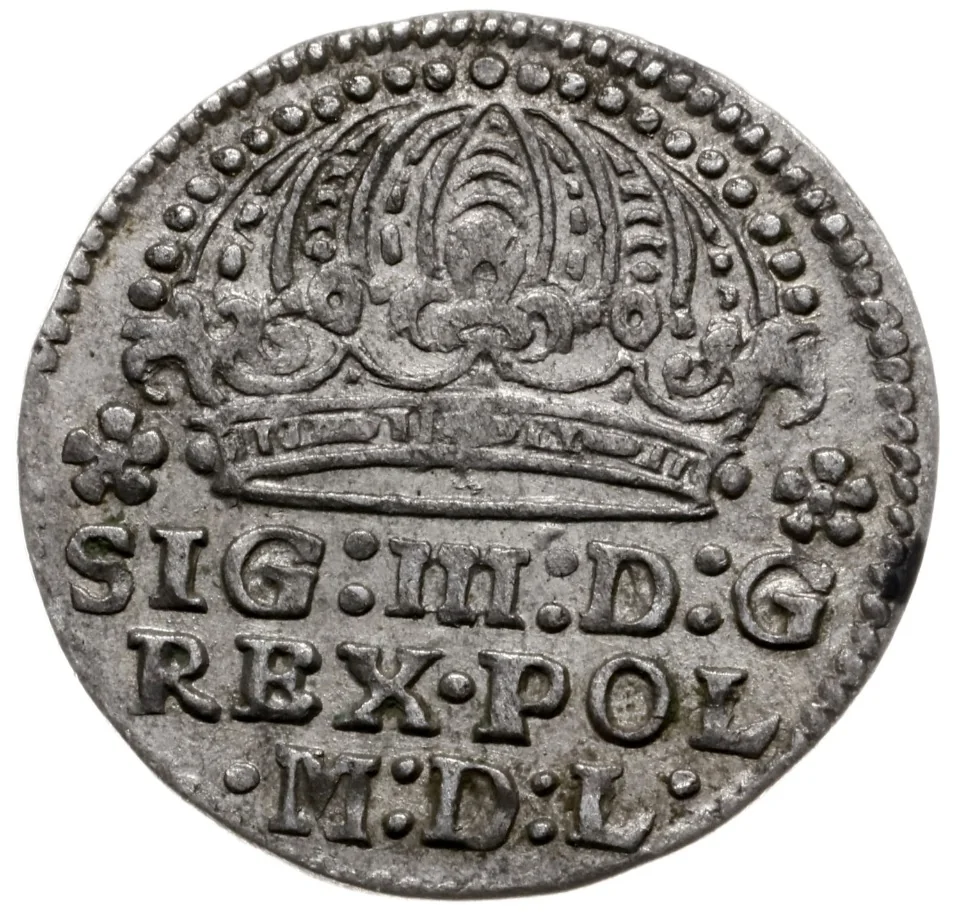
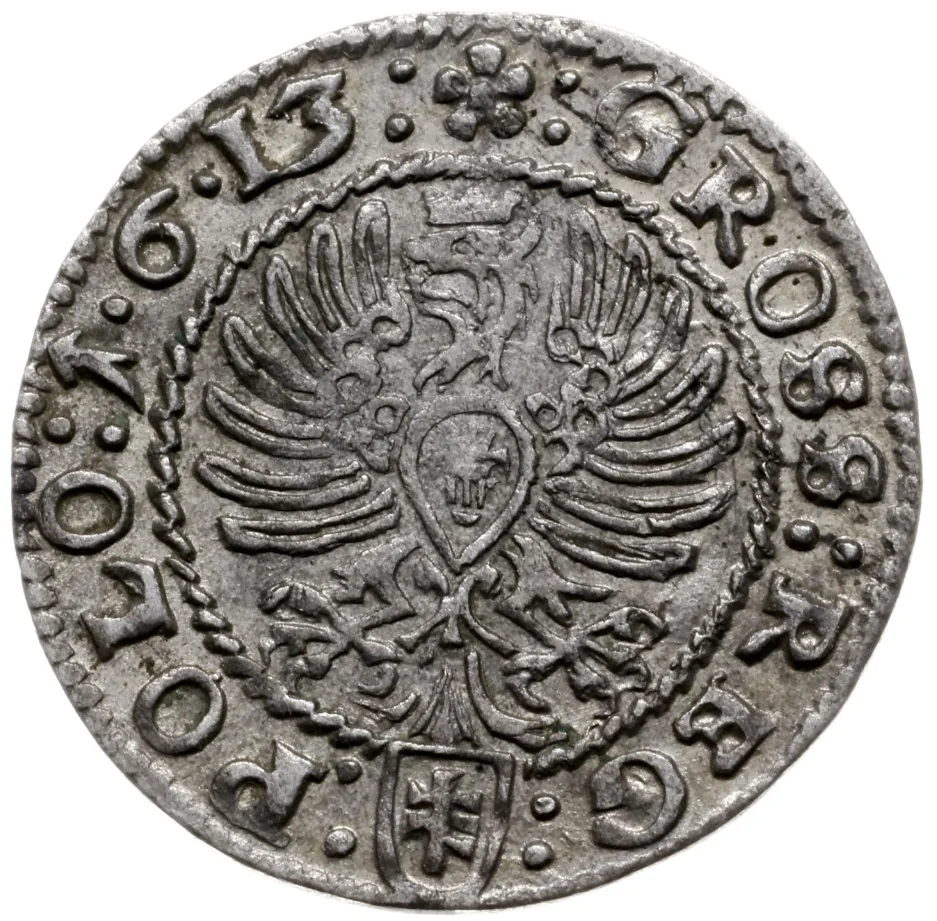
1 Groschen – Polish–Lithuanian Commonwealth
Poland
Context
Years: 1601–1623
Country: Poland 
Issuer: Polish–Lithuanian Commonwealth
Ruler: Sigismund III Vasa
Currency:
(1573—1795)
Demonetized: Yes
Material
References
KM: #Click to copy to clipboard11
Numista: #126824
Value
Bullion value: $4.08
Obverse
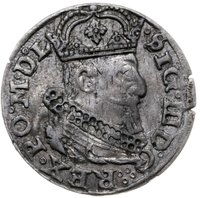
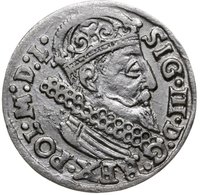
Inscription:
SIG: III: D: G
REX. POL
.M: D: L.
REX. POL
.M: D: L.
Script: Latin
Reverse
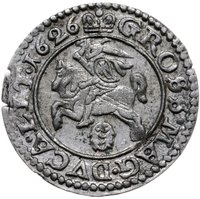
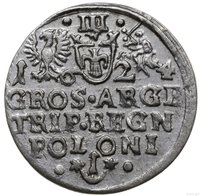
Inscription:
* : GROSS: REG: (_) :POLO: 1.6.13:
Script: Latin
Edge
Plain
Mints
| Name | Mark |
|---|---|
| Kraków | — |
Mintings
| Year | Mint Mark | Mintage | Quality | Collection |
|---|---|---|---|---|
| 1601 | — | — | ||
| 1607 | — | — | ||
| 1608 | — | — | ||
| 1609 | — | — | ||
| 1610 | — | — | ||
| 1611 | — | — | ||
| 1612 | — | — | ||
| 1613 | — | — | ||
| 1614 | — | — | ||
| 1615 | — | — | ||
| 1616 | — | — | ||
| 1617 | — | — | ||
| 1621 | — | — | ||
| 1623 | — | — |
Historical background
In 1601, the Polish–Lithuanian Commonwealth was grappling with a severe and multifaceted monetary crisis, rooted in policies established decades earlier. The core of the problem was the coexistence of two parallel currency systems: a domestic one based on the silver złoty polski (as an accounting unit) and its physical counterpart, the silver grosz, and an international trade currency, the gold złoty czerwony (red złoty). The state mint, seeking profit, had systematically debased the silver coinage since the 1570s, reducing its precious metal content while officially maintaining its face value. This created a widening gap between the unstable domestic coinage and the stable, valued foreign coins, leading to Gresham's Law in action: "bad money drives out good." People hoarded full-weight foreign coins and older Polish issues, while the newly minted, inferior grosz flooded the market, causing inflation and eroding public trust.
The situation was exacerbated by massive imports of cheap bullion, particularly from Germany, which was minted into debased coinage at the royal mints. Furthermore, the monetary union with the Duchy of Prussia, established in 1528, broke down in 1601 as Prussian cities, suffering from the flood of bad Polish-Lithuanian coin, began to issue their own stable currency. This fragmentation undermined internal trade and fiscal unity. The year 1601 fell within the early stages of the Polish–Swedish War over Livonia (1600–1611), which placed enormous strain on the royal treasury. To finance the military, the state relied heavily on seigniorage profits from minting debased coinage, thus deepening the inflationary spiral and further destabilizing the economy.
Consequently, prices for basic goods rose sharply, disrupting commerce and causing social unrest, particularly among the peasantry and urban poor fixed on traditional prices. The landed nobility (szlachta), who received rents in nominal monetary terms, saw their real incomes decline, fueling political discontent. While calls for monetary reform were growing, comprehensive action would not be taken until the landmark Currency Reform of 1621, which introduced a stable, full-weight tymf and złoty system. Thus, in 1601, the Commonwealth was in the throes of a deepening crisis where fiscal short-termism, war financing, and a fractured monetary system were creating significant economic and social strain.
The situation was exacerbated by massive imports of cheap bullion, particularly from Germany, which was minted into debased coinage at the royal mints. Furthermore, the monetary union with the Duchy of Prussia, established in 1528, broke down in 1601 as Prussian cities, suffering from the flood of bad Polish-Lithuanian coin, began to issue their own stable currency. This fragmentation undermined internal trade and fiscal unity. The year 1601 fell within the early stages of the Polish–Swedish War over Livonia (1600–1611), which placed enormous strain on the royal treasury. To finance the military, the state relied heavily on seigniorage profits from minting debased coinage, thus deepening the inflationary spiral and further destabilizing the economy.
Consequently, prices for basic goods rose sharply, disrupting commerce and causing social unrest, particularly among the peasantry and urban poor fixed on traditional prices. The landed nobility (szlachta), who received rents in nominal monetary terms, saw their real incomes decline, fueling political discontent. While calls for monetary reform were growing, comprehensive action would not be taken until the landmark Currency Reform of 1621, which introduced a stable, full-weight tymf and złoty system. Thus, in 1601, the Commonwealth was in the throes of a deepening crisis where fiscal short-termism, war financing, and a fractured monetary system were creating significant economic and social strain.
⭐ Somewhat Rare