

¼ Thaler – Austrian Empire
Austria

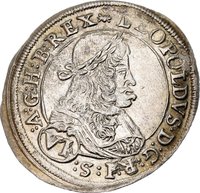
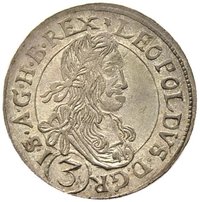
Obverse
Description:
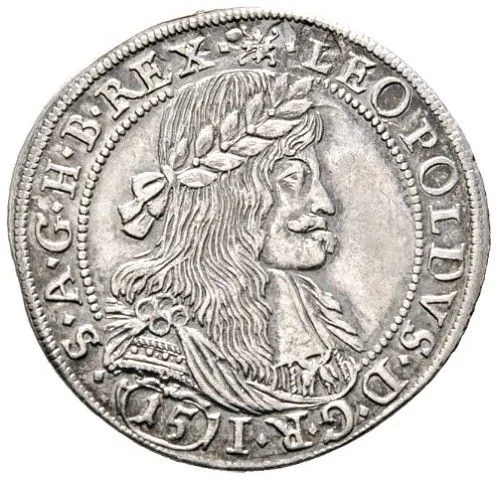
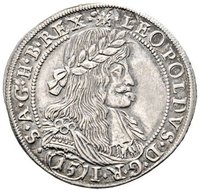
Portrait of Leopold I of Habsburg facing right, crowned with laurel, value in numerals below.
Inscription:
LEOPOLDVS D G R I (15) S A G H B REX
Script: Latin
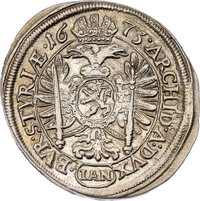
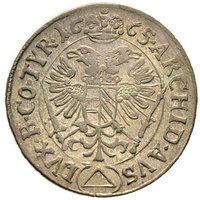
Reverse
Description:
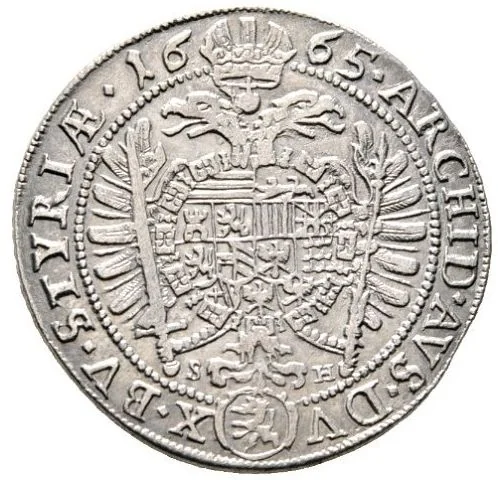
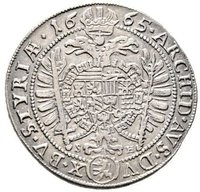
Double-headed imperial eagle with central coat of arms. The crown divides the date; the mint mark (triangle) divides the legend.
Inscription:
ARCHID AVS DV // X BV STYRIÆ
S H
S H
Script: Latin
Edge
Mints
| Name | Mark |
|---|---|
| Graz | — |
Mintings
| Year | Mint Mark | Mintage | Quality | Collection |
|---|---|---|---|---|
| 1665 | S | — |
Historical background
In 1665, the currency system of the Habsburg-ruled Austrian Empire was a complex and fragmented patchwork, reflecting the decentralized political structure of the realm. The Empire lacked a unified, centrally managed coinage. Instead, various constituent territories—including the Archduchy of Austria, the Kingdom of Bohemia, and the Kingdom of Hungary—often exercised their own minting rights, producing a plethora of coins with differing standards, weights, and denominations. The most important large silver coin was the Reichsthaler, a theoretical standard, but in daily circulation, people used a confusing array of regional Kreuzers, Groschen, and Guldens.
This monetary fragmentation was exacerbated by chronic fiscal strain. The Habsburg monarchy was engaged in near-continuous warfare, particularly against the Ottoman Empire in the east, which drained the imperial treasury. To raise funds, the state frequently resorted to debasement—reducing the precious metal content in coins while maintaining their face value. This practice, often conducted by leasing mints to private operators for profit, led to inflation, a loss of public trust, and the circulation of heavily degraded coinage. "Bad money drove out good," as older, full-value coins were hoarded or melted down.
Consequently, economic transactions were fraught with difficulty. Merchants and money changers had to navigate intricate exchange rates and assess the actual metal content of coins, hindering trade and economic integration within the Empire. While there were periodic imperial ordinances attempting to regulate coinage standards, enforcement was weak. Thus, in 1665, the Austrian Empire's currency situation was characterized by disorder, inflationary pressure, and a lack of uniform monetary authority, posing a significant obstacle to both state finance and economic development.
This monetary fragmentation was exacerbated by chronic fiscal strain. The Habsburg monarchy was engaged in near-continuous warfare, particularly against the Ottoman Empire in the east, which drained the imperial treasury. To raise funds, the state frequently resorted to debasement—reducing the precious metal content in coins while maintaining their face value. This practice, often conducted by leasing mints to private operators for profit, led to inflation, a loss of public trust, and the circulation of heavily degraded coinage. "Bad money drove out good," as older, full-value coins were hoarded or melted down.
Consequently, economic transactions were fraught with difficulty. Merchants and money changers had to navigate intricate exchange rates and assess the actual metal content of coins, hindering trade and economic integration within the Empire. While there were periodic imperial ordinances attempting to regulate coinage standards, enforcement was weak. Thus, in 1665, the Austrian Empire's currency situation was characterized by disorder, inflationary pressure, and a lack of uniform monetary authority, posing a significant obstacle to both state finance and economic development.
✨ Legendary