

1 Thaler – Austrian Empire
Austria

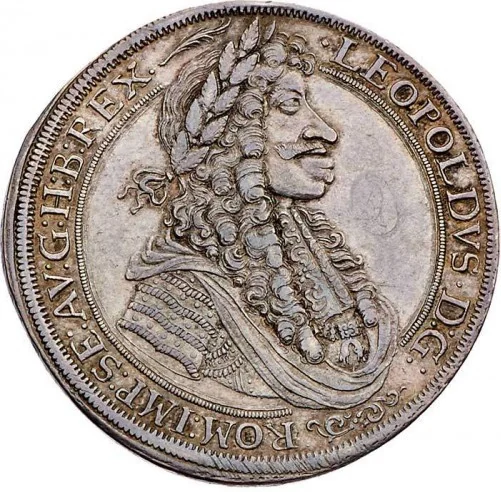
Obverse
Description:
Armored bust right, head to rim, inner circle divided below.
Inscription:
LEOPOLDVS D G // ROM IMP SE AV G H B REX
IAN
IAN
Script: Latin
Engraver: Johann Anton Novak
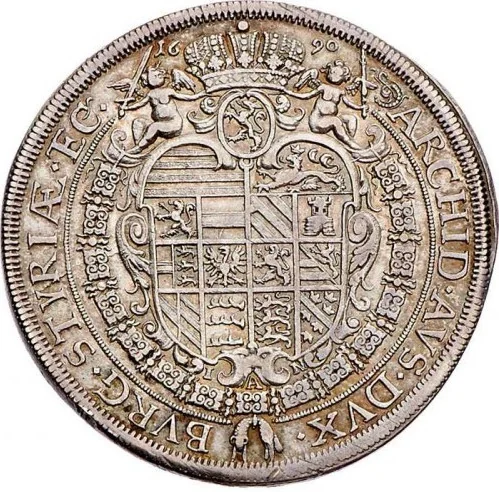
Reverse
Description:
Baroque frame with composite arms, flanked by angels and a small Styrian shield above. Date in small characters; "MM" signature on armor, right of the arm.
Inscription:
ARCHID AVS DVX // BVRG STYRIÆ ETC 1690
MM
MM
Script: Latin
Engraver: Matthias Mittermayer
Edge
Mints
| Name | Mark |
|---|---|
| Graz | — |
Mintings
| Year | Mint Mark | Mintage | Quality | Collection |
|---|---|---|---|---|
| 1690 | — | — |
Historical background
In 1690, the Habsburg Monarchy, often referred to as the Austrian Empire, was embroiled in the Great Turkish War (1683-1699), a conflict that placed immense strain on its finances. The war effort, requiring vast sums to fund armies and fortifications, led to chronic fiscal shortfalls. The state's primary response was to drastically debase its silver coinage, particularly the ubiquitous Kreuzer and the larger Taler. By reducing the precious metal content in new coins while mandating they be accepted at their old, higher face value, the treasury created a short-term influx of funds. However, this practice severely eroded public trust in the currency and triggered rampant inflation, as the intrinsic value of coins fell far below their nominal worth.
The monetary landscape was further complicated by extreme regional fragmentation. There was no single, unified imperial currency. The Habsburgs directly controlled the minting of coins for the Austrian hereditary lands (like the Reichsthaler), but other territories within the Empire, such as the Kingdom of Hungary and the Kingdom of Bohemia, operated their own minting authorities and issued distinct coinage. This created a chaotic system of multiple circulating currencies with fluctuating exchange rates, hindering trade and efficient tax collection. Furthermore, older, high-quality coins were hoarded or melted down (Gresham's Law in action), leaving the debased new issues as the common medium of exchange, which further accelerated the inflationary spiral.
Consequently, the year 1690 represents a peak of monetary disorder. Prices for essential goods soared, causing hardship for soldiers on fixed pay and the general populace. The debasement also damaged Vienna's credit and complicated the logistics of paying its multinational armies. While the eventual victory at Zenta in 1697 would bring relief and war reparations, the immediate period was defined by a fiscal policy of currency manipulation that sacrificed monetary stability for military survival, leaving a legacy of economic disruption that would challenge the Habsburg state for decades to come.
The monetary landscape was further complicated by extreme regional fragmentation. There was no single, unified imperial currency. The Habsburgs directly controlled the minting of coins for the Austrian hereditary lands (like the Reichsthaler), but other territories within the Empire, such as the Kingdom of Hungary and the Kingdom of Bohemia, operated their own minting authorities and issued distinct coinage. This created a chaotic system of multiple circulating currencies with fluctuating exchange rates, hindering trade and efficient tax collection. Furthermore, older, high-quality coins were hoarded or melted down (Gresham's Law in action), leaving the debased new issues as the common medium of exchange, which further accelerated the inflationary spiral.
Consequently, the year 1690 represents a peak of monetary disorder. Prices for essential goods soared, causing hardship for soldiers on fixed pay and the general populace. The debasement also damaged Vienna's credit and complicated the logistics of paying its multinational armies. While the eventual victory at Zenta in 1697 would bring relief and war reparations, the immediate period was defined by a fiscal policy of currency manipulation that sacrificed monetary stability for military survival, leaving a legacy of economic disruption that would challenge the Habsburg state for decades to come.

✨ Legendary