

½ Thaler – Austrian Empire
Austria

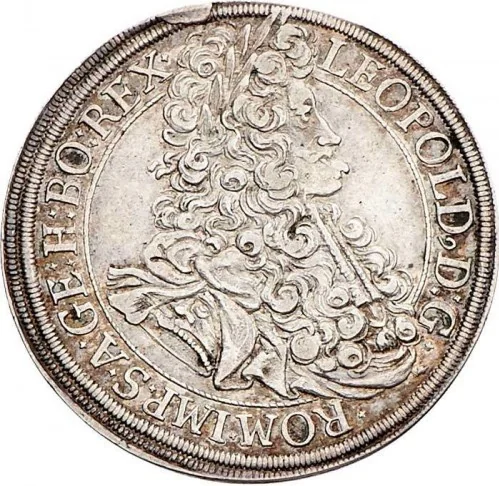
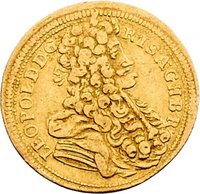
Obverse
Description:
Portrait above, legend below, divided by the head.
Inscription:
LEOPOLDVS D G // ROM IMP SA GE H BO REX
Script: Latin
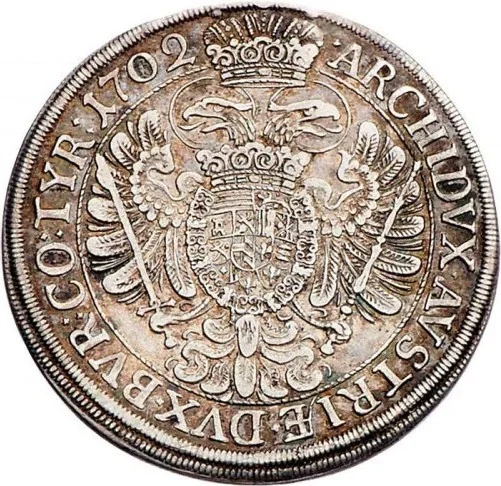
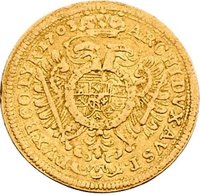
Reverse
Description:
Double-headed imperial eagle with halos, holding a sword and scepter, over a composite shield. Date in legend.
Inscription:
ARCHIDVX AVSTRIÆ DVX BVR CO TYR 1702
Script: Latin
Edge
Mints
| Name | Mark |
|---|---|
| Münze Österreich | — |
Mintings
| Year | Mint Mark | Mintage | Quality | Collection |
|---|---|---|---|---|
| 1702 | — | — |
Historical background
In 1702, the currency situation within the Habsburg-ruled Austrian Empire was complex and strained, a direct consequence of its ongoing participation in the War of the Spanish Succession (1701-1714). The immense financial demands of fielding large armies against France and its allies placed the imperial treasury under severe pressure. The government's primary response was to debase the coinage, notably the ubiquitous silver thaler and smaller kreuzer, by reducing their precious metal content while maintaining their face value. This practice, essentially a form of inflation, created short-term revenue but eroded public trust in the currency.
The monetary landscape was further fragmented by significant regional diversity. While the central authorities in Vienna issued coinage, various constituent lands of the empire, such as the Kingdom of Hungary and the Austrian Netherlands, often retained their own minting rights and circulated distinct coins. This lack of uniformity created confusion in commerce and exchange, hindering economic integration. Furthermore, the empire's extensive borders saw a constant influx of foreign coins, particularly from German states and the Ottoman Empire, which circulated alongside domestic issues, complicating trade and valuation.
The resulting instability led to a sharp divergence between the official banko money of account, used for bookkeeping and large transactions, and the depreciated current coinage used in everyday trade. This "agio," or premium, on banko money became a persistent feature, destabilizing prices and credit. While the government attempted to regulate exchange rates and curb the worst abuses, its efforts in 1702 were largely reactive and ineffectual against the overwhelming fiscal imperative of funding the war, setting a pattern of monetary instability that would challenge the empire for decades.
The monetary landscape was further fragmented by significant regional diversity. While the central authorities in Vienna issued coinage, various constituent lands of the empire, such as the Kingdom of Hungary and the Austrian Netherlands, often retained their own minting rights and circulated distinct coins. This lack of uniformity created confusion in commerce and exchange, hindering economic integration. Furthermore, the empire's extensive borders saw a constant influx of foreign coins, particularly from German states and the Ottoman Empire, which circulated alongside domestic issues, complicating trade and valuation.
The resulting instability led to a sharp divergence between the official banko money of account, used for bookkeeping and large transactions, and the depreciated current coinage used in everyday trade. This "agio," or premium, on banko money became a persistent feature, destabilizing prices and credit. While the government attempted to regulate exchange rates and curb the worst abuses, its efforts in 1702 were largely reactive and ineffectual against the overwhelming fiscal imperative of funding the war, setting a pattern of monetary instability that would challenge the empire for decades.
✨ Legendary