

1 Ducat – Austrian Empire
Austria
Context
Years: 1703–1705
Country: Austria 
Issuer: Austrian Empire
Ruler: Leopold I
Currency:
(1520—1754)
Demonetized: Yes
Material
References
KM: #Click to copy to clipboard1325
Numista: #125741
Value
Bullion value: $575.72
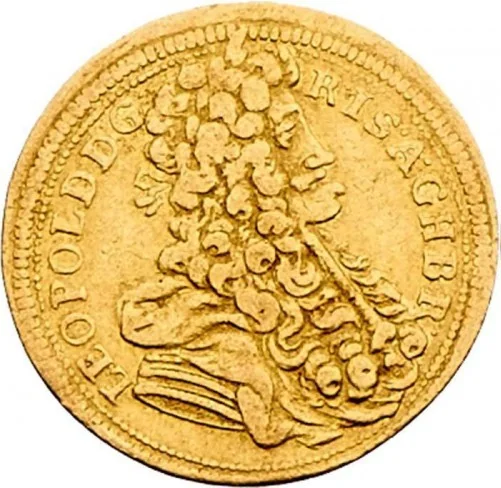
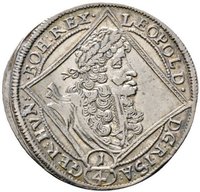
Obverse
Description:
Legend starts at 8, divided above by the head.
Inscription:
LEOPOLD D G // R I S A G H B R
Script: Latin
Engraver: Matthias Mittermayer
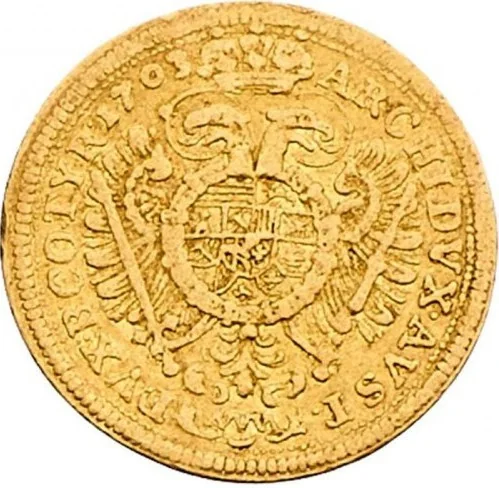
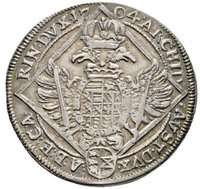
Reverse
Description:
Imperial eagle with rounded wings. Date follows legend.
Inscription:
ARCHIDVX AVST (MM) DVX B CO TYR 1703
Script: Latin
Edge
Mints
| Name | Mark |
|---|---|
| Münze Österreich | — |
Mintings
| Year | Mint Mark | Mintage | Quality | Collection |
|---|---|---|---|---|
| 1703 | MM | — | ||
| 1704 | MM | — | ||
| 1705 | MM | — |
Historical background
In 1703, the currency situation in the Austrian Habsburg Monarchy was characterized by severe instability and depreciation, a direct consequence of the immense financial strain of the War of the Spanish Succession (1701-1714). The government, under Emperor Leopold I and his central financier, Samuel von Oppenheimer, was desperate for funds to maintain its vast armies. To meet these costs, the state resorted to the large-scale debasement of coinage, notably the silver gulden and the smaller kreuzer. By reducing the precious metal content in newly minted coins while demanding taxes be paid in older, full-weight currency, the treasury created a short-term revenue stream but triggered rampant inflation and a loss of public trust.
This period saw the proliferation of unstable paper instruments alongside the debased coinage. The most notorious were Einlösungsscheine (redemption notes), essentially compulsory credit notes forced upon suppliers to the army and state. These promises of future payment circulated as a de facto, but deeply discounted, paper currency. Furthermore, the Vienna City Bank (Wiener Stadtbank), established in 1703, began issuing Bancozettel. While initially intended as credit certificates backed by tax revenues, they soon began to circulate as money, laying an early and shaky foundation for a paper money system, though their stability was precarious from the outset.
The result was a chaotic multi-currency system where good, full-weight silver coins (often older issues or foreign currency) were hoarded, while the new, lightweight coins and paper notes flooded the market and lost value rapidly. This led to a wide gap between the official face value of money and its actual market worth, causing hardship for soldiers paid in depreciated currency, creditors, and the general populace facing rising prices. Thus, in 1703, the Habsburg financial apparatus was in a state of emergency management, sacrificing monetary integrity for wartime survival and setting the stage for recurring fiscal crises throughout the 18th century.
This period saw the proliferation of unstable paper instruments alongside the debased coinage. The most notorious were Einlösungsscheine (redemption notes), essentially compulsory credit notes forced upon suppliers to the army and state. These promises of future payment circulated as a de facto, but deeply discounted, paper currency. Furthermore, the Vienna City Bank (Wiener Stadtbank), established in 1703, began issuing Bancozettel. While initially intended as credit certificates backed by tax revenues, they soon began to circulate as money, laying an early and shaky foundation for a paper money system, though their stability was precarious from the outset.
The result was a chaotic multi-currency system where good, full-weight silver coins (often older issues or foreign currency) were hoarded, while the new, lightweight coins and paper notes flooded the market and lost value rapidly. This led to a wide gap between the official face value of money and its actual market worth, causing hardship for soldiers paid in depreciated currency, creditors, and the general populace facing rising prices. Thus, in 1703, the Habsburg financial apparatus was in a state of emergency management, sacrificing monetary integrity for wartime survival and setting the stage for recurring fiscal crises throughout the 18th century.
✨ Legendary