

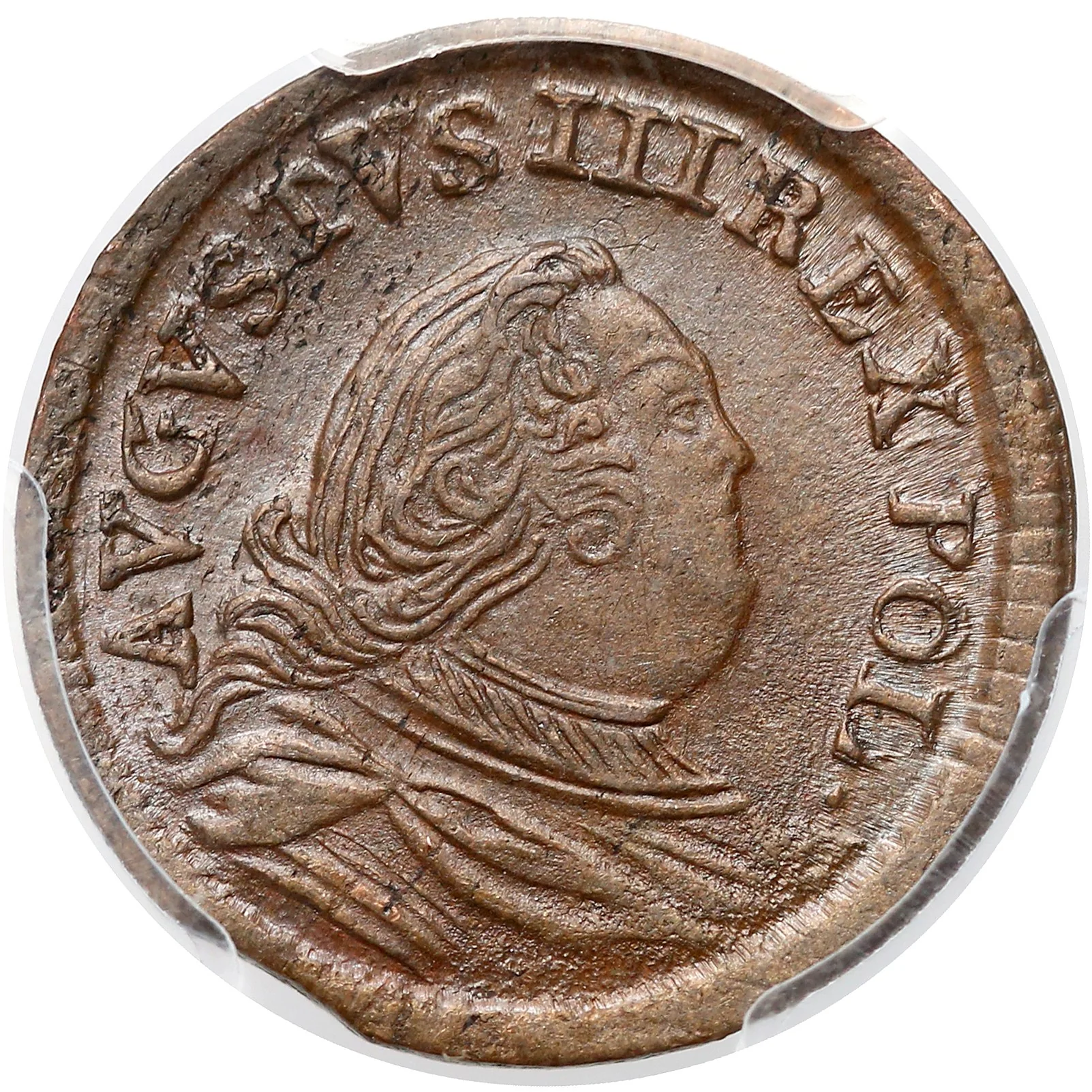
1 groschen – Polish–Lithuanian Commonwealth
Add to wishlist
Poland
Context
Years: 1754–1755
Country: Poland
Issuer: Polish–Lithuanian Commonwealth
Ruler: Augustus III
Currency:
(1573—1795)
Demonetized: Yes
References
KM: #
Numista: #122975
Obverse
Reverse
Description:
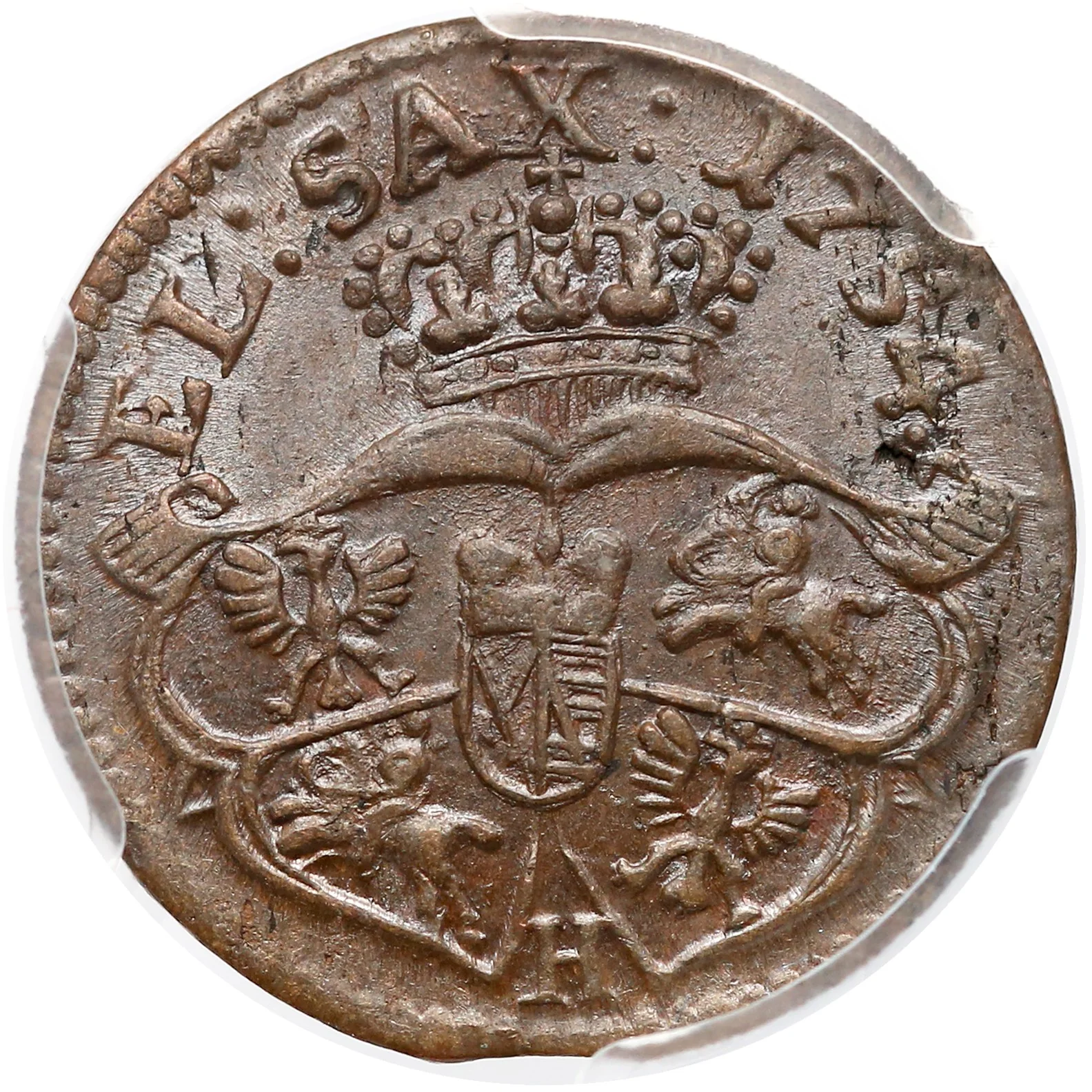
Arms of Poland-Lithuania quartered, crowned, with Saxony at center.
Inscription:
EL SAX 1754
Script: Latin
Edge
Mints
| Name | Mark |
|---|---|
| Grünthal | — |
Mintings
| Year | Mint Mark | Mintage | Quality | Collection |
|---|---|---|---|---|
| 1754 | H | — | ||
| 1755 | H | — |
Historical background
By 1754, the currency situation in the Polish–Lithuanian Commonwealth was one of profound instability and debasement, a direct result of the state’s political paralysis. The central authority, crippled by the liberum veto and powerful magnate factions, lacked the power to implement a unified monetary policy. Instead, the right to mint coins was exercised separately by the Crown (Poland) and the Grand Duchy of Lithuania, as well as by numerous private mints operated by wealthy magnates like the Czartoryski and Potocki families. This fragmentation led to a chaotic proliferation of coins of varying quality and value.
The primary currency in circulation was the Polish złoty, but it existed primarily as an accounting unit (złoty polski), with its physical representation being the silver tymf and the copper szeląg. The period was marked by severe debasement, most infamously under the mintmaster Andreas von der Borch, whose "boratynki" and "tymfy" (named after the mintmaster Tymf) were struck with reduced silver content. These coins, often containing less than 50% of their nominal value in precious metal, flooded the market, driving out full-weight foreign coins like thalers and ducats through Gresham’s Law. This practice provided short-term revenue for the treasury and mint operators but eroded public trust and caused rampant inflation.
This monetary chaos severely hampered both domestic commerce and international trade. Merchants and the population faced constant uncertainty, while the state’s ability to fund its operations and military was critically weakened. The situation reflected the broader decline of the Commonwealth, where private and short-term interests of the nobility systematically undermined the economic foundations of the state. Attempts at reform were repeatedly blocked in the Sejm, leaving the monetary system in a degraded condition that would persist until the partitions.
The primary currency in circulation was the Polish złoty, but it existed primarily as an accounting unit (złoty polski), with its physical representation being the silver tymf and the copper szeląg. The period was marked by severe debasement, most infamously under the mintmaster Andreas von der Borch, whose "boratynki" and "tymfy" (named after the mintmaster Tymf) were struck with reduced silver content. These coins, often containing less than 50% of their nominal value in precious metal, flooded the market, driving out full-weight foreign coins like thalers and ducats through Gresham’s Law. This practice provided short-term revenue for the treasury and mint operators but eroded public trust and caused rampant inflation.
This monetary chaos severely hampered both domestic commerce and international trade. Merchants and the population faced constant uncertainty, while the state’s ability to fund its operations and military was critically weakened. The situation reflected the broader decline of the Commonwealth, where private and short-term interests of the nobility systematically undermined the economic foundations of the state. Attempts at reform were repeatedly blocked in the Sejm, leaving the monetary system in a degraded condition that would persist until the partitions.
🌟 Limited