

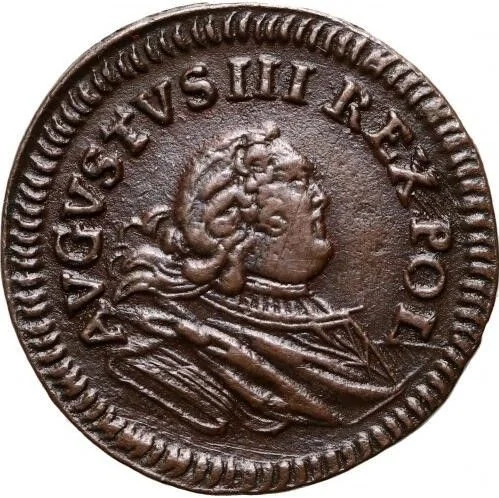
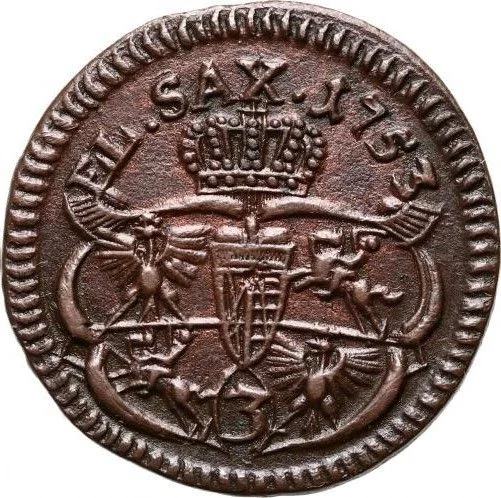
1 groschen – Polish–Lithuanian Commonwealth
Add to wishlist
Poland
Context
Years: 1752–1758
Country: Poland
Issuer: Polish–Lithuanian Commonwealth
Ruler: Augustus III
Currency:
(1573—1795)
Demonetized: Yes
Material
References
KM: #
Numista: #31087
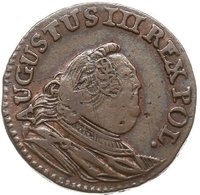
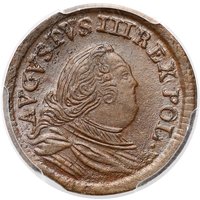
Obverse
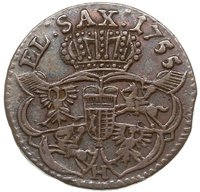
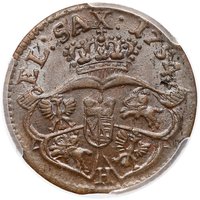
Reverse
Edge
Plain
Categories
| Symbols> Coat of Arms |
Mints
| Name | Mark |
|---|---|
| Grünthal | — |
Mintings
| Year | Mint Mark | Mintage | Quality | Collection |
|---|---|---|---|---|
| 1752 | — | — | ||
| 1753 | — | — | ||
| 1754 | — | — | ||
| 1755 | — | — | ||
| 1758 | — | — |
Historical background
In 1752, the Polish–Lithuanian Commonwealth's currency situation was a reflection of the state's profound political and economic weakness. The monetary system was decentralized and chaotic, with multiple mints operating across the realm—notably in Kraków, Gdańsk, Elbląg, and Toruń—often under foreign influence or leased to private individuals. The primary silver coin was the tymf, introduced in the 1660s, and its debased successor, the zloty polski (Polish złoty), which had a nominal value much higher than its intrinsic silver content. This practice of "crying down" the coinage, combined with a flood of inferior foreign coins, particularly Saxon and Prussian, led to severe inflation, a loss of public trust, and Gresham's Law in action, where "bad money drove out the good."
The root of the problem lay in the Commonwealth's political structure, particularly the liberum veto, which allowed any single noble deputy to paralyze the Sejm (parliament). This made comprehensive fiscal and monetary reform impossible, as powerful magnates and foreign powers (especially Saxony, Prussia, and Russia) actively opposed any centralization of monetary authority that would strengthen the crown. The state treasury was perpetually empty, funding the government relied on sporadic taxes granted by the Sejm, and the monarch, Augustus III of the House of Wettin, often prioritized the interests of his hereditary Saxon electorate over those of the Commonwealth.
Consequently, by 1752, the monetary chaos was a chronic condition hindering trade and economic development. Prices were unstable, and transactions often required careful weighing of coins rather than counting them at face value. While there were occasional discussions about reform, no effective action was taken, leaving the Commonwealth with a dysfunctional currency that symbolized its accelerating decline towards the partitions that would end its existence by the end of the century.
The root of the problem lay in the Commonwealth's political structure, particularly the liberum veto, which allowed any single noble deputy to paralyze the Sejm (parliament). This made comprehensive fiscal and monetary reform impossible, as powerful magnates and foreign powers (especially Saxony, Prussia, and Russia) actively opposed any centralization of monetary authority that would strengthen the crown. The state treasury was perpetually empty, funding the government relied on sporadic taxes granted by the Sejm, and the monarch, Augustus III of the House of Wettin, often prioritized the interests of his hereditary Saxon electorate over those of the Commonwealth.
Consequently, by 1752, the monetary chaos was a chronic condition hindering trade and economic development. Prices were unstable, and transactions often required careful weighing of coins rather than counting them at face value. While there were occasional discussions about reform, no effective action was taken, leaving the Commonwealth with a dysfunctional currency that symbolized its accelerating decline towards the partitions that would end its existence by the end of the century.
🌟 Limited