

Italy
Context
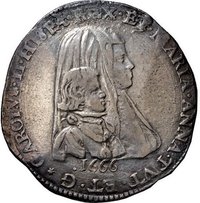
Years: 1665–1675
Country: Italy 
Issuer: Milan
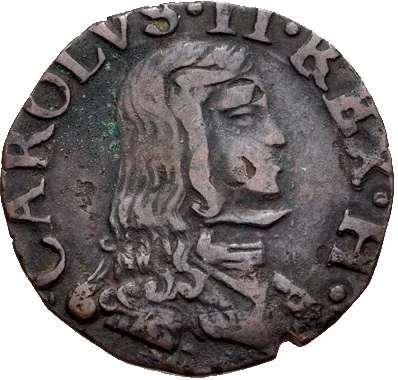
Ruler: Charles II
Currency:
(1515—1796)
Demonetized: Yes
Material
References
KM: #Click to copy to clipboard67
Numista: #121922
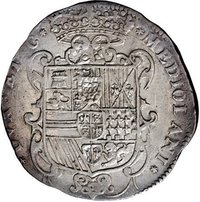
Obverse
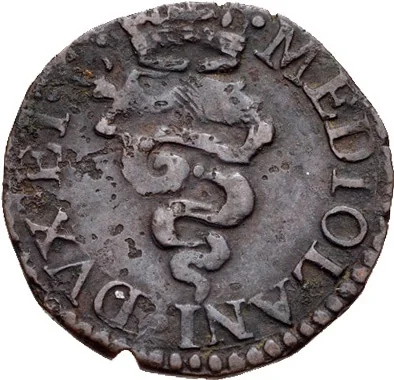
Reverse
Edge
Mints
| Name | Mark |
|---|---|
| Milan | — |
Mintings
| Year | Mint Mark | Mintage | Quality | Collection |
|---|---|---|---|---|
| — | — | — |
Historical background
In 1665, Milan operated within the complex monetary landscape of the Spanish Habsburg Empire, utilizing a bimetallic system of gold scudi and silver lire. However, the period was characterized by severe instability and currency debasement. Decades of imperial financial strain, driven by protracted warfare, had led to the systematic reduction of silver content in coinage minted in Milan and elsewhere. This resulted in a proliferation of undervalued, worn, and counterfeit coins circulating alongside older, purer pieces, creating a chaotic multi-tiered currency market where the intrinsic value of a coin often exceeded its face value.
The local economy suffered from this "bad money" crisis, as Gresham's Law took hold: good, full-weight coins were hoarded or exported, while debased coins flooded daily transactions. This eroded public trust, complicated trade, and caused price inflation, as merchants adjusted prices to account for unreliable coinage. The situation was exacerbated by the presence of numerous foreign currencies from other Italian states and Northern Europe, necessary for commerce but adding another layer of exchange rate confusion and arbitrage.
Authorities, including the Milanese Senate and the Spanish Governor, were engaged in a continuous but largely futile struggle to rectify the situation. They issued repeated proclamations to fix exchange rates and mandate the acceptance of official coinage at face value, but these edicts were widely ignored in practice. The fundamental problem was a lack of precious metal to restore confidence, leaving Milan trapped in a cycle of monetary dysfunction that stifled economic activity and reflected the broader fiscal decline of Spanish power in the region.
The local economy suffered from this "bad money" crisis, as Gresham's Law took hold: good, full-weight coins were hoarded or exported, while debased coins flooded daily transactions. This eroded public trust, complicated trade, and caused price inflation, as merchants adjusted prices to account for unreliable coinage. The situation was exacerbated by the presence of numerous foreign currencies from other Italian states and Northern Europe, necessary for commerce but adding another layer of exchange rate confusion and arbitrage.
Authorities, including the Milanese Senate and the Spanish Governor, were engaged in a continuous but largely futile struggle to rectify the situation. They issued repeated proclamations to fix exchange rates and mandate the acceptance of official coinage at face value, but these edicts were widely ignored in practice. The fundamental problem was a lack of precious metal to restore confidence, leaving Milan trapped in a cycle of monetary dysfunction that stifled economic activity and reflected the broader fiscal decline of Spanish power in the region.
✨ Legendary