

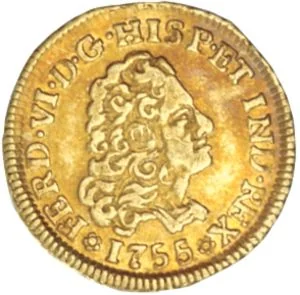
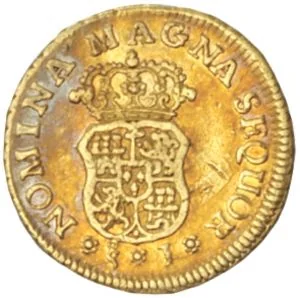
1 escudo – Chile
Add to wishlist
Chile
Context
Years: 1754–1756
Issuer: Chile
Ruler: Ferdinand VI
Currency:
(1541—1852)
Demonetized: Yes
Total mintage: 1,041
Material
References
KM: #
Numista: #121818
Value
Bullion value: $479.61
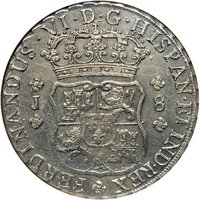
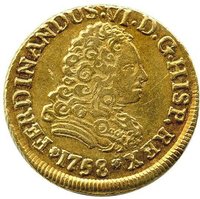
Obverse
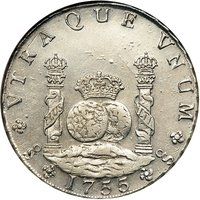
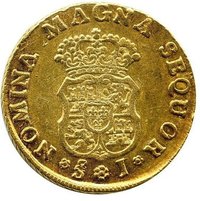
Reverse
Edge
Mintings
| Year | Mint Mark | Mintage | Quality | Collection |
|---|---|---|---|---|
| 1754 | So | 680 | ||
| 1755 | /4 | 253 | ||
| 1756 | So | 108 |
Historical background
In 1754, Chile was a colonial outpost of the Spanish Empire, and its currency situation was characterized by severe scarcity and reliance on a chaotic mix of foreign and improvised monies. The official Spanish silver real, minted in Peru or Mexico, was the legal tender, but these coins were perpetually in short supply due to the colony's limited export economy (primarily agricultural and pastoral goods) and the Crown's mercantilist policies that drained precious metals to Spain. This chronic shortage stifled trade and economic growth within the Captaincy General.
To facilitate everyday transactions, Chileans extensively used a variety of substitute currencies. The most common was the macuquina—crudely cut and often clipped "cob" coins from Potosí—valued by weight rather than face value. Alongside these, gold dust measured in pesos de oro, copper tokens issued by local merchants and hacienda owners, and even barter for goods like wheat or tallow were widespread. The circulation of coins from other empires, particularly Portuguese moidores and French luises, further complicated the monetary landscape, requiring constant and fluctuating exchange rates.
This unstable system was a source of constant complaint from merchants and governors alike, as it created uncertainty, encouraged fraud, and hampered administrative efficiency. The Spanish Crown, however, was largely indifferent to Chile's local monetary difficulties, viewing the region as a strategic military frontier against indigenous Mapuche resistance and European rivals rather than a significant economic asset. Consequently, the monetary scarcity and improvisation of 1754 would persist for decades, only finding a degree of resolution with the establishment of the first royal mint in Santiago in 1749, which began production a few years later, slowly introducing a more stable and locally produced coinage.
To facilitate everyday transactions, Chileans extensively used a variety of substitute currencies. The most common was the macuquina—crudely cut and often clipped "cob" coins from Potosí—valued by weight rather than face value. Alongside these, gold dust measured in pesos de oro, copper tokens issued by local merchants and hacienda owners, and even barter for goods like wheat or tallow were widespread. The circulation of coins from other empires, particularly Portuguese moidores and French luises, further complicated the monetary landscape, requiring constant and fluctuating exchange rates.
This unstable system was a source of constant complaint from merchants and governors alike, as it created uncertainty, encouraged fraud, and hampered administrative efficiency. The Spanish Crown, however, was largely indifferent to Chile's local monetary difficulties, viewing the region as a strategic military frontier against indigenous Mapuche resistance and European rivals rather than a significant economic asset. Consequently, the monetary scarcity and improvisation of 1754 would persist for decades, only finding a degree of resolution with the establishment of the first royal mint in Santiago in 1749, which began production a few years later, slowly introducing a more stable and locally produced coinage.
✨ Legendary