

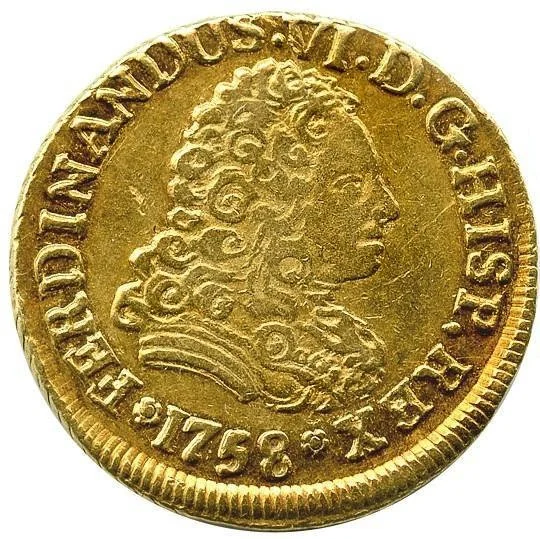
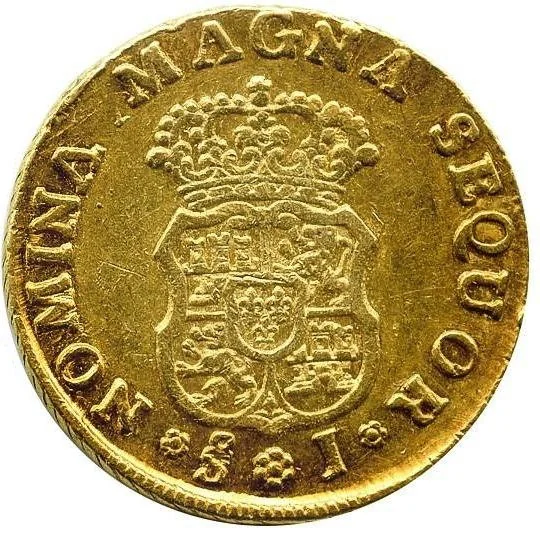
2 escudos – Chile
Add to wishlist
Chile
Context
Year: 1758
Issuer: Chile
Ruler: Ferdinand VI
Currency:
(1541—1852)
Demonetized: Yes
Total mintage: 443
Material
References
KM: #
Numista: #122953
Value
Bullion value: $958.21
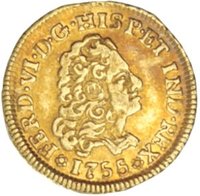
Obverse
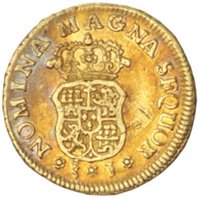
Reverse
Edge
Mints
| Name | Mark |
|---|---|
| Casa de Moneda de Chile | (So) |
Mintings
| Year | Mint Mark | Mintage | Quality | Collection |
|---|---|---|---|---|
| 1758 | So | 443 |
Historical background
In 1758, Chile was a remote captaincy-general within the Spanish Empire, and its currency situation was defined by chronic scarcity and improvisation. The colony lacked a mint (the Casa de Moneda in Santiago had been authorized but would not begin operations until 1749, and its early output was limited), so officially minted coin was rare. The economy relied heavily on a mix of worn and clipped Spanish coins—primarily silver pesos, reales, and maravedís from Peru and Mexico—that circulated alongside crude macuquinas (irregularly shaped cobs). The insufficient supply of these physical coins severely constrained commercial transactions.
This scarcity led to the widespread use of substitute currencies and credit instruments. In daily trade, goods like wheat, tallow, and hides often served as de facto barter currency, especially in rural areas and for paying obligations. More formally, merchants and large landowners issued vales (promissory notes) and used ledger credit to facilitate larger transactions. The Jesuit order, a major economic power, also issued its own credit notes that circulated with reliability. This system created a dual monetary environment: a strained official coinage system for external trade and taxes, and a flexible, credit-based internal economy.
The underlying driver of this situation was mercantilist Spanish policy, which aimed to extract Chilean resources—particularly gold from the southern placers—while limiting the colony's economic autonomy. Precious metals were systematically shipped to Peru and onward to Spain, draining the local money supply. Furthermore, Chile was part of the Viceroyalty of Peru's trade monopoly, which restricted commerce and the inflow of currency. Therefore, the currency landscape of 1758 was one of inherent contradiction: a gold-producing colony perpetually starved of official coin, forced to develop a pragmatic and complex patchwork of monetary solutions to sustain its internal economy.
This scarcity led to the widespread use of substitute currencies and credit instruments. In daily trade, goods like wheat, tallow, and hides often served as de facto barter currency, especially in rural areas and for paying obligations. More formally, merchants and large landowners issued vales (promissory notes) and used ledger credit to facilitate larger transactions. The Jesuit order, a major economic power, also issued its own credit notes that circulated with reliability. This system created a dual monetary environment: a strained official coinage system for external trade and taxes, and a flexible, credit-based internal economy.
The underlying driver of this situation was mercantilist Spanish policy, which aimed to extract Chilean resources—particularly gold from the southern placers—while limiting the colony's economic autonomy. Precious metals were systematically shipped to Peru and onward to Spain, draining the local money supply. Furthermore, Chile was part of the Viceroyalty of Peru's trade monopoly, which restricted commerce and the inflow of currency. Therefore, the currency landscape of 1758 was one of inherent contradiction: a gold-producing colony perpetually starved of official coin, forced to develop a pragmatic and complex patchwork of monetary solutions to sustain its internal economy.
✨ Legendary